+86 13638632902
 Jason@cleanroomequips.com


 MENU
MENUcompanies like











How to Work With Us

Submit Requirements
Provide your site dimensions, required ISO class, and industry-specific needs (GMP, ESD, etc.) to our experts.

Custom Technical Proposal
Receive a detailed design proposal within 24 hours, including airflow strategies, material lists, and transparent pricing.

Modular Production
We manufacture your modular panels, HVAC units, and FFUs with strict QC to ensure full compliance with ISO 14644 standards.

Global Shipping & Setup
Fast global logistics followed by onsite installation guidance and performance validation to get you operational quickly.
ESD Cleanroom Design
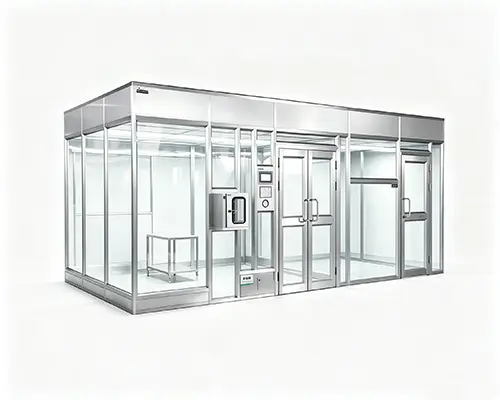
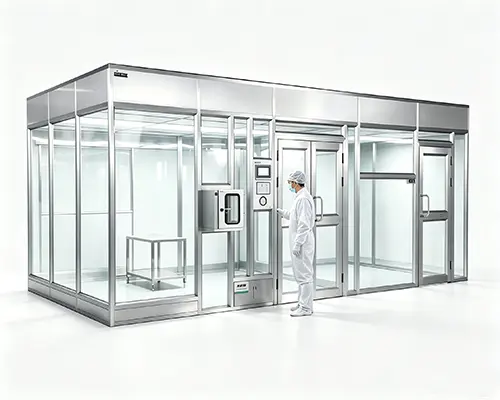
Integrate particle control and ESD protection for electronics manufacturing, precision assembly, and testing. Customize the system to your cleanliness targets, equipment layout, and process requirements.
Integrated ESD Protection
- Static-Control Materials: ESD flooring and dissipative surfaces help reduce charge accumulation. Resistance requirements are defined by the site-specific ESD control plan.
- Grounding and Personnel: Equipotential bonding, wrist straps, footwear systems, and entry testing support controlled charge dissipation.
- Optional Ionization: Ionizers help neutralize charges on insulators and objects that cannot be grounded directly.
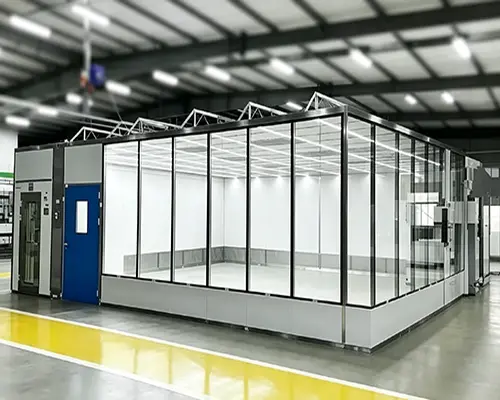
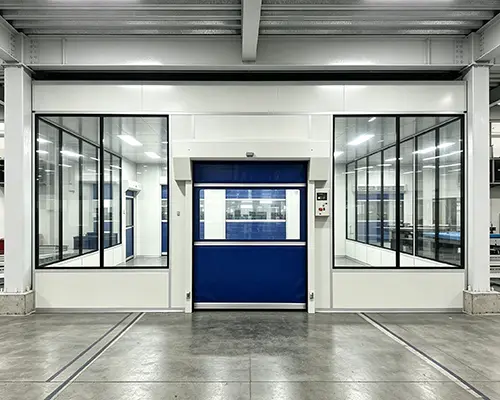
Hardwall Construction
Modular wall panels, low-shedding finishes, and sealed joints support flexible layouts, routine cleaning, and stable room pressure.
Environmental Control
- Cleanliness and Filtration: Design options target ISO 5–8 with H13 or H14 HEPA filtration, subject to airflow design and on-site classification.
- Pressure and Climate: Airflow, pressure differentials, temperature, and humidity are tailored to process needs. Humidity control supplements—not replaces—ESD protection.
Testing and Documentation
Agreed testing may include particle counts, airflow, pressure, HEPA integrity, flooring resistance, grounding continuity, and ionizer performance. Test records and maintenance documentation support acceptance and audits.
Industry Solutions
Technology Manufacturing
Semiconductor processing is based on very fragile components that can easily become damaged from airborne particles and static electricity.
- Main Threats: Contaminated particle from the air, static electricity discharge, defective handling of wafers/chips.
- Intended Facility Design: ISO 5-7 cleanroom, H13/H14 HEPA filter system, static control flooring, and grounding system with optional ionization system.
Electronics Assembly
The static electrical discharge built-up that occurs with the handling of PCBs, sensors, modules, and components means greater attention is needed to controlling static while in the electronics assembly area.
- Main Threats: Damage from ESD, dust contamination, unstable ground reference, and personnel transfer of charge.
- Intended Facility Design: Controlling static flooring, static dissipative work surfaces, ground connection straps and shoe ground connection, entrance lack of charge testing, and controlled humidity.
Precision Assembly
Precision assembled parts (from the smallest to the largest part) are particularly sensitive to the environment. They require stable and controlled environments to ensure full performance.
- Main Threats: Micro-particle contamination, static attraction for dust, defective assemblies, and loss of product produced.
- Intended Facility Design: Hardwall enclosure, sealed joints, controlled airflow to/from the cleanliness of the assembly, positive pressure, ESD protected materials, and on-going monitoring.
Test Labs
With increasingly tighter specifications for testing of electronics and precision assemblies, controlled cleanliness, a good ground reference, and controlled temperature and humidity are key in providing a favorable environment for electronic testing.
- Main Threats: Static discharge interference, inaccurate test results, contamination during inspection, and excessive sensitivity of the test equipment to unwanted external influences.
- Intended Facility Design: Grounded work zones, ESD-Protected Workstations and furniture, controlled environmental monitoring, HEPA filtered air, and maintenance procedures for documented history of maintenance.
Medical Electronics
Medical electronics must be manufactured in clean assembly areas and be subjected to proper control of static electricity for the protection of the end user's health and to maintain quality consistency in their products.
- Main Threats: Contamination, potential ESD damage to electronic modules, and failure to meet quality control standards.
- Intended Facility Design: ISO Class Cleanroom, HEPA filtered air, static-control surfaces, verification of grounding, and documented acceptance testing of the products developed by your company.
Testing & Validation
Challenge: Precision electronics, semiconductor, micro-component and new energy battery manufacturing environments need adherence to both cleanroom cleanliness standards and ESD electrostatic discharge protection standards. Conventional cleanroom testing identifies airborne particle levels only, and has not taken into account other important ESD risks, such as the accumulation of static electricity, instantaneous electrostatic discharge, lack of stable grounding and anti-static surface performance that cannot be qualified. The lack of ESD control will often cause chips to break down or damage components or cause a short circuit, resulting in low production yield. Unstandardized testing procedures will prevent meeting ISO certification, also lead to customer audit failures, competency audit failures, incomplete qualification records, and also possibly result in batch product quality issues or production shutdowns.
Solution: Our complete ESD-Safe Hardwall Cleanroom validation service includes Cleanroom Environmental Cleanliness Testing as well as Professional ESD Performance Verification: all three qualifications have been completed and implement standardized factory qualification in accordance with the requirements set forth by the ISO 14644 and ANSI/ESD S20.20 industry standards for Cleanroom Environmental Cleanliness Testing, ESD Performance Verification, and ESD Factory Qualification.
Our complete test items include: airborne particle concentration, counting, HEPA/ULPA Filter Integrity and Leakage Detection, Air Change Rate Testing and Airflow Uniformity Testing, Pressure Cascade Stability Verification, and Temperature and Humidity Accuracy Calibration, while also completing all core ESD Testing such as Surface Resistance Detection, Grounding System Continuity Verification, Static Decay Time Measurement, Ionizer Balance Inspection, and ESD Protective Material Compatibility Testing.
To verify full-life-cycle compliance through a complete four-stage qualification (DQ, IQ, OQ and PQ) process for ESD cleanrooms, we utilize DQ to verify that the design scheme matches the production process and the corresponding industry risk standards; IQ to verify the installation of anti-static panels, grounding devices and filtration systems are standardized; OQ to verify that the stable parameters under no-load conditions verify that the cleanroom is qualified and has no static hazards; and PQ to verify that the cleanroom continues to function and provide an environmentally controlled environment providing a stable cleaning environment as evidenced by long-term monitoring under actual production loading conditions.
The Core Value to Our Customers and Our Compliance Guarantee: All testing performed with calibrated instruments with records and reports permanently retained in real-time, with holder records as part of the enterprise internal quality. We provide customers with documentation and records of complete qualifications to support their enterprise qualification files, to also support third-party certification, and in support of global customers during their factory audits. We also offer Custom Routine Monitoring, Regular Retesting, and Professional ESD Maintenance Solutions for long-term compliance to cleanroom and ESD Standards, reduced product defect rates, elimination of safety risks related to products during manufacturing, and all qualifying requirements for high-precision manufacturers.
FAQ
Deiiang ESD-Safe Hardwall Cleanrooms can be created and validated in compliance with ISO 14644, Cleanroom Standard and ESD Control Procedures of the customer or as part of the design. Based on the intended use of the cleanroom, conductive or dissipative flooring, grounded wall panels, workstation and equipment bonding points, and personnel grounding can be used to provide ESD protection to the cleanroom. The final calibration of compliance will depend upon the scope of the project specification, process risk assessment(s) and adherence to any environmental or regulatory codes.
An ESD Safe Cleanroom will generally include static dissipative and/or conductive flooring, an equipotential grounding network, grounded hardwall panels, ESD-safe doors and work surfaces, personnel grounding connection points, and optional wrist strap or shoe tester(s). Ionization systems may also be included to neutralize electrical charge on sensitive items or insulating materials that require additional charge neutralization.
Hand-over testing may include particle counts per ISO 14644-1; HEPA filter test verification with PAO/DOP method; air velocity and airflow-volume measurement; differential pressure verification; temperature and relative humidity tracking; smoke visualization testing; and instrument calibration records. ESD-related tests may include resistance-to-ground, continuity of ground, floor resistance, and if applicable, verification of Ionizer performance.
Yes, the HVAC system can be designed to maintain controlled temperatures, relative humidity levels and room pressure. Proper humidity control minimizes the generation of static charge. The exact relative humidity and temperature operating point should be based on product sensitivity, process requirements, comfort of employees and what is outlined in the ESD control program.
The project documentation for Deiiang ESD-Safe Hardwall Cleanrooms includes as-built drawings, equipment layouts, electrical wiring schematics including grounding, an operation and maintenance manual, data sheets for every component, HEPA filter test reports, particle counter reports, balancing reports, calibration certificates and ESD-test reports. This documentation package may be customized to accommodate customer qualification, quality assurance and compliance audit requirements.
Deiiang ESD-Safe Hardwall Cleanrooms are produced from rigid cleanroom construction material in conjunction with controlled levels of contamination and electrostatic discharge (ESD). There are no limits regarding application, and the design can be customized to meet an individual customers specifications. When necessary, Deiiang will provide complete design and engineering support during the design phase, installation coordination, testing, and follow-up assistance for spare parts and maintenance.
Ventilation Times (ACH)
| ISO Class | ACH (Air Changes Per Hour) |
|---|---|
| ISO 3 | 360 - 540 |
| ISO 4 | 300 - 540 |
| ISO 5 | 240 - 480 |
| ISO 6 | 50 - 60 |
| ISO 7 | 30 - 40 |
| ISO 8 | 15 - 25 |
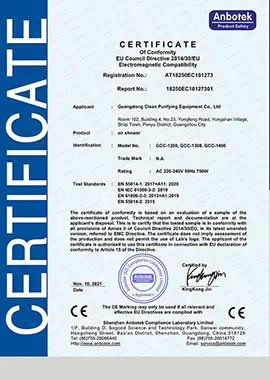
CE Certificate for Deiiang Air Shower and HEPA Filters
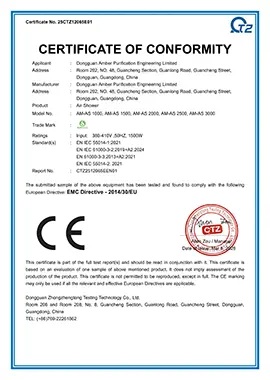
Electromagnetic Compatibility EMC Certification
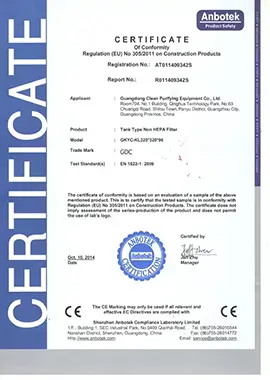
Filter CE-Certification
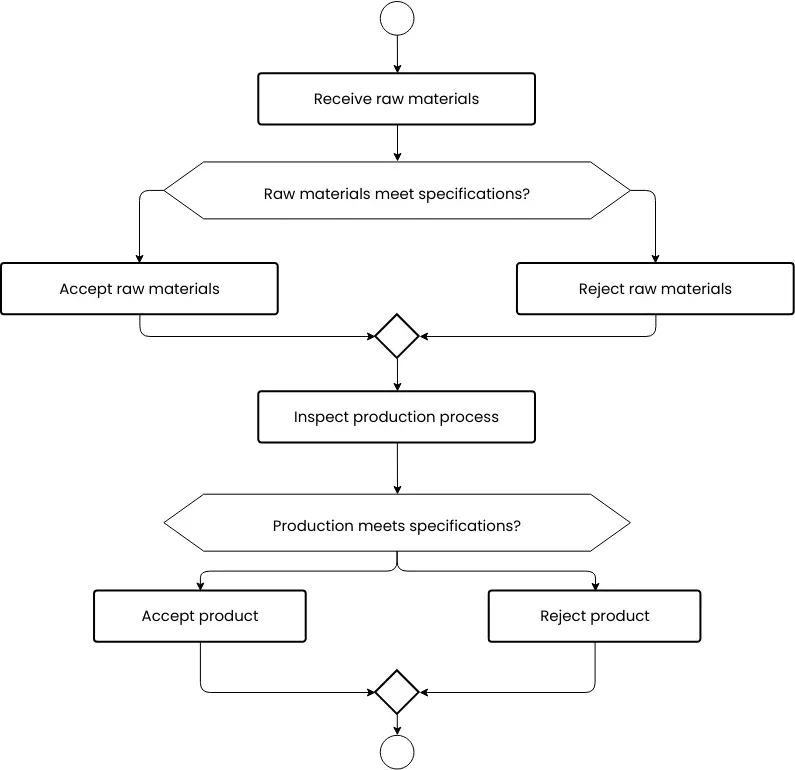
Deiiang Hardwall Cleanrooms Quality Control Flowchart