+86 13638632902
 Jason@cleanroomequips.com
 MENU
MENU
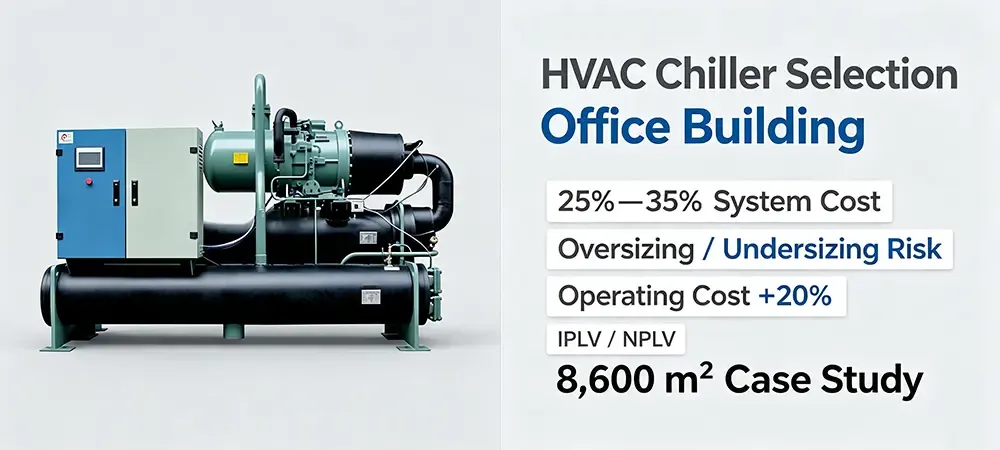
For HVAC schemes the choice of chiller selection is crucial. For typical office buildings chiller, pump and tower together can account for 25%–35% of total system cost. Annual electricity costs for running the chiller become apparent with the choice of design being a big cost, with the potential to increase running costs by more than 20% for the wrong choice.
This article is brand-agnostic. It details working principles of various chillers, outlining their capacity boundaries. In addition, it explains IPLV and NPLV performance measures, using a real 8,600 m² office building case study.
How Each Chiller Works and Where It Excels
Understanding the core of a chiller's compression is critical to any chiller comparison. Here are the three main cooling technologies, comparing how they handle part-load and different ambient conditions.
Screw Chiller: The versatile workhorse in mid-range cooling
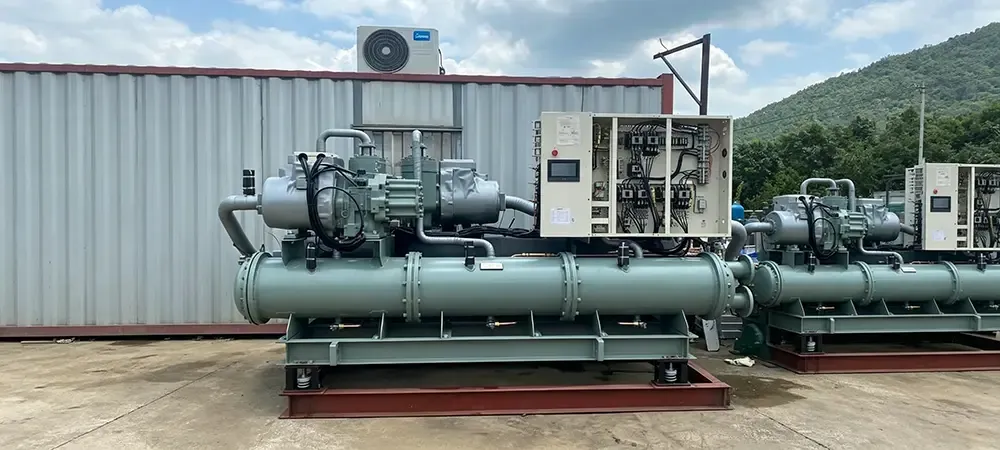
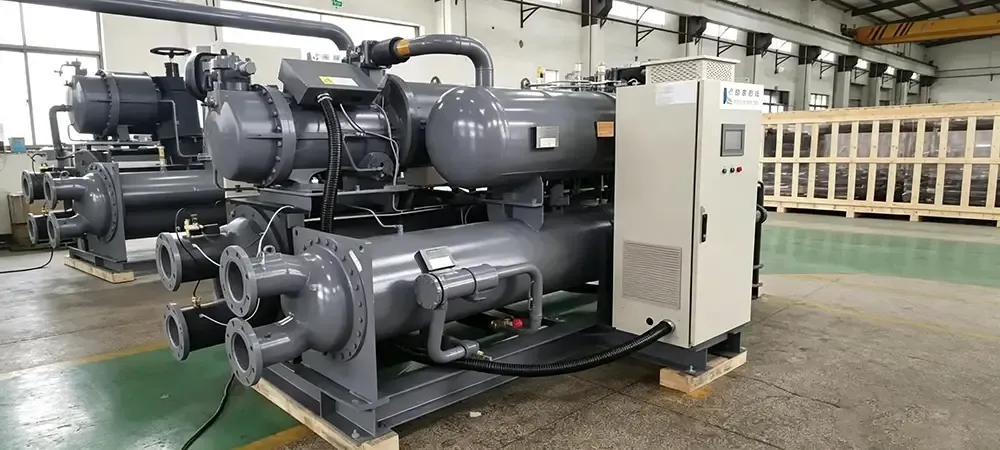
Screw chiller compressors are positive-displacement rotary machines, consisting of a pair of intermeshing rotors, which continuously compress the refrigerant in the operating chamber.
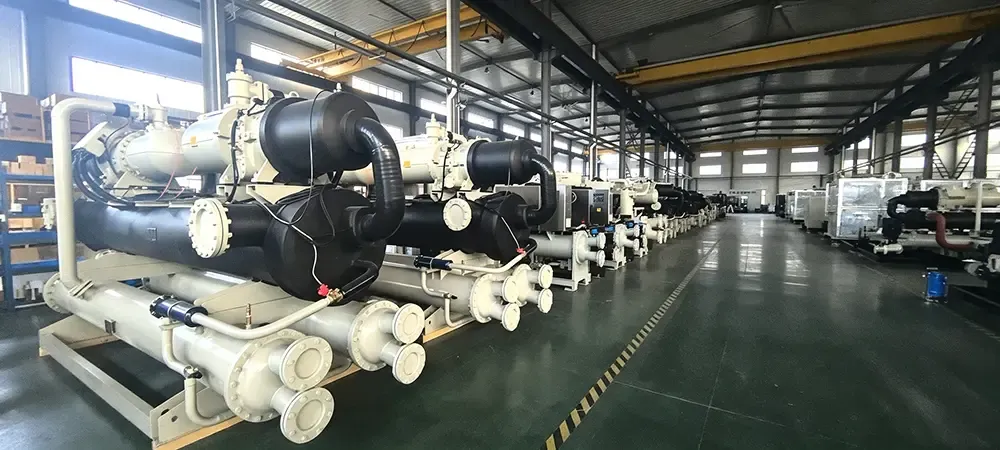
A single screw chiller can be as small as 150 RT and as large as 1,500 RT. By running both heads in parallel, capacities of up to 2,000 RT can be achieved. A wide part-load range from 25% to 100% enables high IPLV values.
High IPLV is maintained even with fluctuating chilled water temperature. This chiller needs periodic service: oil changes and slide valve checks.
Typical applications: district energy stations, commercial complexes, hospitals, and mid-sized data centers. Projects with fluctuating loads benefit most.
Centrifugal Chiller: The efficiency king for large constant loads
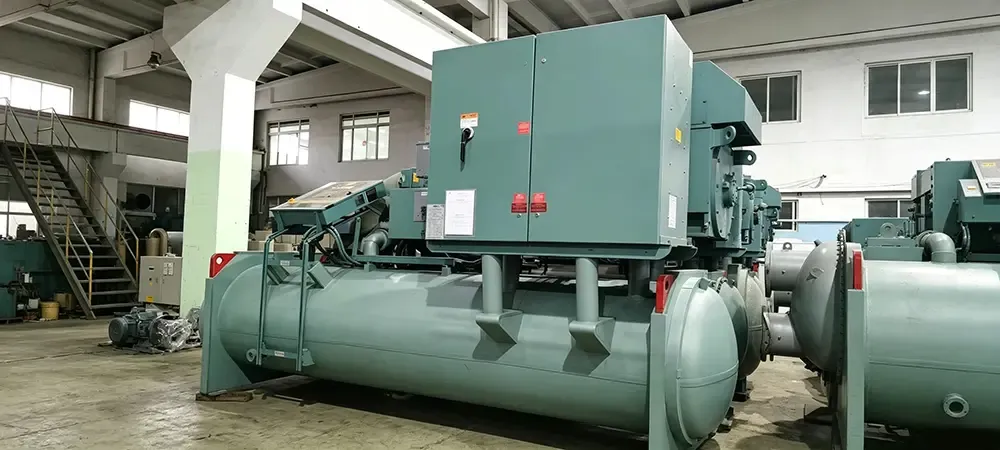
The velocity-type centrifugal chiller uses high-speed impellers to accelerate refrigerant vapor, then a diffuser converts velocity to pressure in the condenser.
Single-unit capacity ranges from about 300 RT to over 3,000 RT. At full load, the Centrifugal Chiller has the highest efficiency. Water-cooled models reach 5.5–6.5, and magnetic-bearing types exceed 7.0.
Surge risk exists with the centrifugal compressor. When load drops below 20%–30%, reverse gas flow causes oscillations, leading to very low efficiency or bearing damage.
Centrifugal chillers suit large offices, airports, campus cooling, and huge data centers. If total load exceeds 800 RT and runs year-round, centrifugal is the first choice.
Scroll Chiller: The light cavalry for small distributed terminals
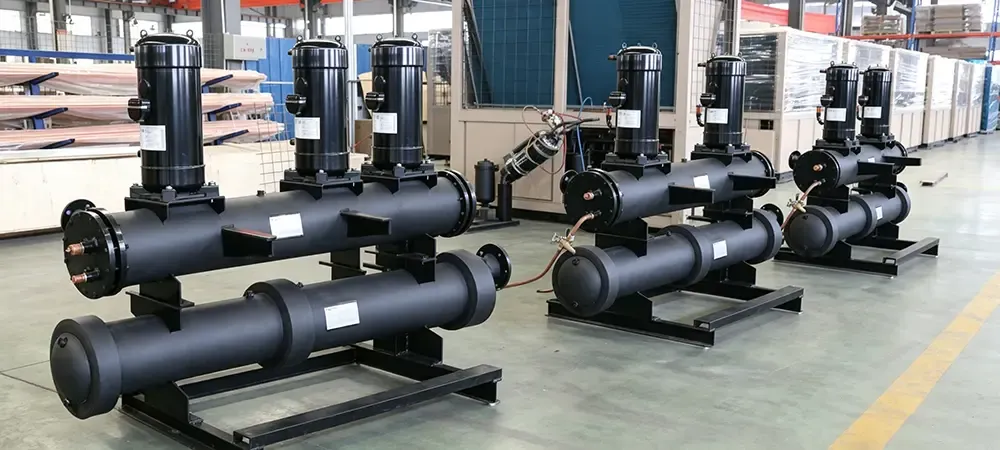
Using orbiting and fixed scrolls, the Scroll Chiller delivers 30-80 RT per module. It is a positive-displacement design.
Parallel scroll chillers can reach 200 RT. They are simple, highly reliable, low maintenance, and have a small footprint.
Single-unit capacity is limited. Initial cost rises quickly with volume. The scroll compressors are sensitive to liquid slugging.
Ideal for: small commercial buildings, hotels, retrofit projects, air-cooled modular chillers. Best for total loads below 200 RT or phased installations.
Metrics That Matter: COP vs IPLV vs NPLV
A smart chiller selection never relies on full-load COP alone. Real buildings spend most hours at part load. IPLV and NPLV reveal true energy performance.
AHRI 550/590 defines IPLV weighting: 100% load (1%), 75% (42%), 50% (45%), 25% (12%). NPLV corrects for actual condenser and chilled water temperatures.
Projects with lower cooling tower sump temperatures often see NPLV outperform IPLV by a noticeable margin.
| Metric | Description | Best used for |
|---|---|---|
| COP | Full-load efficiency at standard conditions | Base load plants, constant cooling |
| IPLV | Weighted part-load efficiency (standard profile) | Commercial buildings, variable load |
| NPLV | IPLV adjusted to site-specific temperatures | Projects with low condenser water temps |
Sizing and Staging Strategy
Proper staging of chiller equipment is as important as type selection. An oversized single chiller at 30% capacity wastes energy and may surge.
Design cooling load must come from hourly simulations (GB50736). Use Q = A × q × k. The classic chiller sizing strategy: two large units plus one small, or centrifugal + screw hybrid.
Total load < 150 RT: scroll modular or air-cooled screw; flexible and compact.
150 RT ≤ load ≤ 800 RT: variable-speed screw in multiple parallel for backup.
Continuous > 800 RT: magnetic-bearing or VFD centrifugal for lowest TCO.
Large night turndown: combine small screw/scroll with a larger centrifugal.
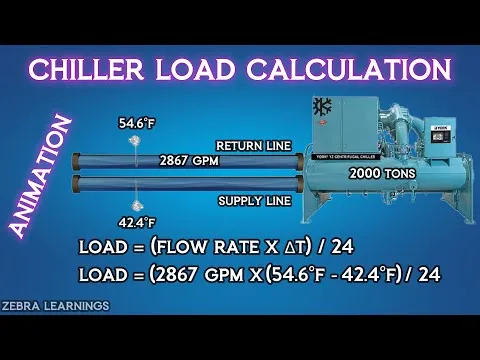 ▶
▶ Total Cost of Ownership (TCO) Logic
A genuine chiller comparison includes capital cost, pumps, towers, energy, and maintenance. Deiiang™ provides downloadable TCO tools.
Beware the Low-Price Trap: Some suppliers quote low initial prices by undersizing the heat exchanger surface area. This results in higher fouling factors and a 10–15% drop in efficiency after just one year of operation. Always request the heat exchanger design specs — a properly sized exchanger should have a fouling factor allowance of at least 0.018 m²·K/kW (per AHRI 550/590). A cheaper chiller today can cost far more in electricity over its lifetime.
Example: Shanghai, 8,600 m² office, design load 720 kW (204.6 RT). 1,200 equivalent full-load hours, electricity 0.75 CNY/kWh.
Option A: 2×130 RT variable-speed screw (COP 5.6, IPLV 7.2). Option B: 1×220 RT variable-speed centrifugal (COP 6.1, IPLV 7.8).
Option C: 4×60 RT scroll modules (COP 4.5, IPLV 5.6). Weighted annual consumption showed clear differences.
Option A (screw): 132 kWh/m²·a → annual electricity ~950,000 CNY
Option B (centrifugal): 113 kWh/m²·a → ~814,000 CNY
Option C (scroll): 163 kWh/m²·a → ~1,174,000 CNY
10-year simple TCO: A ≈10.28M CNY, B ≈9.06M CNY, C ≈12.42M CNY. The centrifugal option recovers its premium in about 5.1 years. Chiller selection here clearly favors B for lifecycle cost.
Quick Payback Calculator
Deiiang™ Case Study: 8,600 m² Office in Shanghai
Deiiang™ implemented a hybrid solution for a mixed-use office. The project had strict low-load and noise requirements.
Project snapshot: Shanghai, hot-summer/cold-winter zone. 8,600 m², design load 720 kW. 1,200 operating hours, 0.75 CNY/kWh.
Challenges: low night load, limited mechanical room height (4.2 m), noise constraints near residential areas, and harmonic limits.
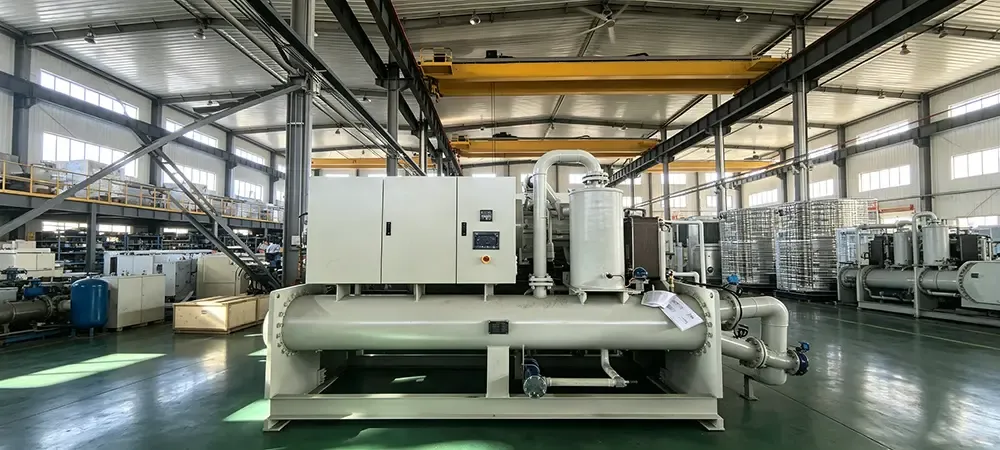
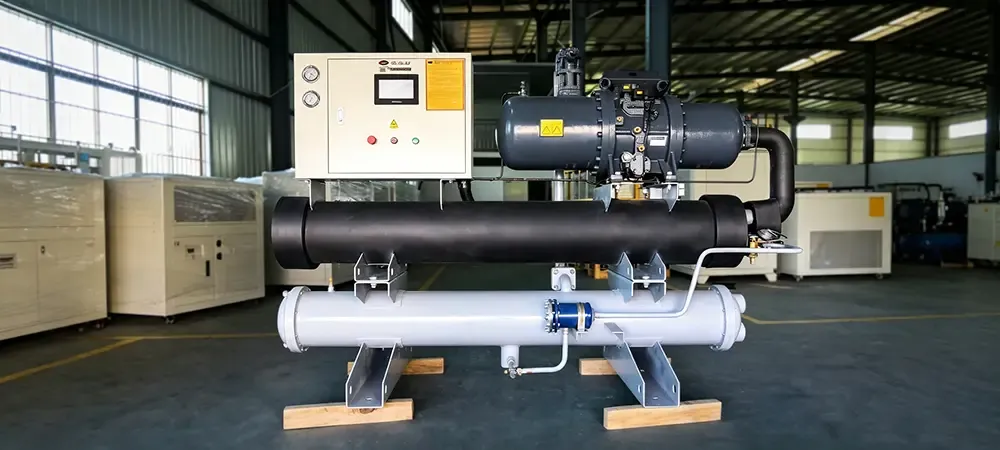
Deiiang solution: 1× magnetic-bearing centrifugal chiller (220 RT, COP 6.3) + 1× variable-speed screw chiller (130 RT, COP 5.7). N+1 redundancy achieved.
Chilled water setpoint 7°C. Condenser water reset based on wet-bulb. Active harmonic filter ensured THDi <4.8%.
Verified KPIs: Annual energy reduced 18.3% vs. baseline scroll. NPLV improved to 8.5. Noise measured 74 dB(A) at 1 m. System COP exceeded 5.1.
Comparison Snapshot: Screw vs Centrifugal vs Scroll
The table below consolidates key parameters for rapid chiller comparison during schematic design.
| Parameter | Screw | Centrifugal | Scroll |
|---|---|---|---|
| Typical capacity | 150–1,500 RT | 300–3,000+ RT | 30–200 RT (modular) |
| Full-load COP | 5.2–6.0 | 5.5–7.5 | 3.0–5.0 |
| IPLV typical | Excellent (VFD) | Superior (mag bearing) | Good (staging) |
| Min stable load | ~25% | 20–30% (10% mag) | module staging |
| Maintenance | Oil/bearings | Oil-free (mag) / cleaning | Low, replace module |
| Ideal scenario | Mid-capacity, variable load | Large, continuous base load | Small, distributed |
Maintenance Insights: The Serviceability Factor
Beyond efficiency, consider the Serviceability Index of each chiller type — this directly impacts downtime costs and long-term operational resilience.
Centrifugal: Major overhaul every 8–12 years; magnetic bearing specialist required; parts may need importing.
Screw: Oil change every 2–3 years; slide valve inspection every 5 years; wide local service coverage.
Scroll: Hermetically sealed — no major overhaul; simply replace failed module; lowest downtime risk.
Localized Engineering Notes
Climate and installation conditions can shift NPLV by 10–20%. For Shanghai, design wet-bulb 28.2°C often yields 32/37°C condenser water.
Using NPLV instead of generic IPLV avoids underestimating performance in real projects.
Harmonic management: VFD chillers generate 5th and 7th harmonics. THDi can reach 15–30%. Deiiang™ integrates filters to maintain THDi ≤5%.
High-rise static pressure: Heat exchanger rating must exceed 1.25× system pressure. A 150 m building demands exchangers rated ≥2.0 MPa.
Water treatment and strainer maintenance prevent scroll liquid slugging and fouling. This preserves long-term chiller efficiency.
Refrigerant Trends: GWP Compliance & Future-Proofing
Modern chiller selection must account for environmental compliance. Refrigerant regulations are tightening globally, and choosing the wrong refrigerant today could mean an expensive retrofit tomorrow.
Key trends: R134a is being phased down under the Kigali Amendment; R1234ze (ultra-low GWP of 7) is emerging as the preferred choice for magnetic-bearing centrifugal chillers in Europe and Asia-Pacific. R513A serves as a drop-in replacement for R134a with ~56% lower GWP. Always verify local refrigerant phase-down schedules — China's latest GB standards increasingly favor low-GWP options for new installations.
Selection Playbook (Quick Checklist)
< 150 RT: Scroll modules or air-cooled screw — highest flexibility for retrofit.
150–800 RT: VFD screw multi-parallel – balances redundancy and part-load.
> 800 RT & stable base: Magnetic-bearing/VFD centrifugal — highest efficiency.
Deep night turndown: One large + one small, or centrifugal + screw hybrid.
Always localize: Recalculate NPLV; verify room, harmonics, pressure, noise.
Frequently Asked Questions
What is a good IPLV for office buildings?
For water-cooled chillers, IPLV above 7.0 is very efficient. Offices benefit from strong 50% and 75% load points.
How to avoid centrifugal surge at low load?
Use magnetic-bearing or VFD centrifugal with hot-gas bypass. Deiiang™ mag-bearing units operate down to 10% load.
How many chillers for N+1 redundancy?
Two identical capacity chillers are recommended. Often 2×50% capacity plus one smaller swing chiller.
Does magnetic bearing eliminate oil-related losses?
Yes. Oil-free magnetic bearing chillers remove oil management and improve heat transfer across the load range.
How do cooling tower setpoints affect NPLV?
Lower condenser water temperature raises compressor lift. A 2°C decrease can boost NPLV by 4–8%.
References
AHRI 550/590 – Performance Rating of Water-Chilling Packages. AHRI standard
ASHRAE 90.1 – Energy Standard for Buildings. ashrae.org
EN 14825 – Air conditioners, liquid chilling packages. EU standard
GB19577 – Minimum allowable values of energy efficiency for chillers. Chinese national standard
GB/T 18430 – Water chilling (heat pump) packages. Standard link
GB50736 – Design code for heating ventilation and air conditioning. China MOHURD