+86 13638632902
 Jason@cleanroomequips.com
 MENU
MENU
TL;DR — Executive Summary
EC fans in packaged AHUs reACH 90%+ motor efficiency vs. 50–70% for AC, delivering 20–30% energy savings at both partial and full loads.
Multiple control interfaces — 0–10V, 4–20mA, RS485/Modbus, PWM — enable direct BAS integration and dynamic airflow adjustment for cleanroom pressure cascades.
Deiiang™ EC fanwall arrays span 50–50,000 m³/h with single-unit noise as low as 30 dB(A) at 1 m; corridor levels stay ≤65 dB(A) in pharmaceutical facilities.
Design life of 50,000–80,000 hours (6–9 years) with zero brush maintenance reduces total cost of ownership by about 40% over a 7-year lifecycle.
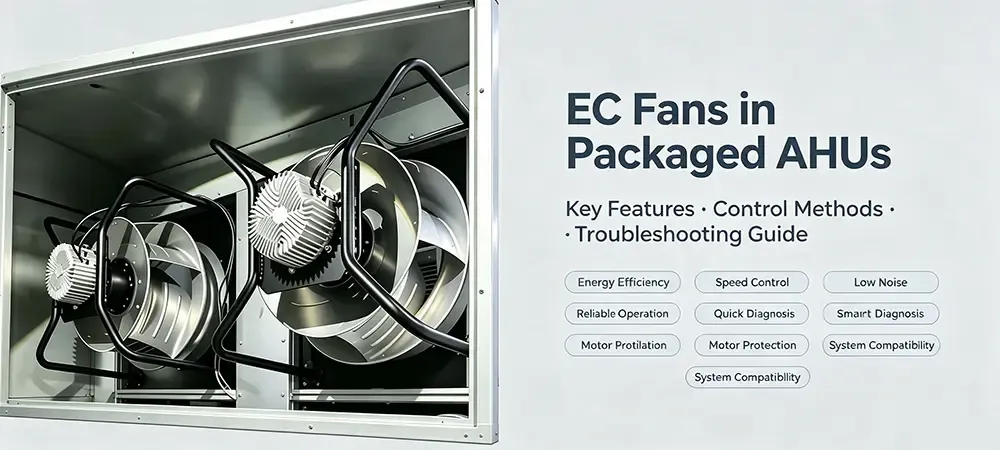
Understanding EC Fan Technology in Packaged AHUs
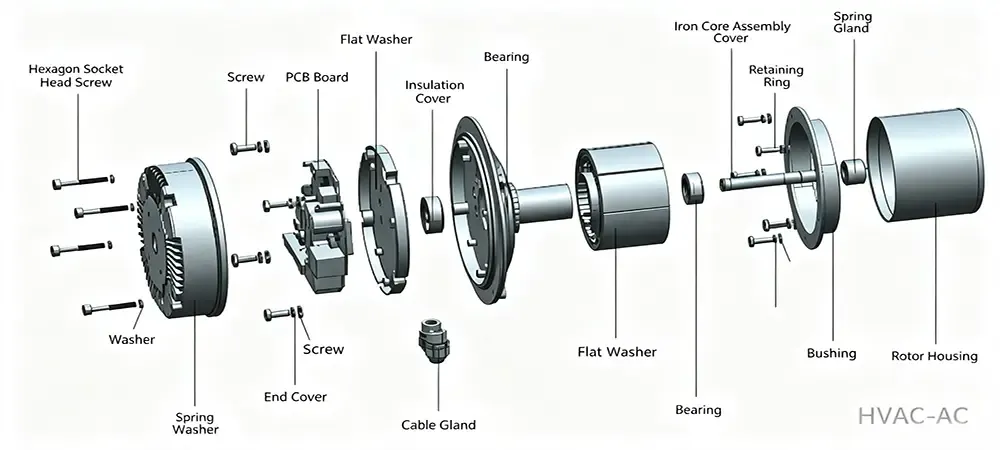
EC fans use a microprocessor to change incoming AC to DC. The stator windings are then sequenced in precise order to create a magnetic field that causes the permanent-magnet rotor to spin.
In packaged AHU the motor of the EC fan runs cooler and is even quieter than an induction motor. Additionally the airflow remains constant even with a change in filter load.
Comparison of different EC fan models in packaged AHUs primarily refers to the permanent-magnet rotor of the EC motor. The power factor of an EC motor reaches 0.95–0.98, whereas the power factor of an induction motor only reaches 0.75–0.85. This results in a reactive power saving of $380–$520 per year for a 7.5 kW fan in a packaged AHU, operating 8,000 hours/year at $0.12/kWh.
The integrated controller tracks the rotor position of the EC fan via Hall sensors or back-EMF. This allows for 0–100% variable-speed control of the fan and no low-frequency cogging even at standstill.
The ability of EC fans in packaged AHUs to operate at night at a reduced airflow, i.e. 30% of design airflow, while maintaining precise pressurization is ideal for hospital AHUs operating in night setback mode.
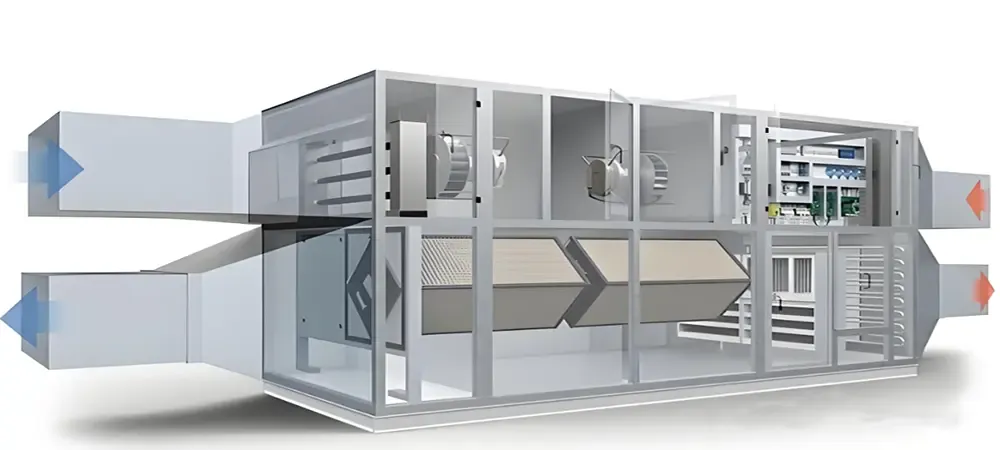
Key Features of EC Fan in Packaged AHUs
The key features of EC fan in packaged AHUs focus on four measurable axes: efficiency, acoustics, controllability, and service life. AMCA-certified tests show EC fans in packaged AHUs hold flat efficiency above 88% from 40% to 100% speed.
Meanwhile, AC motors with VFDs degrade sharply below 60% speed due to slip and harmonic losses.
Efficiency: 90–93% peak motor efficiency; wire-to-air efficiency typically 70–78% vs. 45–58% for AC. At 50% part load, EC holds a 25–35 percentage-point advantage.
Noise: 30–55 dB(A) at 1 m for single units; fanwall arrays with phase-angle staggering limit combined noise to ≤70 dB(A). That's 3–10 dB(A) quieter than equivalent AC centrifugal fans.
Control flexibility: Native 0–10V, 4–20mA, PWM, RS485/Modbus RTU, and optional BACnet MS/TP — all within the same packaged AHU footprint.
Service life: 50,000–80,000 hours (L10 at 40°C); no brush inspection. Deiiang™ field data shows MTBF exceeding 60,000 hours in Pharmaceutical cleanroom duty.
Source: Deiiang™ laboratory test data, 2024. 5.5 kW motor, 60% rated RPM, 25°C ambient.
Control Methods & System Integration
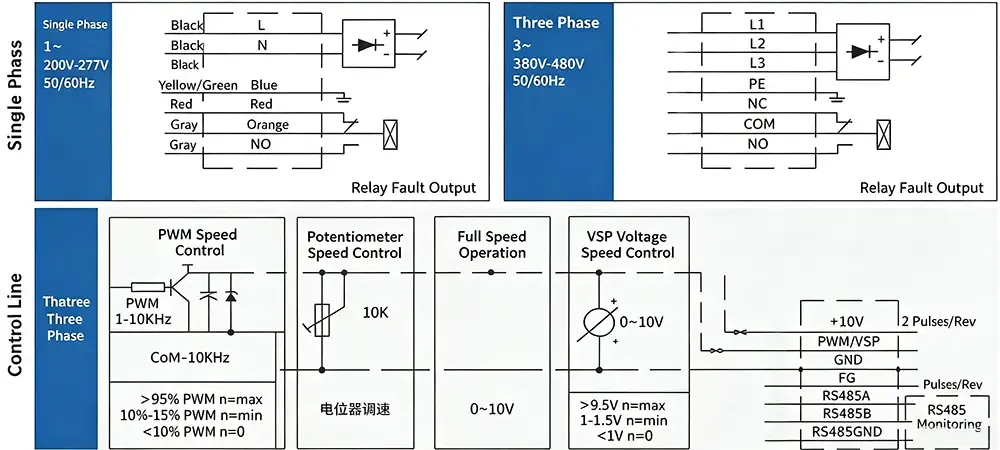
A standout key feature of EC fan in packaged AHUs is the multiplicity of control interfaces available without external VFDs. A typical terminal block provides Yellow (VSP 0–10V), Blue (GND), Red (+10V ref), White (Tach), and RS485 A/B. This plug-and-play architecture dramatically cuts commissioning time for packaged AHU integrations.
0–10V Analog: Apply DC 0–10V between VSP and GND; 0V = stop, 10V = 100% RPM. Linear relation: RPM% = (Vin / 10) × 100. For a 3,200 RPM fan, 6.5V yields ~2,080 RPM. Ideal for standalone AHU controllers.
4–20mA Current Loop: Converted internally via a 500Ω resistor to 2–10V. Used in pharmaceutical BAS where 4mA = off and 20mA = 100%, with live-zero fault detection.
RS485 / Modbus RTU: Reads actual RPM, motor temperature, DC-link voltage, and fault codes. Up to 32 fans on a single bus. Deiiang™ EC fan models in packaged AHUs ship with pre-configured Modbus maps for major BAS platforms.
Master-Slave Cascading: One fan acts as speed reference; up to 10 slaves follow its PWM output. Essential for EC fanwall arrays in packaged AHUs where uniform airflow must be maintained across a 4×3 or 5×4 matrix.
Comparing EC Fan Models in Packaged AHUs — Selection & Sizing
Selecting among EC fan models in packaged AHUs means matching static pressure, airflow, and physical envelope. The table below summarizes typical backward-curved EC centrifugal fans for packaged AHU supply and return sections.
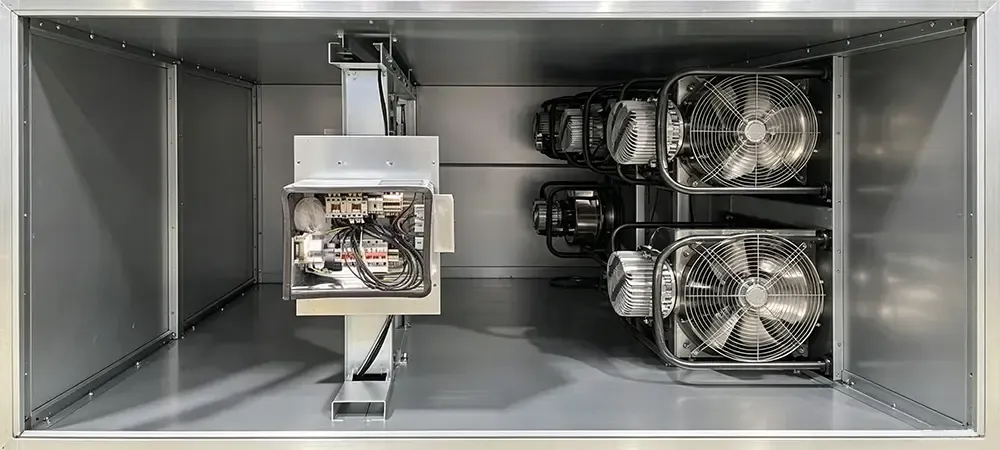
Fanwall configurations multiply airflow while keeping the same pressure capability — a 4×3 array of 2.2 kW units can deliver about 36,000 m³/h at 800 Pa.
| Model Class | Power (kW) | Pressure (Pa) | Airflow (m³/h) | Noise @1m (dB(A)) | Interfaces | Best Application |
|---|---|---|---|---|---|---|
| EC-250 Compact | 0.5–1.5 | 50–600 | 500–4,500 | 30–42 | 0–10V, PWM, RS485 | Fan coil units, small AHU |
| EC-310 Mid-Range | 2.2–5.5 | 200–1,200 | 4,000–15,000 | 38–50 | 0–10V, 4–20mA, RS485, Master-Slave | Medium packaged AHU, cleanroom recirc |
| EC-400 High-Pressure | 7.5–11.0 | 500–2,000 | 10,000–22,000 | 45–55 | 0–10V, 4–20mA, RS485, BACnet, Alarm | Large AHU, HEPA-filtered supply |
| EC Fanwall Array | Multiple 2.2–7.5 | 100–1,500 | 15,000–50,000 | ≤65–70 (combined) | RS485 bus + Master-Slave + BAS | Pharmaceutical AHU, N+1 redundancy |
*Data based on Deiiang™ EC fan product line. All values at 50 Hz equivalent speed, 20°C air, sea-level density.
*Data based on Deiiang™ EC fan product line.
Quick Sizing Example — Packaged AHU Supply Fan
Q = 18,000 m³/h, ΔPtotal = 850 Pa, target ≤55 dB(A) at 1m.
One EC-400 (11 kW) delivers 19,500 m³/h at 900 Pa with 52 dB(A).
Alternatively, a 3×2 EC-310 fanwall (6 × 3.0 kW) provides the same airflow at 850 Pa with ~54 dB(A) and N+1 redundancy. The fanwall adds ~12% to first cost but eliminates single-point fan failure in critical packaged AHU duty.
Troubleshooting EC Fan Malfunctions in Packaged AHUs
Troubleshooting EC fan malfunctions in packaged AHUs will follow a power-supply → control-signal → mechanical chain. Because the onboard controller continuously monitors the DC-link voltage as well as the phase currents and the Hall feedback of the EC-fan, the majority of faults will cause a blink code or a Modbus alarm before the complete failure of the fan.
Below are the 5 common issues found during a Deiiang™ service call for packaged AHU with EC fans.
RS485 bus unresponsive: Verify daisy-chain A/B polarity. Measure idle bias: A should be +2.5 to +3.5V, B +1.5 to +2.5V relative to GND. Add 680Ω termination at both ends if missing. Common issue when retrofitting EC fans in packaged AHUs into existing Modbus networks.
Deiiang™ EC Fan Solutions & Performance Data
Deiiang™ EC fans, designed by Jason Peng and the engineering team, fit directly into packaged AHU supply and return sections with standard flange dimensions matching AC fan cutouts.
This drop-in compatibility eliminates sheet-metal changes during retrofits — crucial when upgrading EC fans in packaged AHUs in occupied facilities with short downtime windows.
Power: 1-phase AC 200–277V; 3-phase AC 380–480V (auto-sensing)
Pressure: 50–2,000 Pa (steady-state ±3 Pa via PID)
Airflow: 50–50,000 m³/h (single unit to fanwall)
Noise: 30–55 dB(A) single unit; fanwall ≤70 dB(A) after optimization
Savings: 20–30% vs. AC baseline (IPMVP Option A verified)
Control: 0–10V / 4–20mA / RS485 Modbus / BAS / alarm / master-slave
Life: 50,000–80,000 hours; brushless, low-maintenance
Certifications: CE, UL 507, GB 8624; EN 13501-1 material classification available
Application Case: Pharmaceutical Cleanroom AHU Retrofit
A 15-year-old packaged AHU in iso 7/8 corridors in a Wuhan biopharma facility's administration area was suffering from pressure-instability alarms. The packaged AHU, powered by belt-driven AC fans, consumed 94,600 kWh of electricity annually, and its discharge noise measured 72 dB(A), far exceeding 65 dB(A) limit. It was necessary to maintain 15 Pa differential pressure during cutover.
Deiiang™ installed a 3×3 EC-310 fanwall (9 × 3.0 kW) inside the existing AHU casing over a single weekend:
Pre-retrofit: 94,600 kWh/yr, 72 dB(A), ±8 Pa fluctuation, two belt replacements/year
Post-retrofit: 67,200 kWh/yr (29% reduction), 61 dB(A) corridor, ±2 Pa stability, zero mechanical maintenance in 18 months
ROI: Incremental $42,000 recovered in 2.1 years via energy savings ($19,800/year at $0.105/kWh)
Compliance: EN 13501-1 A2-s1,d0 materials maintained; all penetration seals re-certified with low-VOC firestop
"In cleanroom HVAC, the real measure of an EC fan isn't just its efficiency rating — it's whether it holds ±2 Pa at 3 AM with a loaded HEPA bank and no one on site to tweak a VFD."
— Jason Peng, Product Designer, Deiiang™ EC Fan Systems
Frequently Asked Questions
Do EC fans in packaged AHUs require external VFDs?
No. Each EC fan has an integrated variable-speed controller. This eliminates VFD panels, reduces cabinet footprint by ~30%, and removes VFD harmonics. The controller accepts 0–10V, 4–20mA, PWM, or RS485 directly.
How do EC fanwall noise levels compare to single large AC fans?
A single 15 kW AC centrifugal fan often produces 68–75 dB(A) at 1 m. A Deiiang™ 3×3 EC-310 fanwall delivers equivalent airflow with combined noise ≤65 dB(A) after phase optimization. A 6 dB(A) reduction roughly halves perceived loudness.
What is the maximum single EC fan power for packaged AHU duty?
Deiiang™ offers single units up to 11 kW (EC-400). For larger packaged AHU demands, a 4×3 array of 7.5 kW units provides 90 kW installed power with N+1 redundancy and superior part-load staging.
How does water treatment (RO/UF) affect EC fan longevity in cleanroom AHUs?
RO-quality water (<0.1 µS/cm) minimizes mineral carryover into humidification sections, reducing scale on impellers and housings. This preserves balance and bearing life. Facilities using softened water should schedule quarterly inspections — a factor often missed when troubleshooting EC fan malfunctions in packaged AHUs serving humidity-controlled spaces.
References
iso 14644-4:2022 — cleanrooms and associated controlled environments. ISO.org
EN 13501-1:2018 — Fire classification of construction products. CEN/CENELEC
AMCA Standard 210-23 — Laboratory Methods of Testing Fans. AMCA.org
GB 8624-2012 — Classification for burning behavior. GBStandards.org
NFPA 90A — Installation of Air-Conditioning Systems. NFPA.org
IEC 60364-5-52 — Low-voltage electrical installations. IEC.ch
IPMVP Option A — Performance Measurement and Verification. EVO-World.org
Ready to upgrade your Packaged AHU with EC fan technology?
Contact Deiiang™ for a free on-site assessment, performance specification, and ROI calculation tailored to your facility.
Product Designer: Jason Peng | Deiiang™ EC Fan Systems
Service regions: [Province/City] — On-site audit, commissioning, and compliance documentation available.