+86 13638632902
 Jason@cleanroomequips.com


 MENU
MENU
Behind the leaking water search on an AHU there are generally 3 scenarios:
(1) Water leaking from the casing of the AHU down to the floor of the mechanICal room during peak cooling period.
(2) condensate backflow causing internal pan overflow after months of seemingly normal operation.
(3) occasional dripping that seems to get worse as the outdoor humidity increases.
AHU leaking air searches typically stem from:
(1) there are cold air drafts coming from the drain of the unit while it is operating.
(2) unexplained cooling capacity shortfall in served spaces,
(3) The condensation on the uninsulated drain piping or surrounding structural steel. Most problems with leaky air, leaking water, odors returning, loss of energy by the AHU and others all are caused by a single problem: the P-trap for the AHU is either: a) missing; b) undersized; or c) incorrectly replaced by an equal or lesser S-trapped configuration for an AHUS.
Key insight: A single missing water trap can cause a multitude of problems in a building including water leakage, air leakage, odor backflow and decreased energy performance. A missing P-trap is four problems with one solution.
Positive vs negative pressure AHUs: why the P-trap is different
Before you can start to diagnose an AHU leaking water problem, you need to establish whether the unit operates under positive or negative pressure at the drain pan location. This affects how you can configure the AHU P-trap to prevent leaks. Configuring the P-trap to work against you is far worse than not having one at all.
Quick definition: positive vs negative pressure AHUs
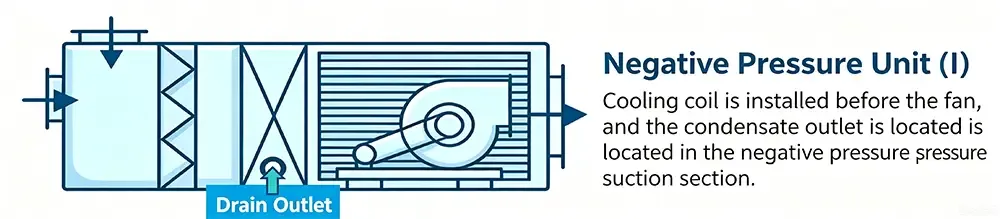
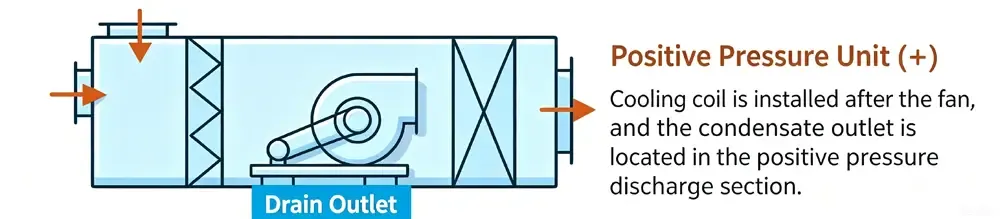
In a negative pressure AHU the supply fan is located after the cooling coil and thus the condensate drain pan is in the suction zone of the fan. Since the air pressure in the AHU at the location of the drain pan is lower than the ambient outdoor air pressure, air will enter the AHU through any open passage or pipe including the drain pipe. In a positive pressure AHU the fan is located before the cooling coil so the drain pan is on the discharge side of the fan. In this case the internal pressure of the AHU is greater than the outdoor ambient air pressure and thus air will exit the AHU through the drain line unless it is sealed with water.
Negative pressure AHU: Fan after coil → drain pan in suction zone → air drawn inward. This type of air handling unit does not function properly without an appropriate AHU P-trap. Air, dust and insects are pulled into the air handling unit’s airstream. An AHUS S-trap is particularly inadequate as it can self-siphon and leave the seal dry in a matter of hours.
Positive pressure AHU: Fan before coil, Drain pan in discharge zone, Air is pushed outward. No water seal in drain pan of AHU, The conditioned cold air keeps leaking outward continuously through the drain pipe. AHU leaking air waste cooling capacity. Creates condensation on surrounding components and surfaces.
Why every AHU drain pan needs a water trap
A water trap or P-trap in an air handling unit (AHU) drain serves three purposes simultaneously. It 1) equalizes the air pressure across the face of the unit (positive or negative) to prevent air (leakage of air into or out of the unit), 2) prevents sewer gasses, bugs and bacteria from entering the return ductwork through the drain and being distributed throughout the facility by the supply ductwork, and 3) in conjunction with an appropriately located vent, creates a siphon action that allows for the reliable evacuation of condensate from the unit under varying loads. This is in contrast to an AHUS S-trap which may appear to serve similar purposes but does not have the vent associated with it to make it functional for long term reliable operation in HVAC applications.
How a P-trap should be designed for AHUs (with data)
AHU P-trap design is not art, but straightforward hydraulic calculation based on the actual operating static pressure of the AHU. However, 40% of P-traps Deiiang’s field survey engineers encountered are installed to a fixed height without taking pressure differences between units into consideration. Calculating the AHU P-trap properly in design stage eliminates risk of AHU leaking water and AHU leaking air.
Basic design formula & recommended values
Water seal height minimum value H in mm is given by the following equation: H ≥ (ΔP × 1000) / (ρ × g) × SF, with ΔP the maximum pressure difference (across the drain pan) in Pa, ρ the water density in kg/m³ (ρ ≈ 1000 kg/m³), g the gravity in m/s² (g ≈ 9.00981 m/s²) and SF safety factor (typically between 1.2 and 1.5). For a unit with a ΔP of 500 Pa the minimum height of the water seal is: (500 × 1000) / (1000 × 9.81) × 1.5 = 76 mm. Deiiang™ has experience in designing float operated ball valves for evaporators. On the basis of this experience Deiiang™ defines the following ranges for the pressure categories in mm water seal height minimum value H:
Deiiang Design Guideline Range — based on field measurements across 200+ AHU installations, 2020–2025.
P-trap vs S-trap in AHUs
While both AHU P-trap and AHUS S-trap configurations create a water seal, their long-term reliability in air handling applications differs significantly. The table below summarizes the key comparison points:
| Dimension | P-trap | S-trap |
|---|---|---|
| Maintenance accessibility | Easy — accessible from one side; cleanout port can be integrated | Difficult — compact shape limits access for Cleaning |
| Risk of seal dry-out | Low — retains water well with proper vent | High — prone to self-siphoning and evaporation |
| Suitability for negative pressure | Excellent — stable seal under suction | Poor — siphon action empties seal rapidly |
| Suitability for positive pressure | Excellent — water column blocks air escape | Marginal — may work but less reliable long-term |
| Code / standard preference | Recommended by ASHRAE & SMACNA | Generally discouraged for HVAC condensate drains |
| Maintenance | P-trap: Easy access, cleanout-friendly |
| S-trap: Compact, hard to clean | |
| Dry-out risk | P-trap: Low with vent |
| S-trap: High, self-siphoning | |
| Negative pressure | P-trap: Excellent |
| S-trap: Poor | |
| Positive pressure | P-trap: Excellent |
| S-trap: Marginal | |
| Standards | P-trap: ASHRAE/SMACNA preferred |
| S-trap: Generally discouraged |
Our Deiiang™ field investigations on over 200 AHUs (2020–2025) found that about 35% of units were equipped with an inappropriate AHUS S-trap or a makeshift pseudo P-trap constructed by bending flexible tubing. Of those, 80% of them experienced condensate overflow or contaminated air ingestion at some point in their lifespan.
Localized considerations
In high-humidity areas outside such as coastal Southeast Asia or southern China, the wet-bulb temperature in summer could be as high as 28°C and thus generate a lot more condensate than in typical temperate climates. Deiiang™ recommends increasing the water seal safety factor by 20–30% in such areas. Additionally, Drain pipe should be sloped to a minimum of 1:100 and insulated continuously with a minimum thickness of 19mm to prevent secondary condensation. For building in cold climates where building are shut down for winter, an AHU P-trap should either be equipped with electric heat tracing or have a drain-down procedure for the season.
Typical failure modes: why your AHU P-trap doesn't work
While the P-trap on an AHU drain is designed to prevent water from leaking back to the unit, it can silently fail. In order to troubleshoot leaking water or leaking air from an AHU it is very important to understand the causes of failure for eACH of the pressure regimes. Below are the most common types of failure for each of the regimes.
For negative pressure units
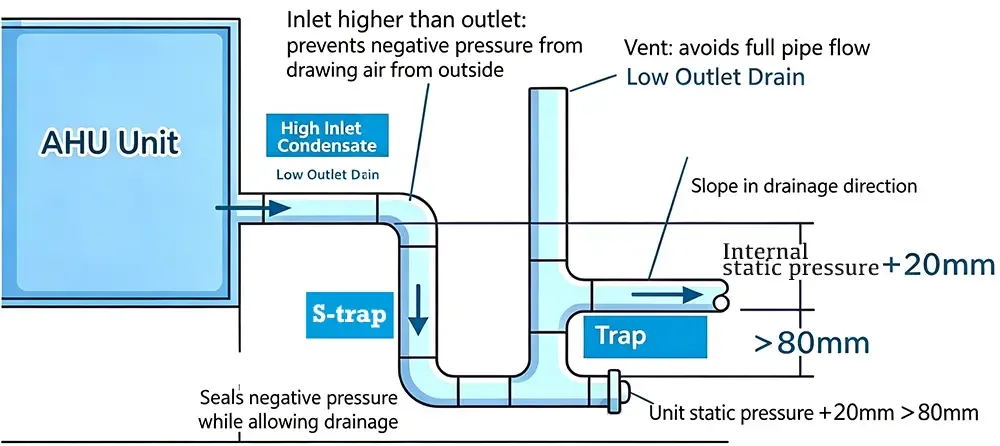
Air will pull through the water seal and create bubbles when the water seal height is below the units actual suction pressure. The seal will eventually empty and there will be an open airway to outDoors through the drain. The second error is in reversing the heights of the inlet and outlet for the drain. When the drain outlet is placed above the inlet to the drain pan, the negative pressure “locks” the water in the drain pan and does not allow for drainage. AHU leaking water from the unit casing occurs as a result. Three common incorrect configurations for drain piping are:
No trap at all: Negative pressure draws outside air with dust, pollen, insects etc continuously down drain hose through open drain pipe into the coil section of the unit.
Trap height too short:Due to static pressure, the water seal is frequently over come by negative pressure and will intermittently gurgle and ultimately lose seal in 24–48 hours.
Reversed inlet/outlet elevation: The bottom outlet of the coil section is higher than the pan connection resulting in condensate collecting in the coil section and eventually overflowing.
For positive pressure units
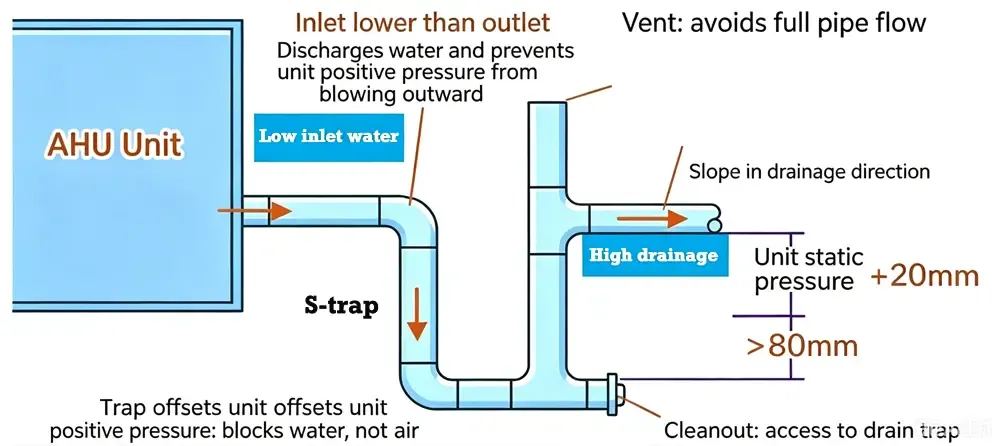
The biggest error in positive pressure situations is not having a water seal. In Deiiang’s field measurement on air handling units with discharge static pressures of 400–600 Pa, the cold air velocity at the drain outlet was 3–5 m/s without an AHU P-trap. This leaking of AHU air in operation causes measured losses of 3–8% of cooling capacity per unit. Also, the escaping air with very low temperature causes condensation on the outside of drain pipes, on the nearby structural steel work and on the floor slabs, creating slippery surfaces and causing corrosion. An incorrectly sized trap with a too shallow water column will be ‘blown through’ by the positive pressure and be seen as a spray of water coming from the end of the drain. In the long term this error will wear the seal away completely, causing the unit to return to full air leakage.
Step-by-step checklist: how to diagnose AHU leaking water / air on site
When arriving at a mechanical room with a reported leak from an AHU, going through a check list to diagnose the problem in an efficient manner can save a lot of time instead of wandering around and finding the problem by accident. This check list has been perfected by hundreds of Deiiang™ field service cases and can be done by anyone by using the common tools in 30 minutes or less.
Quick on-site inspection checklist
Check 1: Is there a water trap installed at all?! Simply follow the drain pipe from the pan connection out to the first 90° elbow (U-bend) – is there a ‘dip’ in the pipe to the main floor drain?! Yes, you’ve found the primary cause of AHU leaking water leaking and also why the unit is also leaking air!
Check 2:Check the size of the water seal in the trap (in mm) against the static pressure of the unit (as listed on the nameplate or with a digital manometer). The height of the water seal in millimeters must be greater than the static pressure of the unit in millimeters of water column (mWC) plus 20–30% for safety.
Check 3: While unit is operating listen for sounds of air leaking through water seal such as bubbling, gurgling or hissing near drain connection. This indicates that AHU P-trap water seal is unstable or has been breached.
Check 4: Look for more water traps, by checking for any downward sloping, sagging or low points in the pipe runs. Water in these locations can form additional water traps that develop their own bio-film and subsequently become clogged and cause AHU leaking water into the drain pan.
Check 5: Open up the drain pan access and check the drain pan for levelness, cleanliness and presence of debris. A tilted drain pan will concentrate water to the lower corner(s) and as a result the drain outlet may be submerged unevenly.
Simple measurement and temporary fix
When lacking design information about an undersized AHU P-trap a temporary transparent U-tube manometer can be filled with water and connected to the drain port. It immediately gives the actual static pressure at the pan of the AHU. For negative pressure units the water column of the manometer will be drawn into the unit. The height difference of the water column gives the minimum seal height which is required. For a temporary check a clear plastic tube can be mounted as test AHU P-trap on the outside of the unit. This tube can be of variable height and the behavior of the water column can be observed. For medical negative-pressure wards and for biosafety-laboratories Deiiang™ recommends a complete simulation of the pressure and a verification of the seal height during the commissioning. A P-trap is not something where one has to be content with “it will do”.
Deiiang solution: data-driven P-trap design & retrofit service
At Deiiang™, based on our extensive field experiences with air handling unit (AHU) cases of water leak and air leak in healthcare, Pharmaceutical and commercial markets, we developed a systematic approach to deliver reliable AHU drainage. Our product design team, led by our engineering team manager Jason Peng, strives to design and validate cost effective and innovative AHU P-trap solutions to take the uncertainty out of designing AHU P-trap.
Deiiang product & service overview
Pre-engineered AHU drainage modules: ready to install P-trap assemblies for Air Handling Units with inspection Windows, cleanout ports and vent connections.
On-site pressure testing + design calculation service:We send our Deiiang™ engineers to your sites to carry out live static pressure test readings and work out trap height for your specific AHU(s) with calculation results including safety margins all fully documented.
Custom drainage solutions: Duct drainage systems for Hospitals, pharmaceutical cleanrooms, electronICs manufacturing with very hygienic or high purity condensate.
Based on Deiiang post-retrofit survey data, 2022–2025.
Deiiang project case – Hospital negative pressure AHU
Grade A tertiary hospital located in a coastal city in the East of China (hot-humid climate). Twenty two combination AHUs are installed to serve 8 negative pressure isolation wards. There are on average 3-5 leaking water complaints reported per month on the 22 AHUs. Water marks and staining are observed on the floor of the mechanical rooms where the AHUs are installed. There are also persistent musty odors in the nearby corridors of the patient wards. Upon investigation, it was found that 16 of the 22 AHUs did not have any type of water trap installed or had S-traps installed which had already failed. In addition, the static pressures at the bottom of the drain pans of the AHUs were between 380 Pa and 620 Pa. These values are well above the designers’ assumptions.
Challenge: Although Infection control is required in these wards and construction can only take place during 4 hours of night shift, as-built drawings did not reflect fan operating points, hence pressure drop across water trap was severely under estimated. Solution: Deiiang team performed pressure drop measurement on live AHUs, re calculated water seal height with a +20% margin on top of design figures. Prefabricated transparent P-trap modules complete with vents and isolation valves were installed for the hospital. After 12 months there have been no condensate overflow complaints. Time taken to clean and hygiene inspect AHUs has been reduced by approximately 30%. These AHU trap configuration has become a standard for the whole Hospital Facility.
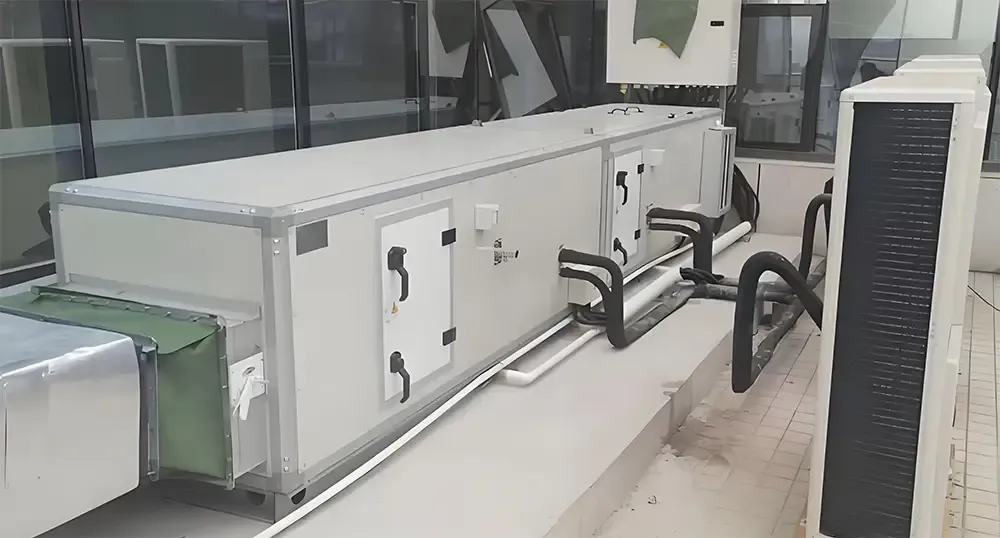
Deiiang project case – Shopping mall positive pressure AHU
Located in the south of China, a large Retail mall in a high humidity city, the rooftop Positive Pressure AHUs supply conditioned air into the Atrium spaces. The Facility team reported that there were persistent leakage of air from AHU drain outlets which caused condensation on the structural beams and slippery floor in the maintenance corridors. After site measurement, the average discharge static pressure of the AHU was 450Pa, and the cold air velocity passing through the unterminated drain outlet was 4.2m/s. Based on designed condition, the leakage caused 5.5% loss of cooling capacity of the AHU, equipping with typical operation 18,000kWh energy waste per year.
Deiiang™ firstly computed the individual optimized P-trap elevated heights for all of the rooftop positive-pressure AHUs under their corresponding measured static pressures. To effect their effective and seamless drain to the common outlet, Deiiang™ also implemented two important and patented structural measures: First, staggered individual outlet openings to the common header to effectively bar re-circulation of air in the drain lines; Second, increased pipe insulation by using 25 mm thickness of close-cell type of elastomeric foam to minimize heat conduction. The afore-mentioned in-place mechanical problems were efficiently addressed, such that there were reduced leakage points at condensate discharge from individual rooftop units from as many as 10 points to zero, reduced RH in the air-handling mechanical room by 8% to 12%, and predicted annual cooling energy consumption savings, of a combined total of 2% to 4% of the total HVAC power consumption, were achieved for all the rooftop positive pressure AHUs.
Common misconceptions about AHU P-traps (Myth-busting)
Misinformation about AHU P-trap design circulates widely in the field, leading to repeated cases of AHU leaking water and AHU leaking air. Below, we address four persistent myths with data and field observations.
"If the drain pipe has enough slope, I don't need a P-trap."
Slope of drain pipe only serves to assure that water will flow by gravity, and has no bearing on the amount of air that will move by virtue of 300–600 Pa pressure differential. As suction is being created in a negative pressure AHU, it will pull in outdoor air by means of the unsealed (no P-trap) sloped pipe. Slope is used to facilitate good drainage, P-trap is used to create a high pressure zone in order to prevent contamination of air-handling unit and to create a seal against negative pressure areas. Two separate ends that require to be addressed by two separate means.
"One universal trap height works for all AHUs in the building."
Field data from Deiiang™ gathered from multiple facilities with multiple Air Handling Units (AHUs) on different floors indicates that static pressure at the drain pan of similar units on the same floor can vary as much as 200-400 Pa. If one were to simply use a fixed trap height for all units, 30-40% of the AHUs would have an inadequate seal resulting in leaking air from the AHU or worse yet, AHU ingression of contaminants, and the remaining units would have an excessive seal resulting in slow drainage and accumulations of debris in the drain pan.
"An S-trap is cheaper and works fine for AHUs."
At first an AHUS S-trap might be slightly cheaper to make than a Deiiang™ Permanent Indoor Unit Air Outlet S-trap but when they self-siphon and have seals that evaporate quickly there is a huge amount of cost for repair in emergency situations, for water damage, and for cleaning of the coil due to dirty air entering. The majority of problem units found in Deiiang™ retrofits were originally fitted with AHUS S-trap type setups or other bent-tube varieties.
"If there's no visible water leak, the drain design must be fine."
A P-trap in an AHU (Air Handling Unit) is intended to collect water on the floor to confirm that the system is healthy. However, a negative pressure AHU with a dry or missing P-trap can pull dirty outdoor air into the coil section of the unit without any indication of a problem. This condition can exist for months and affect the quality of the supply air as well as cause the filters to become plugged more quickly. These problems typically are discovered by complaints regarding air quality and are traced back to the missing AHU P-trap.
How to design AHU P-traps right from the beginning
For consulting engineers and design-build contractors who create drawings, getting the AHU P-trap specification correct at the drawing stage avoids all of these problems. A small up-front investment to clearly depict a correct design feature on drawings will return many times over in the avoidance of unnecessary service calls for leaking water and leaking air from AHUs.
Design checklist for consultants and designers
Verify the maximum operating static pressure for each AHU at the P-trap drain location, including when the filters are dirty and the system is in VAV turndown, and add a 20–30% design safety factor.
On plumbing/HVAC drawings specify trap Type And minimum water seal height. For example: P-trap, minimum water seal height XX mm. Written information on drawings will prevent incorrect trap construction.
Indicate on plumbing/HVAC drawings the required access and cleanout for each P-trap. For AHUs it is suggested that there be a minimum of 150mm of clearance to one side of the trap (perpendicularly to the run of pipe) for cleaning. For hygienic applications it is often acceptable to have a transparent section or access port to the trap.
On high humidity or cleanroom projects the P-trap is required to be vented with a visible water level indicator. This allows staff from the facility to on a daily basis inspect the trap for proper operation without taking the trap apart.
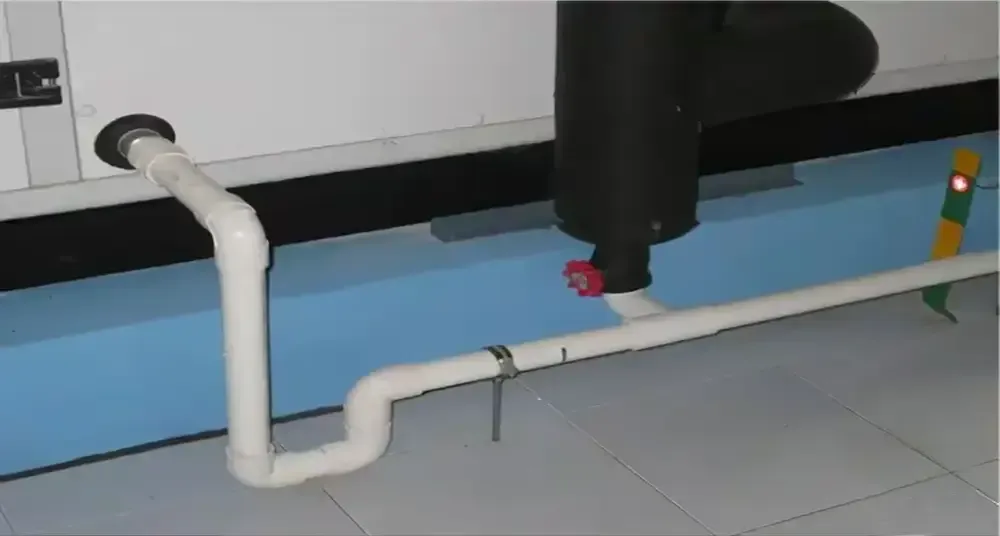
Integration with international and local codes
Drain traps with a small P-trap (e.g. water seal height) are common as they can be sized (e.g. determined by design parameters) using the actual operating pressure of an air handling unit. Most global HVAC design Handbook chapters include HVAC condensate drainage chapters. SMACNA also includes detailed drawings of typical P-traps, for example for Air Handling Units. For many countries local building design code requires that such condensate water drainage system prevents backflow, prevents outdoor odors from entering indoor spaces, and also does not permit heat to escape from the drain. This is true for China national building design codes such as GB 50189 (Design Standard for Energy Efficiency of Public Buildings) and GB 50073 (Design Code for Cleanroom). For such purposes, Deiiang™ engineering staff, led by Jason Peng (product designer for Deiiang™) can assist in building design phase with engineering knowledge, or even provide standard details for typical applications.
Conclusion: Small P-trap, big impact
Based on a careful analysis of the physics, relevant field experience, failure modes and a number of case studies, the following four key conclusions can be drawn regarding AHU drain traps. First, the vast majority of instances of AHU’s leaking water and/or leaking air can be attributed to the P-trap (or its absence, or the incorrect design/sizing of it, or its substitution with an unsuitable type of S-trap). Secondly, that AHUs operate under positive pressure and under negative pressure and thus require two entirely different approaches to the drain trap. Attempting to apply the same logic to both will, in all cases, lead to failure. Thirdly, that the use of a simple, data-driven design for the P-trap, taking account of the actual static pressure at which the AHU is operating and utilizing a pre-engineered set of drain trap components, can reduce instances of leakage to effectively zero, whilst at the same time significantly reducing required maintenance time by as much as 30% or more. And lastly, the P-trap is one of the lowest cost items in the entire AHU, and when properly sized and applied returns a huge amount of value in terms of reliability, efficiency and indoor air quality. Jason Peng, Designer and Product Manager for Deiiang™ HVAC stated, “A drain trap (drain trap) that costs less than a dinner can protect a system worth more than a luxury car. That’s Return on Investment (ROI) that’s worth getting right.”
So whether you’re dealing with an existing piece of leaking water equipment or designing a new HVAC system from scratch, focus on getting the P-trap right. In doing so, you can essentially guarantee that four major problems with AHUs are eliminated.
References
ASHRAE Handbook — HVAC Systems and Equipment, Chapter on Condensate Drainage. ashrae.org
SMACNA — HVAC Systems Duct Design, Condensate Drainage Guidelines. smacna.org
Deiiang™ Project Data 2020–2025 — Internal field survey of 218 AHU drainage systems across healthcare, commercial, and industrial facilities.
GB 50189 — Design Standard for Energy Efficiency of Public Buildings (China).
GB 50073 — Design Code for Cleanroom (China).
Product design lead: Jason Peng, Deiiang™. For technical inquiries about AHU drainage solutions, contact the Deiiang engineering team.