+86 13638632902
 Jason@cleanroomequips.com


 MENU
MENU
For chillers, all of the HVAC Maintenance tasks are to be performed in strICt compliance with the currently applicable industry standards for new Screw Chillers Maintenance and for Air-Cooled Chillers Maintenance. For these tasks the primary references are GB/T 18430.1-2024 “Steam compression cycle Air Cooled Chiller for industrial/commercial use” and T/GXAR 005-2024 “Operation and maintenance regulations for refrigeration mACHine rooms” and GB 9237 “Safety regulations for refrigeration systems”. These standards list out the scheduled inspection frequency and corresponding acceptance criteria, which together form the basis of the work to be done in performing the scheduled maintenance on chillers in order to safely maintain their reliable operation.
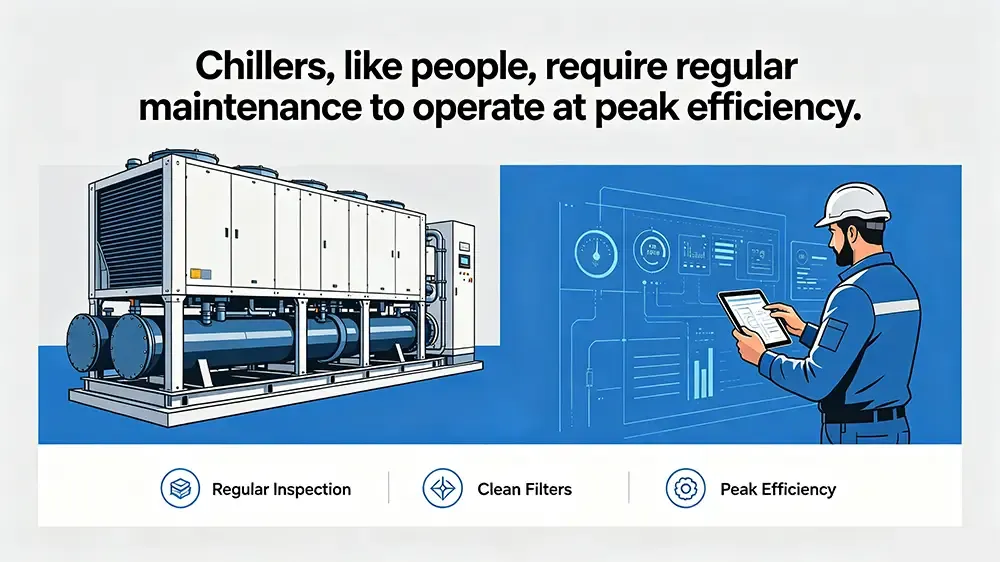
Chillers, like people, require regular maintenance to operate at peak efficiency. (Image: Deiiang™)
Our team at Deiiang™ has implemented a structured tiered approach to discover potential failures at the Daily, Monthly, Quarterly, Semi-annual and Annual levels. The approach is implemented as checklists to screw chillers and modular air-cooled heat pumps that can be immediately put to use by the facility managers, under the technical leadership of Jason.peng, product designer of Deiiang™.
Daily Routine Inspection
The daily checks of HVAC Maintenance are very important and usually recorded by the operators for both screw and air-cooled chillers on a shift basis. Below you will find a summary of the most important inspection points for the daily checks and as you can see, the Screw Chillers Maintenance requires more attention for the oil-level and the sound of the compressor than the Air-Cooled Chillers Maintenance requires attention for the air inlet / outlet temperature-differentials and the fin condition.
| No. | Check Item | Inspection Content | Standard Requirement |
|---|---|---|---|
| 1 | Pressure | Evaporating pressure; Condensing pressure | Evap: 0.3–0.5 MPa; Cond: 1.2–1.6 MPa |
| 2 | Water Temperature | Chilled water supply/return temp; cooling water supply/return temp; air-cooled unit inlet/outlet air temp difference | Chilled supply 7±0.5°C, return 12±1°C; Cooling supply 32±2°C, return 37±2°C |
| 3 | Electrical | Unit operating current | Not exceeding rated current |
| 4 | Lubrication System | Oil level sight glass, oil temperature | Oil level 1/2–2/3; oil temp 45–55°C |
| 5 | Operating Status | Unusual noise or vibration | No abnormal noise or vibration |
| 6 | Control System | Panel & PLC status, interlock function | No fault alarms, correct parameter display, touch responsive |
| Check Item | Standard Requirement |
|---|---|
| Pressure | Evap 0.3–0.5 MPa / Cond 1.2–1.6 MPa |
| Water Temp | Chilled supply 7±0.5°C, return 12±1°C |
| Electrical | ≤ rated current |
| Oil System | Level 1/2–2/3, temp 45–55°C |
| Noise/Vibration | No abnormal |
| Control Panel | No alarms, correct display |
Unit-Specific Daily Inspections
While a universal checklist for all types of compressors and chillers is provided, specialized maintenance procedures are described for the different types of compressors. In particular, for centrifugal chillers it is important to monitor the compressor speed to avoid surge. Also, for screw chillers, it is crucial to check whether the rotors are running smoothly and to look for oil circuit pressure relief or seal leakage. Magnetic bearing units require particular attention to the bearing levitation and to the temperature of the Variable Frequency Drive (VFD) module. Air-Cooled Chillers require special maintenance of the outdoor fans as well as of the air flow passages through the Fan Coil Units to ensure that there is no dust blockage between the fin folds.
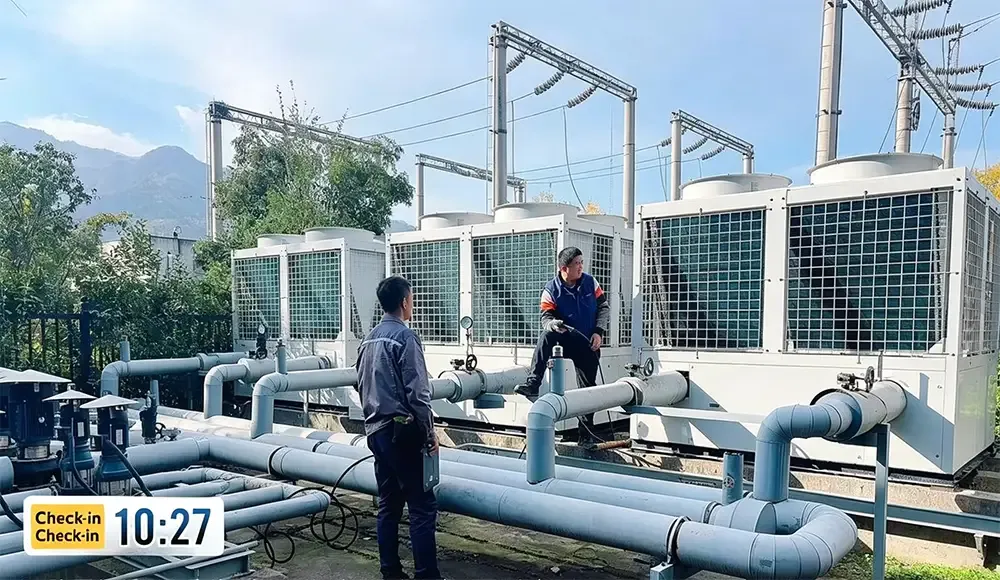
Fig. 2: Daily logging of evaporator and condenser pressures is fundamental to chiller longevity.
Monthly Maintenance
In addition to the routine checks on a daily basis, Monthly HVAC Maintenance allows for trend analysis and protective device verification by compiling the monthly data and comparing it against the same data from the previous year as well as the rated parameters for the piece of equipment. Typically this type of analysis would highlight any deterioration of the Screw Chillers Maintenance or Air-Cooled Chillers Maintenance prior to it becoming a critical issue. This approach is at the core of the Deiiang™ service offering promoted by Jason.peng.
| No. | Check Item | Inspection Content | Standard Requirement |
|---|---|---|---|
| 1 | Operation Analysis | Compile monthly data, compare with historical and rated parameters | Analyze abnormal trends in pressure, water temp, energy consumption; issue report |
| 2 | Refrigerant System | Refrigerant pressure/level; leak check at connections | Normal parameters; no leakage |
| 3 | Safety Protection | High/low pressure, oil pressure differential, water flow, overload protection | Protection devices sensitive, functional |
| 4 | Piping & Air Venting | Check water and refrigerant piping; periodic air venting | No deformation or leakage at pipes and valves |
| 5 | Electrical System | Wiring, terminals, contactors | No overheating, looseness, or insulation damage |
| 6 | Fastener Tightening | Equipment connection bolts | All fasteners tight |
| Check Item | Standard Requirement |
|---|---|
| Operation Analysis | Analyze pressure, temp, energy trends; issue report |
| Refrigerant System | Normal pressure/level; no leaks |
| Safety Protection | All protections functional |
| Piping & Venting | No deformation, leakage |
| Electrical | No overheating, looseness |
| Fasteners | All tight |
Unit-Specific Monthly Tasks
The following are the monthly maintenance activities required for Screw Chillers and Centrifugal Chillers. The Magnetic bearing units require testing of the VFD for the Magnetic bearing and the Power supply modules for the bearing. The Air-Cooled Chillers require Cleaning of debris from the fins of the tubes and a stand by check of the defrost system.
Quarterly Maintenance
Quarterly HVAC Maintenance focuses on the fundamental aspects of the air conditioning equipment’s structure and dynamic parts. For example, the water flow switch needs to be checked for sensitivity and interlocks to ensure that the chiller safely trips in case of no flow. This is a critical safety function and is addressed in the Screw Chillers Maintenance or Air-Cooled Chillers Maintenance program. In addition to the water flow switch, the foundations for all of the equipment, the vibration isolators and the various parts of the drivetrain (motors, fans, compressors, etc.) should be inspected for any signs of wear or settling.
| No. | Check Item | Inspection Content | Standard Requirement |
|---|---|---|---|
| 1 | Water Flow Switch | Sensitivity, signal, interlock protection | Responsive, start/stop protection normal |
| 2 | Foundation & Vibration Isolation | Unit foundation and vibration dampers | No cracking/settlement; dampers not aged or failed |
| 3 | Drivetrain | Motor, fan, compressor rotating components | Smooth operation, no sticking or abnormal sound |
| 4 | Heat Exchange System | Monitor evaporator & condenser entering/leaving water temperature difference | Temperature difference within rated range |
| Check Item | Standard Requirement |
|---|---|
| Flow Switch | Sensitive, protection functional |
| Foundation & Dampers | No cracking, dampers intact |
| Drivetrain | Smooth, no abnormal noise |
| Heat Exchanger ΔT | Within rated range |
Unit-Specific Quarterly Checks
During the quarterly Screw Chillers Maintenance check it’s a good idea to pay attention to the compressor shaft seal lubrication/cooling system for possible leakage. For the magnetic bearing chillers, measure the bearing clearance and check the variable frequency drive for proper heat dissipation. Air-Cooled Chillers Maintenance checks should include inspection of fin deformation and ensure proper cooling of the fan motor.
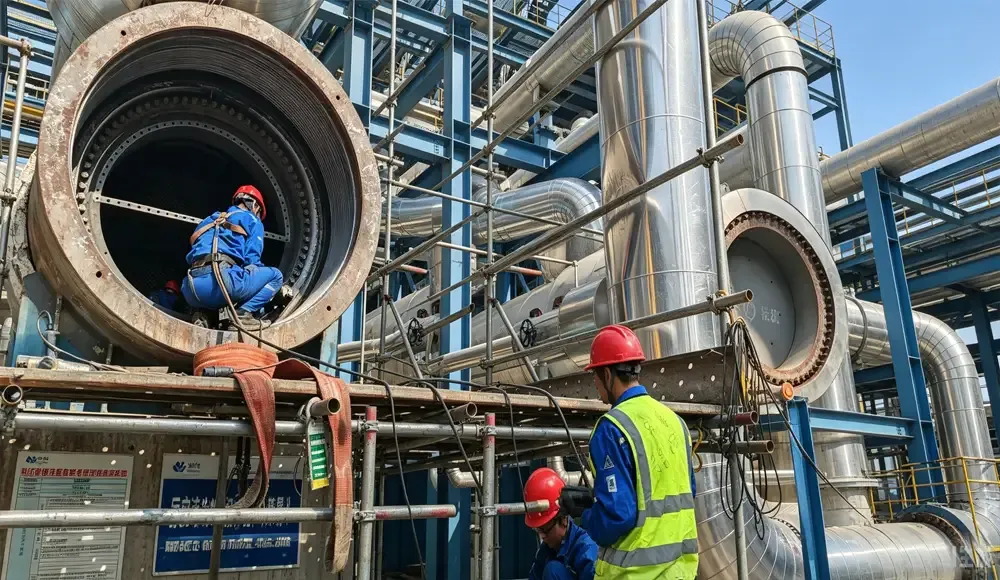
Quarterly inspection of heat exchanger approach temperatures reveals fouling trends.
Semi-Annual Maintenance
Within Semi-annual HVAC Maintenance we are now entering into the deeper cleaning of the HVAC components as well as electrical insulation testing. Dirt is removed from the accumulated deposits in the sumps of the cooling towers as well as from the water distribution pans of these towers, which strongly influences the heat transfer. The electrical insulation is checked by measuring the insulation resistance. This has to be within the limits given in GB/T 18430.1-2024. Vibration and noise of the whole system are measured and by comparing with the measurement data from the factory the Bearing can be checked for wear. This is also the target of the Screw Chillers Maintenance as well as of the Air-Cooled Chillers Maintenance.
| No. | Check Item | Inspection Content | Standard Requirement |
|---|---|---|---|
| 1 | Internal Cleaning | Clean unit interior, water distribution trays, cooling tower sump | No oil/dust buildup; sump free of sludge; water clean |
| 2 | Electrical Insulation | Insulation resistance of distribution components | Insulation values conform to GB/T 18430.1-2024 |
| 3 | Vibration & Noise | Whole unit, compressor, and fan vibration/noise | Values within equipment specifications |
| Check Item | Standard Requirement |
|---|---|
| Internal Cleaning | No sludge, clean water |
| Insulation Resistance | Meet GB/T 18430.1-2024 |
| Vibration & Noise | Within spec |
Unit-Specific Semi-Annual Tasks
For screw and centrifugal chillers, clean the oil circuit filters. For Magnetic bearing chillers, recheck the variable frequency parameters and clean the control cabinet of any dust. For Air-Cooled Chillers, test defrost system and four-way reversing valve for proper operation as part of heat pump maintenance.
Annual Maintenance
The Annual HVAC Maintenance is the most in-depth service offered at Deiiang™ by Jason.peng. This pre-cooling season startup (April–May) and in-season sustained operation (May–September) maintenance program for Screw Chillers Maintenance and Air-Cooled Chillers Maintenance is designed to return your HVAC systems to near-factory form by having a complete lubrication system over-hauled, the heat exchanger’s cleaned deep and the safety valve(s) calibrated. Jason.peng recommends this service to be completed by an authorized service provider.
Pre-Cooling Season Startup (April–May)
| No. | Check Item | Inspection Content | Standard Requirement |
|---|---|---|---|
| 1 | Lubrication System | replace oil and oil filter for screw & centrifugal units | Complete oil change per manufacturer cycle |
| 2 | Refrigerant System | replace filter-drier; calibrate refrigerant pressure; check for shortage | New filter-drier; refrigerant free of moisture/impurities |
| 3 | Heat Exchange Equipment | Chemical + mechanical cleaning of heat exchangers; clean fins of air-cooled units | No fouling on heat exchangers |
| 4 | Safety Components | Professional calibration of safety valves | Safety valve calibration certified |
| 5 | Calibration & Electrical Tightening | Calibrate sensors; tighten all electrical connections | Sensors accurate; terminals tight |
| Check Item | Standard Requirement |
|---|---|
| Oil & Filter | replace per schedule |
| Refrigerant System | New filter-drier, correct charge |
| Heat Exchanger Cleaning | No fouling |
| Safety Valve | Calibrated & certified |
| Sensors & Connections | Accurate, tight |
Cooling Season Operation Period (May–September)
For the cooling season, continue performing the daily, monthly, and quarterly work for the HVAC Maintenance as appropriate. Review and document the operating data on a weekly basis and fix any faults as they occur. Minor issues can become major problems during periods of high load for both the Screw Chillers Maintenance and the Air-Cooled Chillers Maintenance. The Deiiang™ approach is to perform a dedicated weekly review of trend logs to detect any efficiency drift.
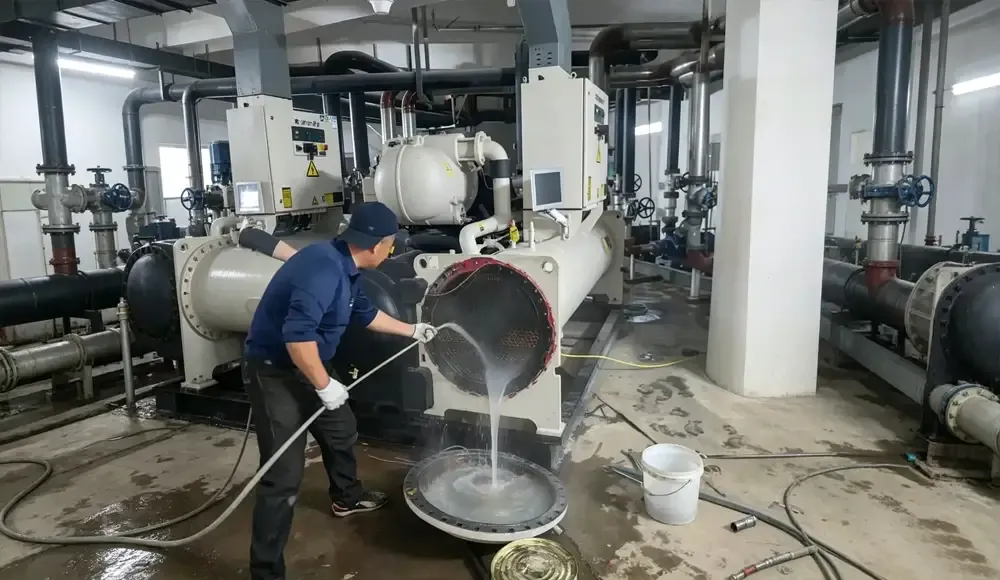
Annual deep cleaning and oil replacement restore chiller efficiency and reliability.
Maintenance Cycle and Standard Basis Summary
Below is a table showing all of the complete scheduled maintenance for all types of Chillers and compare to other HVAC equipment. Use this table to plan maintenance for the Screw Chillers and the Air-Cooled Chillers as well as other equipment at the facility on a yearly basis according to the respective published standards.
| Maintenance Item | Interval | Applicable Unit Type | Standard Basis |
|---|---|---|---|
| Operating parameter recording & inspection | Daily / per shift | All types | T/GXAR 005-2024 |
| Operational data analysis, refrigerant leak check, safety verification, electrical & fastener inspection | Monthly | All types | Industry refrigeration O&M codes, T/GXAR 005-2024 |
| Water flow switch calibration, vibration isolation & drivetrain check, heat exchange system test | Quarterly | All types | Industry refrigeration O&M codes |
| Internal cleaning, electrical insulation, vibration & noise specialized test | Semi-annually | All types | GB/T 18430.1-2024, T/GXAR 005-2024 |
| Lubrication oil & oil filter replacement | Annually | Centrifugal, Screw | Manufacturer technical manual |
| Filter-drier replacement, sensor calibration, electrical terminal tightening | Annually | All types | GB/T 18430.1-2024, manufacturer specifications |
| Condenser & evaporator deep cleaning | Annually | All types | Manufacturer manual, O&M codes |
| Safety valve professional calibration | Annually | All types | Pressure vessel safety regulations, GB/T 18430.1-2024 |
| Winter freeze protection drainage & equipment storage preservation | When ambient temp <0°C & shutdown | All types | GB/T 18430.1-2024 |
| Maintenance Item | Interval | Standard |
|---|---|---|
| Parameter recording | Daily | T/GXAR 005 |
| Data analysis, leak check, electrical | Monthly | T/GXAR 005 |
| Flow switch, vibration, heat exchange | Quarterly | Industry codes |
| Cleaning, insulation, vibration test | Semi-annual | GB/T 18430.1 |
| Oil & filter change | Annual | Manufacturer |
| Filter-drier, calibration, tightening | Annual | GB/T 18430.1 |
| Deep cleaning | Annual | Manufacturer |
| Safety valve calibration | Annual | GB/T 18430.1 |
| Freeze protection | Winter shutdown | GB/T 18430.1 |
References
GB/T 18430.1-2024 — Steam compression cycle Part 1: Industrial or commercial and similar. View Standard
T/GXAR 005-2024 — Refrigeration Room Operation and Maintenance Procedures. View Standard
GB 9237 — Refrigeration System Safety Specifications. View Standard
iso 5149-1:2014 — Refrigerating systems and heat pumps — Safety and environmental Requirements. View Standard
Deiiang™ HVAC Maintenance Documentation. Visit Deiiang™
© Deiiang™ · Product Designer: Jason.peng · All rights reserved.