+86 13638632902
 Jason@cleanroomequips.com
 MENU
MENU
A cooling tower is more than a fan and fill. It is a precision heat‑rejection system whose performance directly dictates chiller efficiency. This guide covers design principles, material trade‑offs, maintenance strategies, and compliance with ASHRAE standards, backed by field data from Deiiang™ projects engineered by Jason Peng.
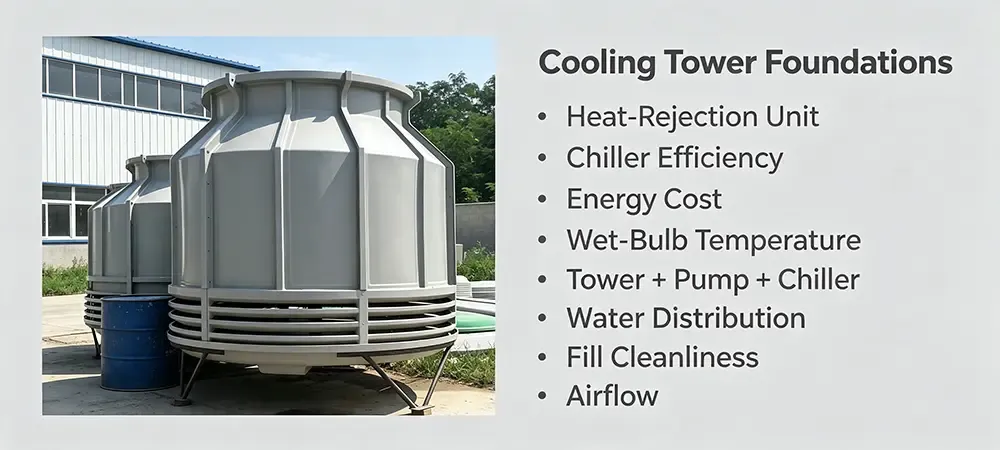
Cooling Tower Principles
Every cooling tower relies on evaporative latent heat transfer. Warm condenser water from the chiller is pumped to the spray system, falling through fill media in counterflow or crossflow to the airstream.
A small portion of water evaporates, removing approximately 2,260 kJ per kg. Because evaporation dominates, the ambient wet‑bulb temperature sets the theoretical cooling limit. ApproACH—the difference between leaving water temperature and entering air wet‑bulb—typically ranges from 3°C to 5°C.
Tighter approach demands more fill area and airflow. The trade‑off: higher capital cost vs. improved chiller COP. Circulation ratio (water flow / evaporation) and drift loss are also key metrics. Modern drift eliminators hold drift below 0.005 % of circulating water.
Main Structure & Key Components
The fill media is the thermal engine, providing up to 150 m²/m³ of air–water contact surface (modern film‑fill designs). Spray nozzles must deliver uniform water distribution; a single clogged nozzle can reduce effective fill area by 10 %.
The fan system drives airflow. A blade pitch deviation of just 2–3° can shift airflow by over 15 %, directly impacting thermal capacity.
Material Selection: FRP vs. Galvanized vs. Stainless Steel
Choosing the right structural material is critical for corrosion resistance and life‑cycle cost. The table below summarizes expected service life in different environments.
| Material | Corrosion Resistance | Typical Life (years) | Best Application |
|---|---|---|---|
| FRP (Fiber‑Reinforced Plastic) | Excellent (chemical environments) | 20+ | Chemical plants, coastal areas |
| HDGS (Hot‑Dip Galvanized Steel) | Moderate | 10–15 | General commercial, inland |
| 304 Stainless Steel | Very good | 15–20 | Food processing, mild coastal |
| 316 Stainless Steel | Excellent (chloride resistance) | 20+ | Offshore, heavy coastal |
| Material | Corrosion | Life |
|---|---|---|
| FRP | Excellent | 20+ |
| Galvanized | Moderate | 10–15 |
| 304 SS | Very good | 15–20 |
| 316 SS | Excellent | 20+ |
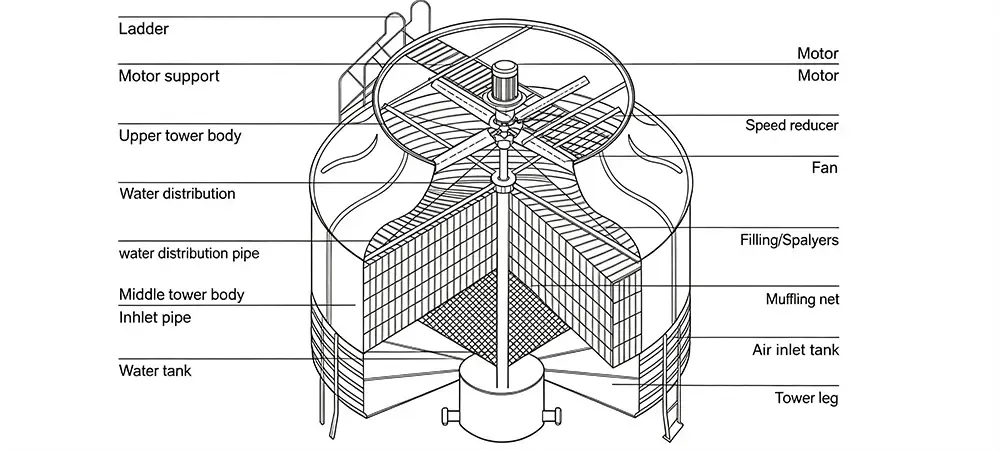
Cooling tower cross‑section with key components
Selection Methodology
Effective cooling tower selection goes beyond matching two temperature points. Designers must input chiller capacity, design water flow, entering/leaving temperatures, site design wet‑bulb, allowable approach, drift limits, and noise constraints.
High‑altitude, coastal, and high‑humidity locations require correction factors. At 1,500 m elevation, air density is about 15 % lower than sea level, directly reducing heat‑rejection capacity.
For multi‑tower parallel systems, hydraulic balance is critical. A 10 % longer pipe run on one branch can reduce flow to that tower by 5–8 %, forcing remaining towers above design flow.
Life‑Cycle Cost (LCC) Comparison — 20‑Year Total Ownership
Purchase price alone is misleading. Over a 20‑year lifespan, energy and water costs dominate. The table below compares a typical 500 RT cooling tower across three material grades, assuming 0.08 $/kWh electricity and 2.00 $/m³ water.
| Cost Category | FRP Tower | Galvanized Tower | 316 SS Tower |
|---|---|---|---|
| Initial capital (USD) | $48,000 | $38,000 | $62,000 |
| 20‑year fan energy | $112,000 | $128,000 | $108,000 |
| 20‑year water makeup | $18,000 | $22,000 | $16,000 |
| 20‑year chemical treatment | $14,000 | $16,000 | $13,000 |
| 20‑year maintenance & repairs | $9,000 | $24,000 | $7,000 |
| Total 20‑year cost | $201,000 | $228,000 | $206,000 |
| Cost (20 yr) | FRP | Galv. | 316 SS |
|---|---|---|---|
| Initial | $48k | $38k | $62k |
| Energy | $112k | $128k | $108k |
| Total | $201k | $228k | $206k |
Key insight: Although galvanized steel has the lowest upfront cost, its higher maintenance and corrosion‑related energy penalty make it the most expensive option over 20 years. Deiiang™ recommends FRP or 316 SS for projects with a design life exceeding 15 years.
Industry‑Specific Design Considerations
Noise Mitigation: Adding sound‑attenuation blankets reduces radiated noise by 4–8 dB(A). VSD fans operating at 80 % speed cut noise by a further 5–7 dB(A). Discharge plenum silencers address tonal frequencies from axial fans.
Operation Optimization & Energy Performance
Real‑world cooling tower operation demands a system‑level mindset. Airflow‑priority control with VSD fans typically saves 15–25 % fan energy. The sweet spot emerges where total system power (pump + fan + chiller) reaches its minimum.
During cooler months, nighttime economizer cooling can slash chiller runtime. When wet‑bulb drops below approximately 10°C, the tower alone can satisfy cooling loads.
In colder climates, winter freeze protection is essential. Basin heaters, recirculation strategies, or dry‑operation protocols prevent ice damage without compromising availability.
Maintenance & Reliability
Disciplined maintenance routines—weekly visual, monthly mechanical, quarterly water quality—catch degradation early. Annual teardowns uncover hidden problems. Legionella management must follow ASHRAE 188 and local health authority water management plans.
Periodic shock disinfection and ongoing biocide monitoring are critical for safety.
Component Life Expectancy & Replacement Triggers
| Component | Typical Life (years) | Replacement Trigger |
|---|---|---|
| Fill media (PVC film) | 8–12 | Visible brittleness or >20% channeling |
| Fan motor (IE3/IP55) | 12–15 | Vibration exceeds 4.5 mm/s (ISO 10816‑3) |
| Drift eliminator | 10–15 | Cracks or visible water carryover |
| Basin (FRP/steel) | 20+ | Structural cracks or through‑wall corrosion |
| Component | Life (years) |
|---|---|
| Fill media | 8–12 |
| Fan motor | 12–15 |
| Drift eliminator | 10–15 |
| Basin | 20+ |
Decision Tree: Repair or replace?
Use this logic to decide whether to overhaul or replace your cooling tower:
Fill media damaged >30 % AND tower age >10 years → replace entire tower. The cost of new fill plus labor often exceeds 60 % of a new unit.
Fan motor failed AND motor frame corroded → replace motor. If original motor is IE1/IE2, upgrade to IE3/IE4 for payback within 2 years.
Basin leaks at multiple weld seams → replace basin or entire unit if tower age >12 years. Patch repairs rarely last beyond 18 months.
Drift eliminators cracked but structure sound AND tower age <8 years → replace eliminators only. Budget ~$1,200–$2,500 per cell.
Annual energy cost exceeds 70 % of a new tower's installed price → replace immediately. The new unit will pay for itself through energy savings within 5–7 years.
Legionella Risk Control — Beyond Chemical Treatment
While maintaining 0.5–1.0 ppm free chlorine residual is essential, physical design plays an equally important role. Deiiang™ towers incorporate smooth basin surfaces to prevent biofilm attachment, easily removable drift eliminators for inspection, and separation distances from air intakes per ASHRAE 188 guidelines.
Thermal pasteurization shock treatments can be automated via the BMS. Quarterly Legionella sampling and total bacteria counts should be trended. In high‑risk installations, copper‑silver ionization may supplement biocide dosing.
Common Myths (Myth‑Busting)
Fact: Selection must consider wet‑bulb and approach simultaneously. A tower delivering 37°C/32°C at 28°C wet‑bulb may fail at 30°C wet‑bulb.
Fact: System power (pump + fan + chiller) determines optimum. A larger fan can increase total power if chiller COP gain no longer offsets the fan draw. Crossover typically occurs at 3.5–4.5°C approach.
Fact: A biofilm just 0.5 mm thick reduces overall heat transfer coefficient by 20–30 %.
Deiiang™ Product & Data Reference
Designed by Jason Peng, Deiiang™ cooling towers target the following certified performance values (typical for a 500 RT crossflow unit):
Nominal drift rate: ≤0.001 % of circulating water flow (CTI ATC‑105 protocol)
Design Approach: 3–5°C per project conditions
Noise level @ 1m: 62 dB(A) (low‑noise variant: 58 dB(A))
Motor rating: IP55, IE3 (IE4 optional), Class F insulation
Certifications: CTI‑STD‑201, AMCA 210/220, CE, CCC, GB/T 7190.1
Wet‑bulb adaptation: Design values sourced from local weather bureau or ASHRAE climatic database
Deiiang™ Project Case Studies
Project A: Large Commercial Complex — Wuhan
Subtropical, design wet‑bulb ~28°C, chiller capacity 3,000 RT. Challenges: high humidity, rooftop load limits, night noise ordinance.
Solution: Multi‑tower parallel with VSD fans, high‑efficiency drift eliminators, symmetric manifold layout for hydraulic balance.
Results: Summer peak condensing pressure reduced 27 %; annual HVAC energy decreased 46 %.
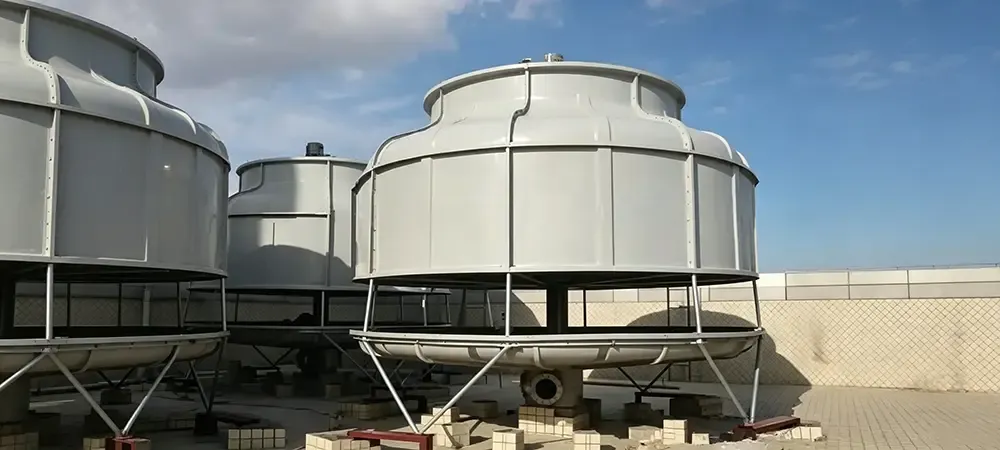
Deiiang™ cooling tower installation — Wuhan project
Frequently Asked Questions
How does wet‑bulb temperature affect leaving water temperature?
A 2°C increase in ambient wet‑bulb typically raises leaving water temperature by 1.5–2°C, increasing chiller compressor power by 4–6 %.
How do you balance water flow across parallel towers?
Use symmetric piping with equal path lengths, plus balancing valves. Verify with ultrasonic flow meters during commissioning. In variable‑flow systems, individual flow control valves linked to pump VSDs maintain balance.
How do you control Legionella risk?
Implement a water management plan per ASHRAE 188. Maintain 0.5–1.0 ppm free chlorine, perform quarterly Legionella sampling, and conduct periodic thermal pasteurization. Ensure drift eliminators are intact and towers are located away from air intakes.
How can cooling towers operate in winter without freezing?
Use electric basin heaters, recirculate warm water during idle periods, and operate fans at minimum speed to prevent ice on blades and louvers. Dry‑sump operation below −5°C is also effective.
Ask our Designer — Jason Peng
Submit your cooling tower question and Jason typically replies within 24 hours.
Submit QuestionDownloadable Resources
📊 Cooling Tower Selection Calculator — includes local wet‑bulb data lookup
📋 Maintenance Inspection Checklist (PDF) — weekly/monthly/annual tracker
📄 Material & Component Specifications / Test Reports — Deiiang™ product documentation
Standards Comparison: GB/T 7190.1 vs. ASHRAE
For projects in China or exported from China, GB/T 7190.1 governs mechanical draft cooling towers. Key differences from ASHRAE include: GB/T mandates a minimum 30‑minute fire resistance rating for FRP components (absent in ASHRAE); thermal performance testing under GB/T requires on‑site verification at 100 % design load, whereas ASHRAE accepts factory‑certified data with a 5 % tolerance; and noise limits under GB are 5–8 dB(A) stricter for urban commercial installations. Deiiang™ products are dual‑certified to both standards.
References
ASHRAE Handbook — HVAC Systems and Equipment, Chapter 40: ashrae.org
CTI STD‑201 — Certification of Water‑Cooling Towers: coolingtechnology.org
AMCA Publication 211: amca.org
ASHRAE Standard 188 — Legionellosis: ashrae.org
ISO 10816‑3 — Mechanical Vibration: iso.org
GB/T 7190.1 — Cooling Towers: gbstandards.org
© 2026 Deiiang™. All rights reserved. Product Designer: Jason Peng. Certified values should be confirmed from actual test reports.