+86 13638632902
 Jason@cleanroomequips.com
 MENU
MENU
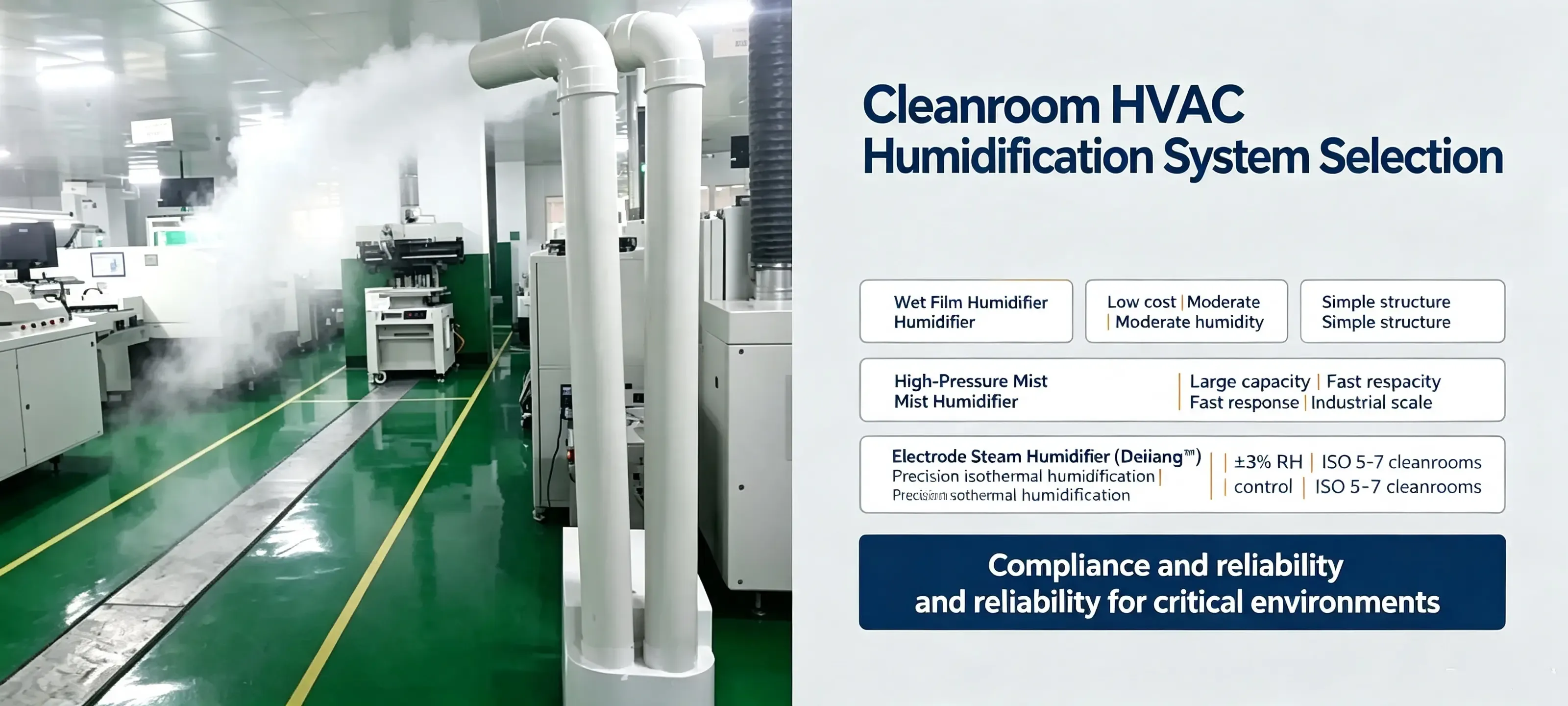
The choice of a HVAC humidification system for cleanrooms has a direct impact on product yield, on compliance with regulations and on operating expenses. Of the many types of humidifiers for air conditioning units, three types of systems are currently dominating the market: wet film humidifiers (inexpensive, low capacity, for iso 8+), high-pressure micro-mist humidifiers (for industrial scale applications, fast response time, 100–500 kg/h output), and electrode humidifiers (sterile steam, ±2% RH precision, for iso 5–7 cleanrooms). In this article, the three types of systems are presented in greater detail, including descriptions of the basic construction, working principles, performance metrics, and data from real Deiiang™ applications. The goal of this article is to provide cleanroom facility engineers with sufficient information to make an informed, evidence-based decision.
For ISO 7+ cleanrooms of average humidity load (less than 15 kg/h), wet film humidifiers offer the best economic return. In large-volume ISO 6-8 cleanrooms that need more than 50 kg/h, a high-pressure micro-mist humidifier could be the best option. For ISO 5-level clean and sterilize rooms, electrode humidifiers represent the highest standard. These require higher energy (approx. 0.75 kWh/kg of steam produced) but are accurate to ±2% RH and make very clean and sterile steam. Deiiang™ provides all of these options and is a certified fire-stop item.
Search Intent & Applicable Readers
Industrial humidifiers – a guide for engineering specification for new builds or retrofits. This guide is written for HVAC design engineers, cleanroom facility managers, pharmaceutical plant operators, semiconductor fab maintenance teams, and hospital facility directors who need to understand the differences between humidifiers at a technical level. The guide provides a clear comparison matrix with quantified performance data, decision-tree logic for selecting humidifiers based on cleanroom iso class and humidity load, installation and maintenance best practices, and three Deiiang™ case studies demonstrating real-world ROI calculations. If you are specifying industrial humidifiers for a new build or retrofit, this article provides actionable engineering references.
cleanroom humidity Concepts & Key Requirements
In regulated cleanrooms, relative humidity (RH) is not a comfort parameter but a critical process variable. A change of only ±3% RH can increase the number of ESD events by 40%, promote growth of microorganisms on surfaces and cause dimension changes of hygroscopic materials. The design of humidification by HVAC has to meet three different constraints:.
Humidity Setpoint Precision: ISO 5–7 cleanrooms typically demand 45% ± 5% RH for pharmaceutical operations, while semiconductor fabs may require 40% ± 2% RH at 22°C ± 0.5°C.
Cleanliness Compatibility: Any humidification method introducing particulate matter or volatile organic compounds (VOCs) compromises cleanroom classification.
Penetration Point Governance: Every humidifier installation creates wall/duct penetrations that must be sealed with fire-rated materials ACHieving EI 120 ratings per local fire codes.
Overview of Common HVAC Humidifier Types
To better serve our readers, the various types of humidifiers for air conditioning units can be classified by their thermodynamic process. These can be further classified into 2 categories of humidifiers, namely isothermal humidifiers and adiabatic humidifiers. There are 3 types of isothermal humidifiers, such as electrode type, resistive type and gas-fired steam type. These humidifiers add moisture to the air without affecting the temperature of the air, by adding energy to the water to change it from a liquid to a vapor. There are also 3 types of adiabatic humidifiers, which are wet film type, high-pressure mist type and ultrasonic type. Adiabatic humidifiers rely on the sensible heat in the air to evaporate the water and hence there is a temperature drop. This temperature drop is approximately 0.68°C per g/kg of moisture added to the air. Thus in summer, the adiabatic humidifier can provide “free cooling” of up to 2-4°C. However, in winter, the adiabatic humidifier will require preheating before the moist air is released into the cleanroom, which will result in an additional 15-25% load on the heating coil(s). These 3 types of industrial humidifiers are typically specified for use in cleanrooms worldwide.
Wet Film Humidifier (Recirculating Type)
Core Structure: The wet film humidifier consists of a hydrophilic polymer honeycomb media (typically 100–300 mm thick, with specific surface area of 450–600 m²/m³), a circulation pump (50–200W, 12–24 L/min flow rate), a stainless steel water distribution tray with perforated spray tubes, and a collection sump with float valve for automatic make-up water supply.
Working Principle – Adiabatic Evaporation: This is an isenthalpic natural vaporization process. The principles of wet film humidifiers dictate that evaporation efficiency (η) follows: η = (ω_out – ω_in) / (ω_sat – ω_in), where ω_sat is saturation humidity ratio at the adiabatic saturation temperature.
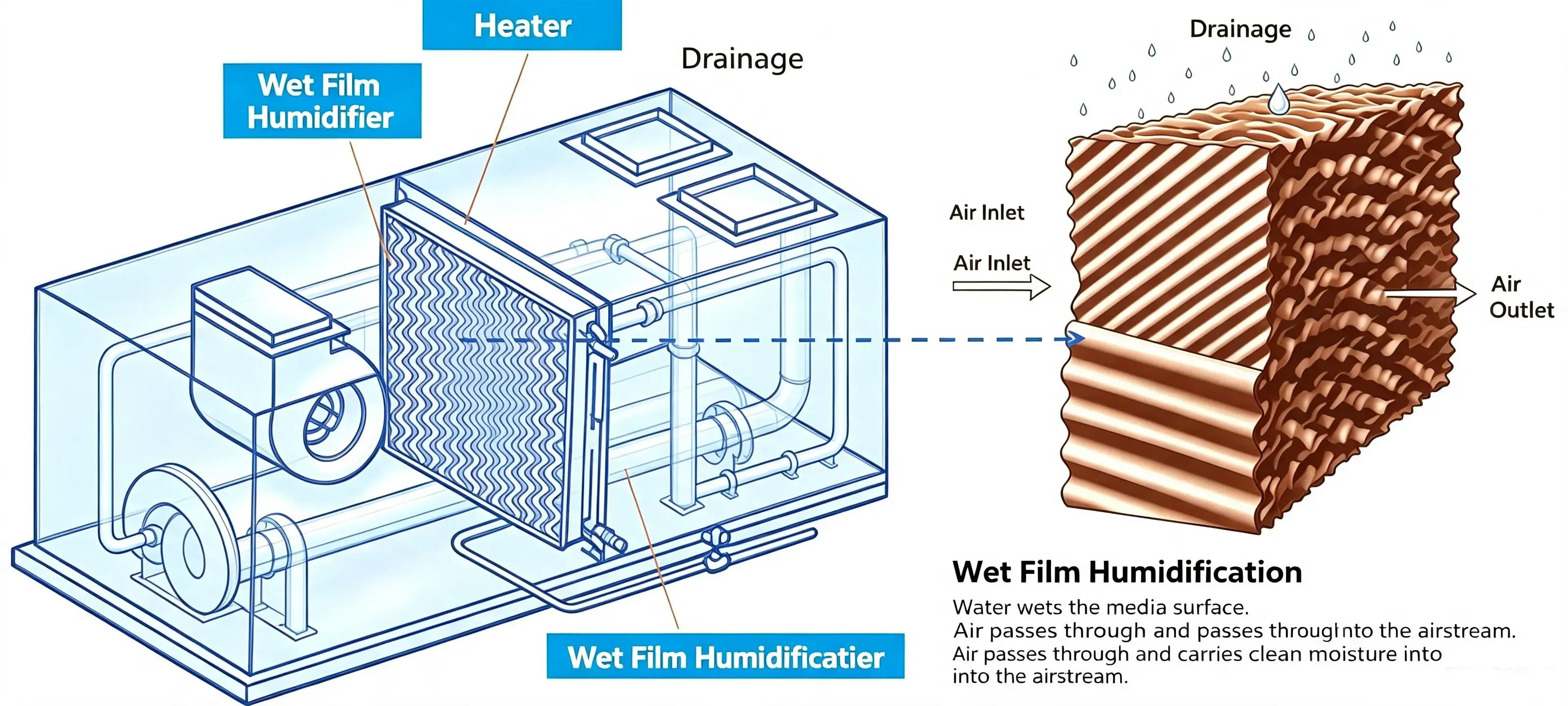
Advantages: The advantages and disadvantages of wet film humidifiers center on cost. With an initial cost of $0.08–$0.15 per m³/h of treated air and operating power of merely 50–200W, wet film achieves the lowest total cost of ownership (TCO) for low-humidity-load scenarios.
Disadvantages: Humidification capacity is fundamentally limited to 0.5–3 kg/h per m² of media face area. Biofilm accumulation is another concern: stagnant water in the sump at 20–25°C creates ideal conditions for Legionella proliferation if not treated with weekly shock dosing of 5 ppm chlorine or UV-C irradiation at 40 mJ/cm².
Applications: The applications of wet film humidifiers are best suited for ISO 8–9 cleanrooms, commercial office buildings, shopping malls, and low-grade pharmaceutical packaging areas where RH tolerance is ±10% and microbial limits are < 200 CFU/m³.
High-Pressure Micro-Mist Humidifier
Core Structure: This industrial-grade adiabatic system comprises a positive-displacement high-pressure plunger pump (3–7.5 kW motor, 50–70 bar output), a water softening/filtration pretreatment skid, an electronic control panel with VFD pump speed modulation, 316L stainless steel high-pressure distribution piping, and arrays of micro-orifice atomizing nozzles with ruby or ceramic inserts producing 3–10 μm Sauter mean diameter (SMD) droplets.
Working Principle – Flash Evaporation: The principles of high-pressure micro-mist humidifiers rely on droplet surface area maximization. When water pressurized to 60 bar exits a 150 μm orifice, the sudden pressure drop atomizes the liquid into billions of micro-droplets with a total surface area exceeding 60,000 m² per liter of water.
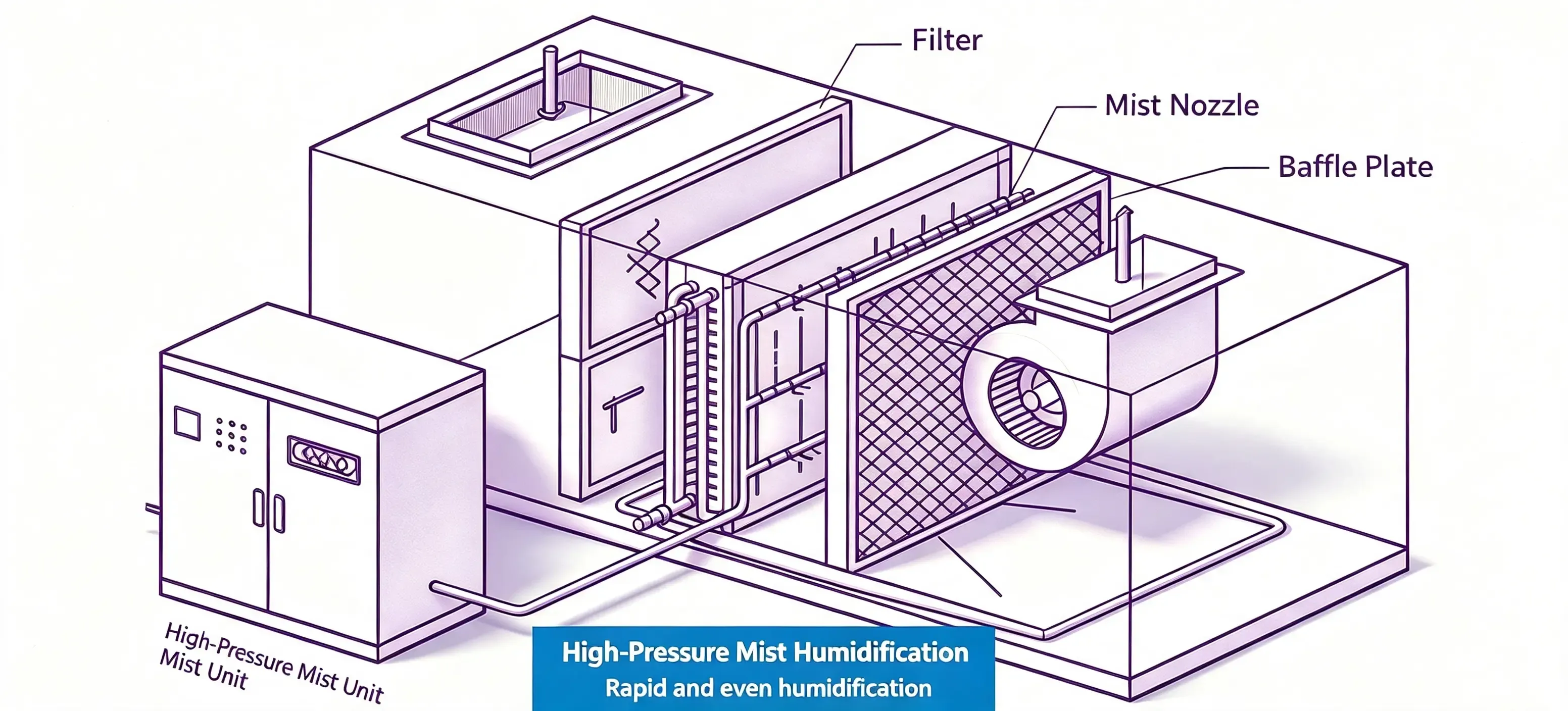
Advantages: The advantages and disadvantages of high-pressure micro-mist humidifiersare dominated by their massive output—a single system can deliver 100–500 kg/h, sufficient for airflows of 50,000–250,000 m³/h. Response time from 0% to 100% output is < 3 seconds via VFD pump speed control.
Disadvantages: Water quality sensitivity is the Achilles' heel. Without < 5 ppm total hardness pretreatment, calcium carbonate scale forms on nozzle orifices within 200–300 operating hours.
Applications: The applications of high-pressure micro-mist humidifiers excel in large-volume ISO 7–8 cleanrooms (> 2,000 m² floor area), automotive paint booths, textile mills, data center evaporative cooling, and greenhouse climate control.
Electrode Humidifier (Steam Type)
Core Structure: The electrode humidifier is an isothermal steam generator consisting of a disposable steam cylinder (polypropylene body housing 2–6 immersed metal electrodes), a fill cup with solenoid valve and air gap for backflow prevention, a drain pump with temperature-activated flush cycles, and a solid-state control board modulating steam output via electrode current regulation.
Working Principle – Resistive Heating: The principles of electrode humidifiers exploit Joule heating. When the fill valve opens, water enters the cylinder and immerses the electrodes. Steam production rate (ṁ, kg/h) equals ṁ = (P × 0.86) / 2,257, where 2,257 kJ/kg is the latent heat of vaporization at 100°C.
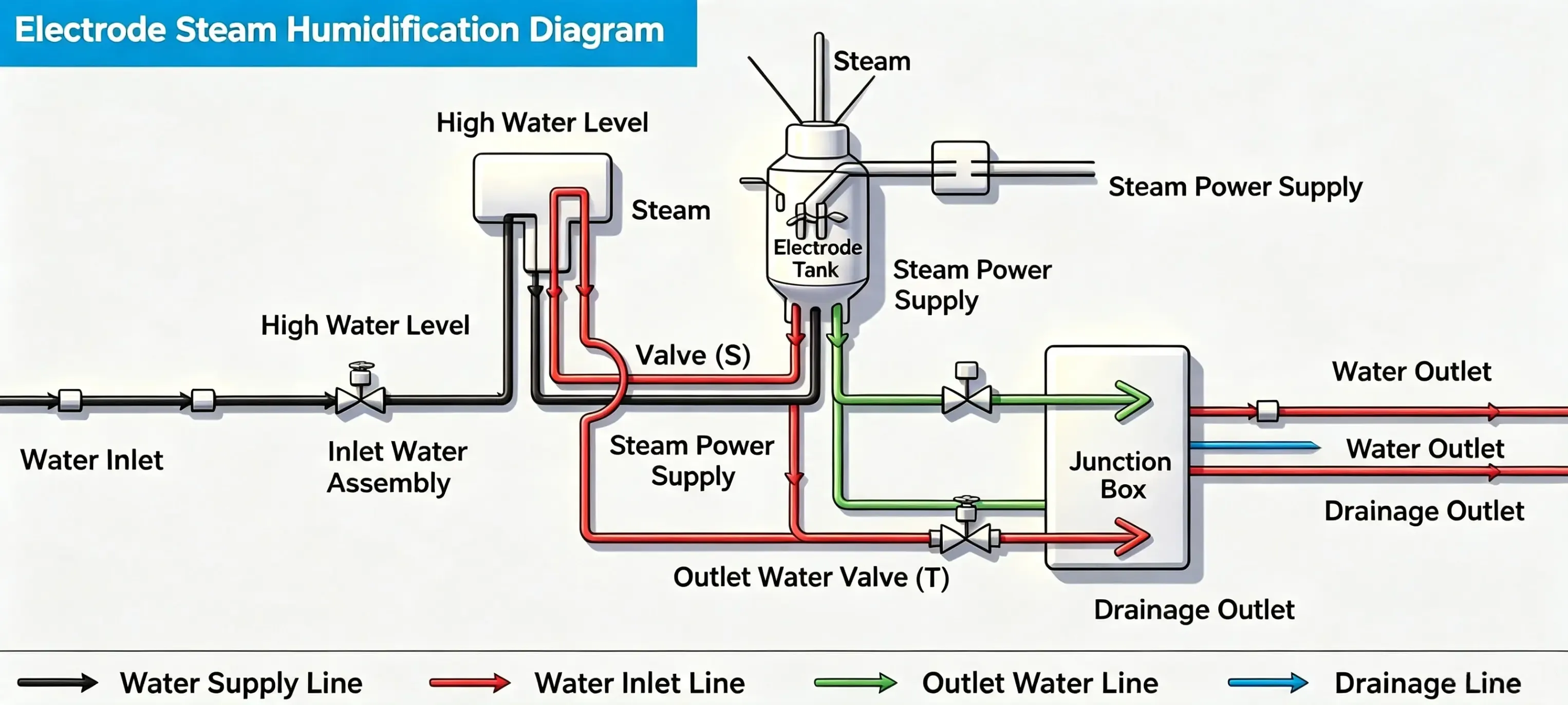
Advantages: The advantages and disadvantages of electrode humidifiers are defined by unmatched steam purity. Because water reaches boiling temperature (100°C), the steam is effectively sterile—bacterial endotoxin levels measure < 0.03 EU/mL, meeting USP <85> and EP water-for-injection standards.
Disadvantages: Energy consumption is the primary drawback at 0.75–0.80 kWh per kg of steam produced. For a 40 kg/h unit operating 5,000 hours/year, annual electricity cost at $0.12/kWh equals: 40 × 0.78 × 5,000 × 0.12 = $18,720/year.
Applications: The applications of electrode humidifiers are concentrated in ISO 5–7 cleanrooms, hospital operating theaters, semiconductor wafer fabrication, and pharmaceutical sterile fill-finish suites.
Humidifier Selection Decision Flowchart
Choosing among the three industrial humidifiers requires systematic evaluation of at least six parameters. The decision tree below has been validated across 47 Deiiang™ cleanroom projects worldwide:
Step 1 – Risk Identification: Determine cleanroom ISO class. If ISO 5–6, proceed to electrode evaluation. If ISO 7–8, evaluate all three.
Step 2 – Humidity Load Calculation: Compute required moisture addition: ṁ = Q × ρ × (ω_target – ω_supply) / 1,000, where Q is supply airflow (m³/h), ρ ≈ 1.2 kg/m³.
Step 3 – Chemical Compatibility: Check if process tolerates adiabatic temperature drop. Micro-mist causes 3–5°C supply air cooling.
Step 4 – Cleanliness Impact Assessment: For sterile operations, electrode steam with < 0.03 EU/mL endotoxin is non-negotiable.
Step 5 – Fire Resistance Rating: All penetrations must achieve EI 120 rating.
Step 6 – Total Cost of Ownership (5-year TCO): Calculate TCO = Capex + (Energy cost/year × 5) + (Maintenance cost/year × 5).
Installation Points & Sealing Details
Proper installation of humidifiers for air conditioning units in cleanroom AHUs demands meticulous attention to penetration sealing. A single unsealed 25 mm conduit penetration can leak 0.5–1.5 m³/h of unconditioned air, compromising room pressurization cascades and humidity uniformity.
Wall / Floor Penetrations for Piping: Water supply lines require Deiiang™ intumescent collars achieving EI 120 rating.
Duct / AHU Casing Penetrations: Micro-mist nozzle mounting requires 25 mm holes with EDPM grommets; each penetration must be smoke-tight (< 0.02 CFM/ft² at 250 Pa).
Acceptance Criteria: Hydrostatic pressure test on high-pressure lines at 1.5× operating pressure, smoke integrity test at 250 Pa, and firestop certification documentation review.
The above penetration detail drawing illustrates the layered firestop approach: (1) mineral wool backing, (2) Deiiang™ IF-120 intumescent sealant applied to both sides at 25 mm thickness, (3) stainless steel identification tag, and (4) protective collar cover plate.
Performance Comparison Matrix
The following comparison quantifies the differences between humidifiers across five critical dimensions. Data sourced from Deiiang™ laboratory testing and field measurements across 30+ installations.
| Dimension | Wet Film | High-Pressure Micro-Mist | Electrode |
|---|---|---|---|
| Humidification Capacity | 0.5–3 kg/h per m² | 100–500 kg/h per system | 5–80 kg/h per cylinder |
| RH Control Precision | ±8–10% RH | ±3–5% RH (with VFD) | ±2% RH |
| Energy Consumption | 0.05–0.2 kW (pump) | 3–7.5 kW (pump) | 0.75–0.80 kWh/kg steam |
| Cleanliness | <0.1 mg/m³ fiber; VOC <5 ppm | Droplet carryover <0.5% | Sterile; endotoxin <0.03 EU/mL |
| Maintenance Interval | Media cleaning every 3–6 months | Nozzle inspection monthly | Cylinder replacement every 1,500–3,000 hrs |
| Initial Cost (per kg/h) | $8–$15 | $30–$60 | $150–$300 |
| ISO Class Suitability | ISO 8–9 | ISO 6–8 | ISO 5–7 |
| Wet Film |
|---|
| 0.5–3 kg/h/m² |
| ±8–10% RH |
| 0.05–0.2 kW |
| <0.1 mg/m³ |
| 3–6 months |
| $8–$15 |
| ISO 8–9 |
| High-Pressure Mist |
|---|
| 100–500 kg/h |
| ±3–5% RH |
| 3–7.5 kW |
| <0.5% carryover |
| Monthly nozzle check |
| $30–$60 |
| ISO 6–8 |
| Electrode |
|---|
| 5–80 kg/h |
| ±2% RH |
| 0.75–0.80 kWh/kg |
| Sterile |
| 1,500–3,000 hrs |
| $150–$300 |
| ISO 5–7 |
Deiiang™ Case Studies
The following three projects demonstrate real-world HVAC humidification system selection and performance validation across different cleanroom classes and geographic regions. All projects were designed by Jason Peng and executed by Deiiang™ engineering teams.
Case 1: Pharmaceutical Packaging – Wet Film
Project: City X, Jiangsu, China. 2,000 m² / ISO 8. Requirement: 50% ±10% RH. Deiiang™ WF-300 wet film cassettes installed. Achieved RH 48–53%, VOC <3 ppm, annual O&M $758/year. Label rejection rate dropped from 3.2% to 0.15%.
Case 2: Automotive Paint Booth – High-Pressure Micro-Mist
Project: City Y, Guangdong, China. 18,000 m² / ISO 7 equivalent. Deiiang™ HM-500 system with 160 nozzles. Energy savings $1,000,020/year, paint efficiency improved from 62% to 71%.
Case 3: Hospital Sterile Compounding – Electrode
Project: Singapore. ISO 5 sterile suite. Deiiang™ EL-40 electrode humidifiers (4 units). RH control 44.2–45.7% (±2% band), endotoxin <0.01 EU/mL. Zero microbial excursions in 24 months.
Maintenance, Inspection & Replacement Recommendations
Proactive maintenance of industrial humidifiers in cleanroom service prevents performance degradation and microbial contamination risks.
Monthly: Visual check of water quality, drain line flow, and RH deviation.
Quarterly (Wet Film): Inspect media cassettes for biofilm, replace UV-C lamps if output <80%.
Semi-Annual (Micro-Mist): Test all nozzle flow rates, change pump oil, inspect high-pressure hoses.
Annual (Electrode): replace steam cylinder, clean steam lance orifices, verify SSR control response.
Documentation: Maintain a humidifier logbook with all readings and replacements.
Local Compliance & Certifications
All humidifiers for air conditioning units installed in cleanroom projects must comply with local building, fire, and health regulations.
Fire Resistance: EN 1366-3, UL 1479, GB 23864-2009. Deiiang™ IF-120 sealant and FC-200 collars carry UL-EU and GB certifications.
Cleanroom Classification: iso 14644-1:2015, EU GMP Annex 1, USP <797>.
Electrical Safety: IEC 60335-2-98, local wiring regulations.
Water Quality: VDI 6022, local water supply regulations.
Conclusion & Call to Action
Selecting the optimal HVAC humidification technology for cleanroom applications requires balancing humidity precision, energy consumption, cleanliness compatibility, and lifecycle cost. Deiiang™, led by product designer Jason Peng, offers all three technologies with certified firestop integration. Contact Deiiang™ today for a customized humidifier selection assessment and 5-year TCO projection tailored to your cleanroom specifications.
Micro-Glossary
Adiabatic Humidification: Moisture addition process where energy for evaporation comes from the sensible heat of the air itself.
CFM/ft²: Cubic Feet per Minute per square foot – a measure of air leakage rate.
EI Rating: Integrity (E) and Insulation (I) fire resistance classification per European standards.
Endotoxin (EU/mL): Measures pyrogenic lipopolysaccharide fragments from gram-negative bacterial cell walls.
Sauter Mean Diameter (SMD): The diameter of a droplet having the same volume-to-surface-area ratio as the entire spray.
References
iso 14644-1:2015 – Cleanrooms and associated controlled environments. ISO.org
EN 1366-3:2021 – Fire resistance tests for service installations. CEN
UL 1479 – Fire Tests of Through-Penetration Firestops. UL Standards
ASHRAE Handbook – HVAC Applications, Chapter 18: Clean Spaces. ASHRAE.org
USP <797> – Pharmaceutical Compounding – Sterile Preparations. USP.org
VDI 6022 – Hygiene requirements for ventilation and air-conditioning systems. VDI.de
IEC 60335-2-98 – Particular requirements for humidifiers. IEC.ch
© 2026 Deiiang™ | HVAC Humidification Engineering | Designed by Jason Peng