+86 13638632902
 Jason@cleanroomequips.com
 MENU
MENU
Freeze-dryer penetration seals are often overlooked when it comes to the material used for cleanroom firestopping and sealing in Bio-pharmaceutical facilities. The role of penetration seals in the overall freeze-dryer validation is quite critical, especially during the OQ/PQ worst-case performance testing, where in addition to temperature changes, also vacuum conditions and CIP/SIP sterilization cycles are tested.
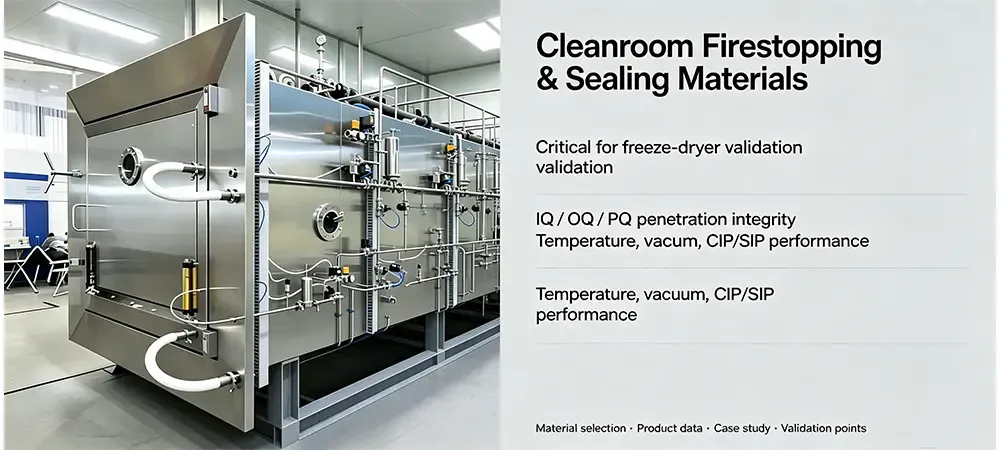
The article provides a very practical approACH to the subject matter of penetration seals in the frame work of freeze-dryer validation. It explains the material selection criteria and provides details of the author’s product Deiiang™. A local case study is also presented which highlights the author’s experience with penetration seals in bio-pharmaceutical facilities.
The article also explains the various validation integration points of penetration seals in overall freeze-dryer validation, which will help the readers to understand the core difficulties of penetration seals in bio-pharmaceutical facilities and also provides practical and compliant solutions to these difficulties.
Common Firestopping & Sealing Materials for Freeze-Dryer cleanrooms
Solutions for firestop material selection for freeze-dryer validation are critical and fundamental to maintaining both fire protection and cleanroom integrity through all phases of the freeze-dryer validation process. One penetration, left un-detected and subsequently un-sealed, can destroy all that has been gained. The following are six common categories of materials used for specifying firestop materials within pharmaceutical freeze-drying facilities. Each addresses a unique problem encountered during the freeze-dryer validation process.
Intumescent Sealant — Expands ≥5× under fire exposure; ideal for cable tray penetrations and pipe sleeves. Fire rating: up to 4 h (EN 1366-3). VOC typically <50 g/L.
Low-VOC Silicone Sealant — Resistant to repeated CIP/SIP chemical washdowns and steam cycles; suitable for wall-to-floor joints near freeze-dryer alcoves. VOC <30 g/L, fire rating up to 2 h.
Mineral Wool / Rock Wool with Metal Edging — Non-combustible (A1 per EN 13501-1), used as backing filler in large annular gaps around vacuum pump exhaust ducts. Always paired with a top-coat sealant.
Firestop Composite Pillows — Removable, re-enterable solution for temporary penetrations during freeze-dryer validation or maintenance. Fire rating: 3 h. Ideal for cable bundles that change between IQ and OQ phases.
Pipe Fire Sleeves / Wraps — Pre-formed intumescent wraps for refrigerant lines and vacuum piping; withstands thermal cycling from -80°C to +150°C without delamination.
Metal insert Strips with Intumescent Core — Used in expansion joints and slab edges near freeze-dryer plinths; rated 2–3 h, minimal smoke emission (<5 m²/s per iso 5659-2).
Deiiang™ Product Data Examples
Deiiang™ fire barriers for pharmaceutical cleanroom environments address several of the recurring problems encountered by users and validators in the freeze-drying process validation for penetration by fire through fire barriers. The information provided below is verified by third party test reports (EN 1366-3, ISO 16000-9) and stock is held locally in key markets. Designer: Jason.peng.
| Product | Fire Rating (h) | VOC (g/L) | Key Feature |
|---|---|---|---|
| Deiiang™ DF-450 Intumescent Sealant | ≤4 h | <40 | Expansion ratio 1:6; syringe-grade for precise annular gap filling |
| Deiiang™ DS-200 Low-VOC Silicone | ≤2 h | <25 | Withstands 200+ CIP steam cycles; Shore A 35 after cure |
| Deiiang™ DP-800 Firestop Pillow | ≤3 h | N/A (solid) | Re-enterable; tool-free removal for OQ sensor re-routing |
Fire Rating: ≤4 h | VOC: <40 g/L
Expansion ratio 1:6; syringe-grade for precise annular gap filling.
Fire Rating: ≤2 h | VOC: <25 g/L
Withstands 200+ CIP steam cycles; Shore A 35 after cure.
Fire Rating: ≤3 h | VOC: N/A (solid)
Re-enterable; tool-free removal for OQ sensor re-routing.
⬆ Third-party certificates (EN 1366-3, ISO 16000-9) and local stock data available upon request.
Installation & Cleanroom Precautions
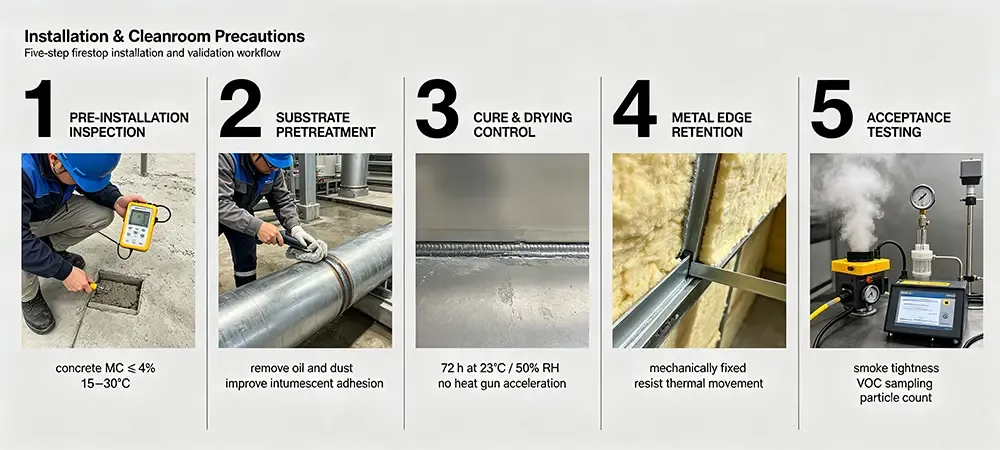
Even the best firestop material will fail if it is not properly installed to meet the requirements of freeze-dryer validation testing. The following tips address specific difficulties encountered during freeze-dryer validation testing such as failed smoke tests and VOC excursions.
Prior to application of sealants a pre-installation inspection shall be conducted to verify that the substrate is dry (concrete MC ≤4%) and ambient temperature is within suitable range (15–30°C).
Substrate pretreatment
Ensure that all cutting oil and dust are removed from metal pipes prior to application. Residual contaminants can decrease intumescent coating adhesion up to 40%.
Cure/drying control
Silicone-based products require 72 hours at 23°C and 50% RH for full cure. Heat guns or other methods used to accelerate cure may void the fire resistance rating of the sealant.
Cavities to be filled/insulated to be sealed out by sealant, e.g. around steel pipes and edges of insulation, must have metal edges retained mechanically. This is particularly important where mineral wool is used in conjunction with a sealant and large thermal movements can occur during defrost of a freeze-dryer.
Acceptance testing of joints
Combination of smoke tightness test (ISO 5925-1) for air tightness, measurement of emissions of VOC (Volatile Organic Compounds) by air sampling (ISO 16000-6) and of particles by particle count test (iso 14644-1) with a minimum classification of Class 5 in order to guarantee that all requirements have been fulfilled before final acceptance.
Core three-step validation logic
① Install a mock-up sample first → ② Run worst-case PQ (max temperature swing + CIP steam exposure) → ③ Integrate into the facility re-validation schedule (annual or after any penetration change).
Localized Case Study: Freeze-Dryer Cleanroom Firestopping
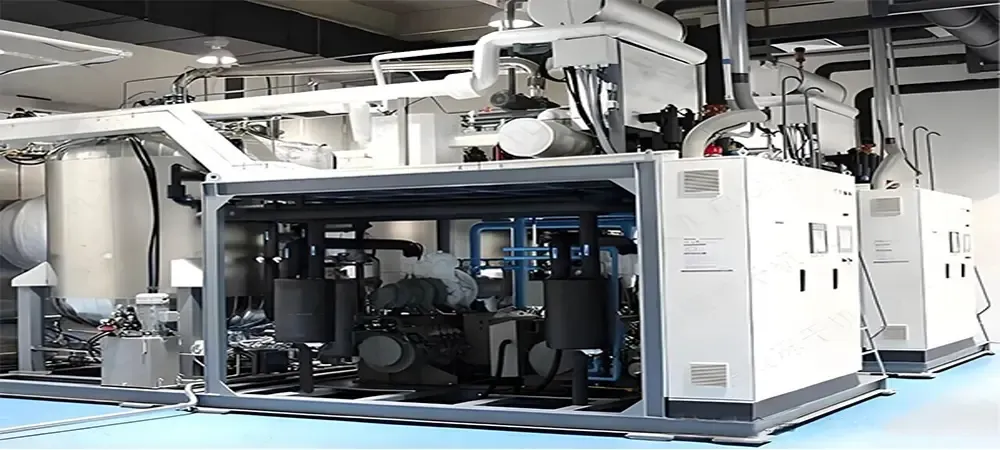
Location: A pharmaceutical campus in Shanghai, China. The facility is an Aseptic freeze-drying suite operating at an ISO 5 / Grade A environment. The core of the problem for the QA team were 12 of 28 wall penetrations around the Freeze-Dryer Validation alcove that failed smoke tightness after 8 months of operation. The GMP re-validation audit for the facility was scheduled around the time the failures occurred.
By CIP temperature cycling, 25°C + 121°C + -40°C over 90 minutes the sealants underwent too much shrinkage. Recommended sealants for this application are DS-200 Low-VOC Silicone for all static joints and the DF-450 Intumescent Sealant for cable tray annular sealings. Total work hours were 18 man hours in 3 shifts. Work was performed without stopping production.
Post work acceptance tests, VOC concentration was <22 µg/m³ while it targeted ≤50. Particle count was 8 particles/m³ and all of them were greater than or equal to 0.5 µm while ISO 5 facilities are limited to 35,000 particles/m³ greater than or equal to 0.5 µm. Smoke tightness tests according to ISO 5925-1 for all wall penetrations were passed 100%. No comments from auditor on fire-barriers. The entire pharmaceutical facility passed the GMP re-validation audit without any fail.
Persona: Who Needs These Solutions
The customer is Mr. Li, the Quality Engineering Manager at a biotech CDMO. He explained the challenges his team was facing for the freeze-dryer validation, specifically the fire-barrier smoke test failures that only happen during the worst-case scenario of the PQ runs and not during the IQ/OQ runs.
He is looking for materials that come with full third-party certificates, has local stock held, and can be delivered within 48 hours. In addition, he needs technical support that understands the GMP validation logic and can help him to close the validation gaps in a single maintenance window.
Deiiang™ can meet all the customer’s requirements as we have local inventory in Shanghai and Guangzhou and a 24-hour response hotline. In addition, we can provide a full certificate package that is pre-mapped to the IQ documentation requirements.
Key IQ/OQ/PQ Validation Points for Firestop Systems
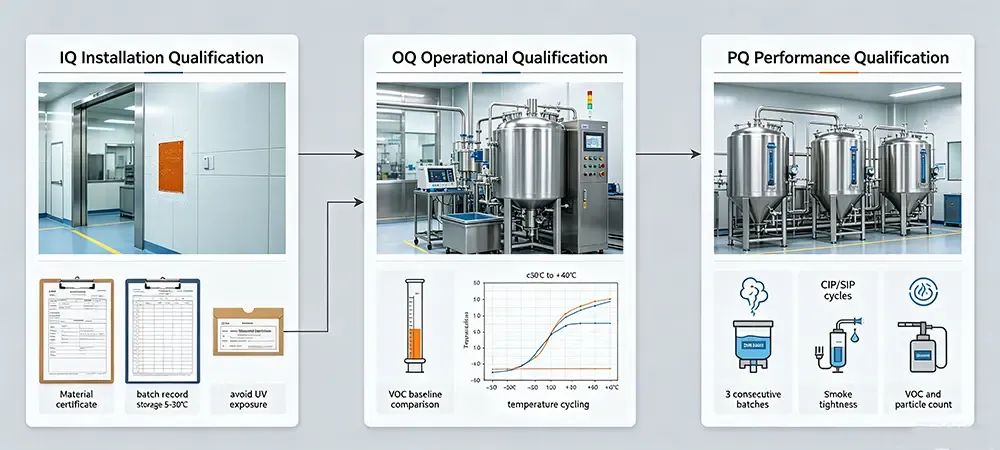
The validation of equipment, such as firestopping, for freeze-dryers follows a similar three-stage process.
IQ: Check the certificates for the firestopping materials, i.e. the written descriptions, the batch numbers and the storage conditions (temperature 5–30°C, not exposed to UV light).
OQ: Is there any evidence of VOC’s from the sealant during empty-chamber behavioral testing, such as VOC’s released from the sealant as the freeze-dryer is cycled from -50°C to +40°C?
PQ: Worst-case situation Full load verification: 3 batches of freeze-drying runs in consecutive order, all CIP/SIP cycles are performed. Verification of smoke tightness, VOC release and of particulate matter in the chamber.
Only a consistent ‘pass’ across all three batches confirms that the solution to the freeze-dryer validation problem is robust.
Micro-Glossary
Intumescent Sealant: A firestop material that expands ≥5× when heated, sealing penetrations against flame and smoke passage.
VOC (Volatile Organic Compounds): Chemical off-gassing measured in µg/m³ or g/L; critical for cleanroom air quality during freeze-dryer operation.
IQ/OQ/PQ: Installation Qualification / Operational Qualification / Performance Qualification—the three-stage validation framework mandated by GMP for equipment and associated barrier systems.
Conclusion & Next Steps
Freeze-dryer validation can be a real challenge and requires a holistic approach. This includes verification of the integrity of the fire barrier in the surrounding cleanroom envelope. Deiiang™ is your partner for the certified materials, a local inventory and 48 hours of technical support you need to close any gaps in the validation of your equipment quickly and efficiently.
✉️ Please include your city and a penetration checklist summary for fastest response.
Product designer: Jason.peng | Deiiang™ Cleanroom Fire Protection Series
References
EN 1366-3: Fire resistance tests for service installations — Penetration seals. CEN Standards
ISO 16000-9: Indoor air — Determination of VOC emission from building products. ISO.org
ISO 14644-1: Cleanrooms and associated controlled environments — Classification of air cleanliness. ISO.org
GMP Annex 1: Manufacture of Sterile Medicinal Products (EU). European Commission
FDA Guidance: Data Integrity and Compliance with Drug CGMP. FDA.gov