+86 13638632902
 Jason@cleanroomequips.com


 MENU
MENUISO 14644-1:2015(EN)
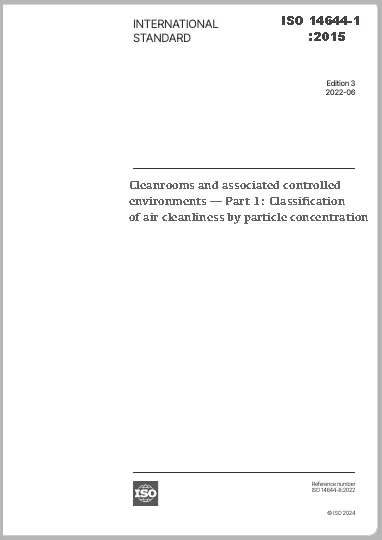
ISO 14644-1 is part of the ISO 14644 series, which sets the standards for cleanrooms and controlled environments. Specifically, ISO 14644-1 defines the classification of air cleanliness in cleanrooms based on the concentration of airborne particles. It specifies different cleanliness levels or "classes," ranging from Class 1 (the cleanest) to Class 9 (the least clean), based on the maximum allowable particle count of particles of 0.5 microns or larger per cubic meter of air. The standard provides detailed requirements for particle concentration levels and categorizes cleanrooms accordingly. The goal of ISO 14644-1 is to ensure that environments such as pharmaceutical manufacturing, semiconductor production, or biotechnology laboratories maintain the necessary levels of cleanliness to prevent contamination and ensure product quality and safety. The classification helps industries monitor and control particulate contamination to meet the needs of their specific applications.

Foreword
The procedures used to develop this document and those intended for its further maintenance are described in the ISO/IEC Directives, Part 1. In particular the different approval criteria needed for the different types of ISO documents should be noted. This document was drafted in accordance with the editorial rules of the ISO/IEC Directives, Part 2 (see www.iso.org/directives).
Attention is drawn to the possibility that some of the elements of this document may be the subject of patent rights. ISO shall not be held responsible for identifying any or all such patent rights. Details of any patent rights identified during the development of the document will be in the Introduction and/or on the ISO list of patent declarations received (see www.iso.org/patents).
Any trade name used in this document is information given for the convenience of users and does not constitute an endorsement.
For an explanation on the meaning of ISO specific terms and expressions related to conformity assessment, as well as information about ISO's adherence to the WTO principles in the Technical Barriers to Trade (TBT) see the following URL: Foreword - Supplementary information
The committee responsible for this document is ISO/TC 209, Cleanrooms and associated controlled environments.
This second edition cancels and replaces the first edition (ISO 14644-1:1999), which has been technically revised throughout.
ISO 14644 consists of the following parts, under the general title Cleanrooms and associated controlled environments:
Part 1: Classification of air cleanliness by particle concentration
Part 2: Monitoring to provide evidence of cleanroom performance related to air cleanliness by particle concentration
Part 3: Test methods
Part 4: Design, construction and start-up
Part 5: Operations
Part 7: Separative devices (clean air hoods, gloveboxes, isolators and mini-environments)
Part 8: Classification of air cleanliness by chemical concentration (ACC)
Part 9: Classification of surface cleanliness by particle concentration
Part 10: Classification of surface cleanliness by chemical concentration
Attention is also drawn to ISO 14698, Cleanrooms and associated controlled environments — Biocontamination control:
Part 1: General principles and methods
Part 2: Evaluation and interpretation of biocontamination data
Introduction
Cleanrooms and associated controlled environments provide for the control of contamination of air and, if appropriate, surfaces, to levels appropriate for accomplishing contamination-sensitive activities. Contamination control can be beneficial for protection of product or process integrity in applications in industries such as aerospace, microelectronics, pharmaceuticals, medical devices, healthcare and food.
This part of ISO 14644 specifies classes of air cleanliness in terms of the number of particles expressed as a concentration in air volume. It also specifies the standard method of testing to determine cleanliness class, including selection of sampling locations.
This edition is the result of a response to an ISO Systematic Review and includes changes in response to user and expert feedback validated by international enquiry. The title has been revised to “Classification of air cleanliness by particle concentration” to be consistent with other parts of ISO 14644. The nine ISO cleanliness classes are retained with minor revisions. Table 1 defines the particle concentration at various particle sizes for the nine integer classes. Table E.1 defines the maximum particle concentration at various particle sizes for intermediate classes. The use of these tables ensures better definition of the appropriate particle-size ranges for the different classes. This part of ISO 14644 retains the macroparticle descriptor concept; however, consideration of nano-scale particles (formerly defined as ultrafine particles) will be addressed in a separate standard.
The most significant change is the adoption of a more consistent statistical approach to the selection and the number of sampling locations; and the evaluation of the data collected. The statistical model is based on adaptation of the hypergeometric sampling model technique, where samples are drawn randomly without replacement from a finite population. The new approach allows each location to be treated independently with at least a 95 % level of confidence that at least 90 % of the cleanroom or clean zone areas will comply with the maximum particle concentration limit for the target class of air cleanliness. No assumptions are made regarding the distribution of the actual particle counts over the area of the cleanroom or clean zone; while in ISO 14644-1:1999 an underlying assumption was that the particle counts follow the same normal distribution across the room, this assumption has now been discarded to allow the sampling to be used in rooms where the particle counts vary in a more complex manner. In the process of revision it has been recognized that the 95 % UCL was neither appropriate nor was applied consistently in ISO 14644-1:1999. The minimum number of sampling locations required has been changed, compared with ISO 14644-1:1999. A reference table, Table A.1, is provided to define the minimum number of sampling locations required based on a practical adaptation of the sampling model technique. An assumption is made that the area immediately surrounding each sampling location has a homogeneous particle concentration. The cleanroom or clean zone area is divided up into a grid of sections of near equal area, whose number is equal to the number of sampling locations derived from Table A.1. A sampling location is placed within each grid section, so as to be representative of that grid section.
It is assumed for practical purposes that the locations are chosen representatively; a “representative” location (see A.4.2) means that features such as cleanroom or clean zone layout, equipment disposition and airflow systems should be considered when selecting sampling locations. Additional sampling locations may be added to the minimum number of sampling locations.
Finally, the annexes have been reordered to improve the logic of this part of ISO 14644 and portions of the content of certain annexes concerning testing and test instruments have been included from ISO 14644-3:2005.
The revised version of this part of ISO 14644 addresses the ≥ 5 µm particle limits for ISO Class 5 in the sterile products annexes of the EU, PIC/S and WHO GMPs by way of an adaptation of the macroparticle concept.
The revised version of this part of ISO 14644 now includes all matters related to classification of air cleanliness by particle concentration. The revised version of ISO 14644-2:2015 now deals exclusively with the monitoring of air cleanliness by particle concentration.
Cleanrooms may also be characterized by attributes in addition to the classification of air cleanliness by particle concentration. Other attributes, such as air cleanliness in terms of chemical concentration, may be monitored and the attribute’s grade or level may be designated along with the classification of the ISO Class of cleanliness. These additional attributes do not suffice alone to classify a cleanroom or clean zone.
FAQ
Q: Which modifications are added in ISO 14644-1?
A: ISO 14644-1 has gone a ton of changes in the 2015 update, especially regarding the cleanroom air cleanliness classification, where the older version lacked the modern methods for particle counting and measurement. The modified version and classification is now focused on modern methods of measurement based on particle counting. The ISO 14644-1 update has also implemented new recommendations for sampling, classification, and new operational conditions. Moreover, the revised version contains clarifications on the relevant requirements, such as air velocity, environmental effects on cleanroom efficiency, temperature, and humidity.
Q: How many particles can be present in ISO 14644-1 cleanroom according to the 2015 version?
A: The term "ISO 14644-1 2015 particle count" refers to different kinds of particles allowed per volume of air for a cleanroom and is explained step by step in the current ISO standard version. In this case, the standard provides different limits for cleanliness classes from Class 1 to Class 9, or if it is ISO Class 7 cleanroom, it means that in this cleanroom the amount of particles of 0.5 microns and larger is equal to 352000 particles per cubic meter of air. This number is very crucial for determining the cleanroom class in terms of air cleanliness rate and can be assessed only with a special and calibrated particle counter.
Q: Is there any temperature recommendation in ISO 14644-1?
A: There is no mandatory temperature requirement in ISO 14644-1, but in the cleanrooms as mentioned in the standard the temperature should be kept at the level that ensures the proper measurement of particles. Temperature and humidity can influence the movement of particles and the efficiency of filtration; therefore, these environmental conditions should be regulated in order to prevent any disturbance in the classification of cleanrooms. Typically, cleanrooms are kept in the temperature range of about 20°C to 22°C (68°F to 72°F), according to the product and process needs.
Q: What is the ISO standard for cleanroom classification?
A: The ISO standard for cleanroom classification is ISO 14644-1, which describes the classification of air purity depending on particle count in the atmosphere. The standard indicates the permitted count of particles depending on their size (for instance, 0.5 microns) per unit of volume of air in every class from Class 1 (the cleanest one) to Class 9 (the dirtiest). ISO 14644-1 provides a method for defining the needed classification of cleanrooms according to their air quality.
Q: What is ISO 14644-1 2015 classification?
A: ISO 14644-1 2015 classification stands for the new version of the document on cleanroom classification based on the airborne concentration of particles. The classification system consists of 9 classes from Class 1 being the cleanest to Class 9 having much contamination with respect to the number of particles per unit of the air volume. Revised in 2015, the version implies the new procedures for measures and provides more exact criteria for the definition of room cleanliness, including the number of particles, their sampling and total air volume.
Q: What is the latest revision of ISO 14644-1?
A: ISO 14644-1 experienced the most recent version in 2015. The new revision implies many crucial changes in cleanroom classification based on airborne particles. The new standards have changed concerning the maximum limit of airborne particles per cubic meter of air.
Q: What are the requirements for ISO 14644-1 Class 8?
A: ISO 14644-1 Class 8 cleanroom requirements imply the requirement for a cleanroom to have a limited amount of airborne particles of 0.5 microns or bigger size. According to Class 8, the number of 0.5-micron particles in 1 cubic meter of air should not be more than 3,520,000. Such class is commonly used when not the highest standards of cleanliness are required, such as some electronic manufacturing sites or some pharmaceuticals. Other factors like air movement, temperature and humidity are also to be controlled to achieve the required results.