+86 13638632902
 Jason@cleanroomequips.com


 MENU
MENUISO 14644-5:2004(EN)
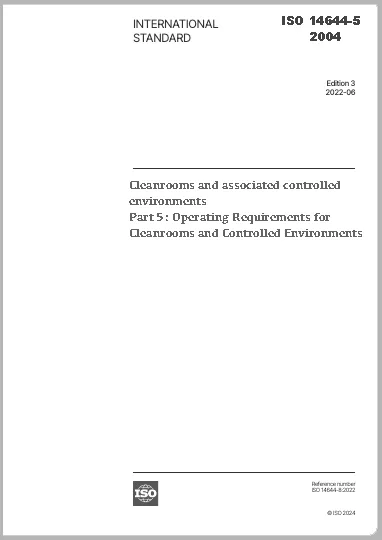
ISO 14644-5 is a part of the ISO 14644 series that provides guidelines for the design, installation, and operational requirements for cleanroom equipment and systems in controlled environments. This standard focuses on the equipment necessary to achieve and maintain the cleanliness standards set in other parts of the ISO 14644 series, particularly regarding air handling systems, monitoring systems, and filtration systems. ISO 14644-5 outlines best practices for selecting, installing, and maintaining equipment such as air filtration units (e.g., HEPA filters), particle counters, and HVAC systems to ensure they perform effectively and maintain the required cleanroom conditions. It also includes recommendations for verifying and calibrating equipment to ensure reliability and accuracy in maintaining air cleanliness, temperature, humidity, and pressure within the cleanroom. The goal of ISO 14644-5 is to support industries like pharmaceuticals, biotechnology, and semiconductor manufacturing in creating and maintaining environments that meet stringent contamination control standards, ensuring the equipment functions optimally throughout the cleanroom's lifecycle.

Foreword
International Standards are drafted in accordance with the rules given in the ISO/IEC Directives, Part 2.
The main task of technical committees is to prepare International Standards. Draft International Standards adopted by the technical committees are circulated to the member bodies for voting. Publication as an International Standard requires approval by at least 75 % of the member bodies casting a vote.
Attention is drawn to the possibility that some of the elements of this document may be the subject of patent rights. ISO shall not be held responsible for identifying any or all such patent rights.
ISO 14644-5 was prepared by Technical Committee ISO/TC 209, Cleanrooms and associated controlled environments.
ISO 14644 consists of the following parts, under the general title Cleanrooms and associated controlled environments:
Part 1: Classification of air cleanliness
Part 2: Specifications for testing and monitoring to prove continued compliance with ISO 14644-1
Part 3: Test methods
Part 4: Design, construction and start-up
Part 5: Operations
Part 7: Separative devices (clean air hoods, gloveboxes, isolators and mini-environments)
Part 8: Classification of airborne molecular contamination
The following part is under preparation:
Part 6: Terms and definitions
Introduction
Industries and organizations of all kinds utilize cleanrooms. Operational procedures have a profound effect on the cleanliness levels achieved during the operation of the cleanroom and equipment. Consistent quality is cleanliness dependent. Operational cleanliness can only be attained and maintained through a deliberate programme established to specify, measure and enforce defined operational procedures. Regulatory agencies that have authority over processes and products produced in the cleanroom may require additional procedures and measures of cleanliness not covered in this general operating standard.
This part of ISO 14644 addresses normative and informative operational requirements related to:
providing a system that defines policies and operational procedures;
clothing used to isolate human-generated contamination from the cleanroom environment;
training of personnel inside the cleanroom and monitoring their compliance to specified procedures and disciplines;
transfer, installation and maintenance of stationary equipment (selection criteria is not discussed);
selection and use of materials and portable equipment in the cleanroom;
maintaining the cleanliness of the cleanroom through systematic cleaning and monitoring procedures.
FAQ
Q: What is the meaning of ISO 14644-5?
A: ISO 14644-5 is a standard that belongs to the ISO 14644 family of standards. It explains the classification, testing, and maintenance requirements for cleanrooms based on environmental conditions and gives special importance to the installation and operation of cleanroom devices such as air treatment systems, HVAC systems, and particle counting devices. This standard includes the requirements for verifying and monitoring cleanrooms to make sure that they are pure and also provides guidelines for maintaining air purity in the clean room environment while taking into account the necessary airflow, temperature of clean room air, and humidity level of clean room air. ISO 14644-5 ensures that the cleanroom has required environmental conditions necessary for conducting clean room activity.
Q: What is the recent version of the ISO 14644?
A: The recent version of ISO 14644 is made of several parts, which include the most recent versions of ISO 14644-1:2015, ISO 14644-2:2015, ISO 14644-3:2019, ISO 14644-4:2018, and ISO 14644-5:2020. These are basically the recent revisions of the cleanroom classification, testing, and monitoring. The ISO 14644-1:2015 describes the criteria for cleanroom classification, the ISO 14644-2:2015 describes cleanroom performance monitoring, the ISO 14644-3:2019 explains the testing methods, the ISO 14644-4:2018 deals with airflow and air change rates, and ISO 14644-5:2020 explains cleanroom equipment and installation of cleanroom equipment.
Q: What is the difference between ISO 4 cleanroom and ISO 5 cleanroom?
A: The difference between ISO 4 cleanroom and ISO 5 cleanroom is that the ISO 4 cleanroom has a much higher level of cleanliness in terms of concentration of airborne particles allowed. ISO 4 has 352 particles of 0.5 microns or larger per cubic meter of air while the ISO 5 cleanroom has 3520 particles of the size. So, ISO 4 cleanroom is multiple times cleaner than the ISO 5 cleanroom making it suitable for some really delicate works, such as manufacturing semiconductors and pharmaceuticals, etc. Also, ISO 4 cleanrooms are used for tasks where there is a critical need to control contamination, while ISO 5 cleanrooms work is less delicate as compared to ISO 4 cleanrooms and so it deals with processes like packaging and assembly of medical devices.
Q: What are the cleanroom standards in accordance with ISO 14644-4?
A: ISO 14644-4 gives the cleanroom standards that cover HVAC systems and airflows in clean rooms. The cleanroom standards include the air change rates, direction of airflow, and clean air distribution, which ensures that the cleanroom environment is devoid of contamination. The developers of the ISO 14644-4 have given cleanroom standards for the design and installation of cleanrooms with the necessary air handling systems in place and associated testing methods for the maintenance of cleanliness levels in cleanrooms. The ISO 14644-4 also explains how other environmental conditions can be monitored, including temperature, humidity, and pressure.
Q: What is the newest version of ISO 14644?
A: The newest version of ISO 14644 contains several revisions, with the current parts of ISO 14644 being the ISO 14644-1:2015, ISO 14644-2:2015, ISO 14644-3:2019, ISO 14644-4:2018, and ISO 14644-5:2020. These revisions outline cleanroom classification, performance monitoring, and cleanroom testing, among other factors. The changes in the different parts of ISO 14644 have been made possible due to the modernization and improvement of cleanroom technology, while ensuring a major shift towards improvement of cleanliness and sustainability in cleanroom environments and practices.