+86 13638632902
 Jason@cleanroomequips.com


 MENU
MENUISO 14644-2:2015(EN)
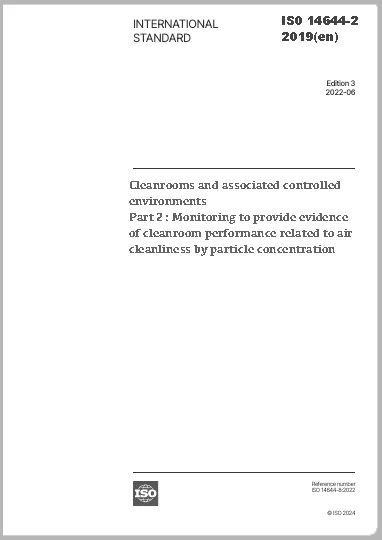
ISO 14644-2 is part of the ISO 14644 series of standards that provides guidelines for monitoring and maintaining the performance of cleanrooms and controlled environments. This standard specifically addresses the requirements for monitoring cleanroom air cleanliness and environmental conditions to ensure that they meet the classification specified in ISO 14644-1. ISO 14644-2 outlines the procedures for ongoing monitoring of particle concentrations, as well as other environmental parameters like temperature, humidity, and pressure. It also specifies the frequency and methods for testing and inspecting cleanrooms to ensure that they continue to meet their designated cleanliness levels throughout their operational life. The standard emphasizes the importance of regular validation, calibration, and data analysis to detect any deviations from cleanliness standards and to maintain the necessary conditions for critical processes in industries such as pharmaceuticals, biotechnology, and electronics manufacturing.

Foreword
ISO (the International Organization for Standardization) is a worldwide federation of national standards bodies (ISO member bodies). The work of preparing International Standards is normally carried out through ISO technical committees. Each member body interested in a subject for which a technical committee has been established has the right to be represented on that committee. International organizations, governmental and non-governmental, in liaison with ISO, also take part in the work. ISO collaborates closely with the International Electrotechnical Commission (IEC) on all matters of electrotechnical standardization.
The procedures used to develop this document and those intended for its further maintenance are described in the ISO/IEC Directives, Part 1. In particular the different approval criteria needed for the different types of ISO documents should be noted. This document was drafted in accordance with the editorial rules of the ISO/IEC Directives, Part 2 (see www.iso.org/directives).
Attention is drawn to the possibility that some of the elements of this document may be the subject of patent rights. ISO shall not be held responsible for identifying any or all such patent rights. Details of any patent rights identified during the development of the document will be in the Introduction and/or on the ISO list of patent declarations received (see www.iso.org/patents).
Any trade name used in this document is information given for the convenience of users and does not constitute an endorsement.
For an explanation on the meaning of ISO specific terms and expressions related to conformity assessment, as well as information about ISO's adherence to the WTO principles in the Technical Barriers to Trade (TBT) see the following URL: Foreword - Supplementary information
The committee responsible for this document is ISO/TC 209, Cleanrooms and associated controlled environments.
This second edition cancels and replaces the first edition (ISO 14644-2:2000), which has been technically revised throughout.
ISO 14644 consists of the following parts, under the general title Cleanrooms and associated controlled environments:
Part 1: Classification of air cleanliness by particle concentration
Part 2: Monitoring to provide evidence of cleanroom performance related to air cleanliness by particle concentration
Part 3: Test methods
Part 4: Design, construction and start-up
Part 5: Operations
Part 7: Separative devices (clean air hoods, gloveboxes, isolators and mini-environments)
Part 8: Classification of air cleanliness by chemical concentration (ACC)
Part 9: Classification of surface cleanliness by particle concentration
Part 10: Classification of surface cleanliness by chemical concentration
Attention is also drawn to ISO 14698, Cleanrooms and associated controlled environments — Bio-contamination control:
Part 1: General principles and methods
Part 2: Evaluation and interpretation of bio-contamination data
Introduction
This revision of ISO 14644-2 emphasizes the need to consider a monitoring strategy in addition to the initial or periodic execution of the classification of a cleanroom or clean zone in accordance with ISO 14644-1:2015, 5.1. The monitoring activity provides a continuing flow of data over time, thereby providing a more detailed view of the performance of the installation.
Potential benefits gained from monitoring are
faster response to adverse events and conditions,
ability to develop trends from data over time,
integration of data from multiple instruments,
enhanced knowledge of installation and process, which allows for more effective risk assessment, and
improved control of operational costs and product losses.
ISO 14644-2 specifies the requirements of a monitoring plan, based on risk assessment of the intended use. The data obtained provide evidence of cleanroom or clean zone performance related to air cleanliness by particle concentration.
In some circumstances, relevant regulatory agencies may impose supplementary policies, requirements or restrictions. In such situations, appropriate adaptations of the monitoring procedures may be required. After a monitoring plan is initially established and implemented, it may be necessary to revise the plan when significant changes are made to the installation or process requirements. It is also prudent to conduct periodic reviews of a monitoring plan based on data obtained and experience in use.
FAQ
Q: What about the guidelines of ISO 14644-2?
A: ISO 14644-2 clarifies how cleanrooms and controlled environments should be monitored and controlled. The standard describes maintenance requirements including whole cleanliness verification processes, which of airborne particles testing should be done and how often, and control of parameters such as airflow, temperature, and humidity in cleanrooms. ISO 14644-2 is supposed to guarantee that cleanrooms keep their classification over time and clarifies main principles of sampling, data recording, and interpretation process.
Q: What are the versions of ISO 14644?
A: The present versions of ISO 14644 are ISO 14644-1:2015 and ISO 14644-2:2015. Both documents are final versions of ISO 14644. The former represents classification of cleanrooms according to airborne particles, while the latter represents some guidelines for cleanrooms monitoring. Both versions are improved and correspond to the present-day principles of cleanroom design, operation, as well as upkeep of values.
Q: Is EN ISO 14644-1 version of ISO 14644-1?
A: Yes, EN ISO 14644-1 marks the European adaptation of ISO 14644-1. The prefix "EN" indicates that the standard is the European one, i.e. it is harmonized with the standards of the ISO organization. It states classification of cleanrooms according to the level of airborne particles concentration corresponding to the aspects in the European union countries characterized by their solutions for cleanrooms in pharmaceutical, electronic, aerospace and other industries regulated by this standard.
Q: What is NF EN ISO 14644-1:2015?
A: NF EN ISO 14644-1:2015 marks the French version of ISO 14644-1:2015 which worldwide recognized standard for cleanroom classification. The letter "NF" describes that this is the French national standard in relevance to cleanroom while "EN" means that it follows EU standards. The 2015 edition of this standard explains the definition of cleanroom classification based on airborne particle number, setting limits to different particles' sizes and respective counting data.
Q: What are ISO 14644-2 guidelines?
A: ISO 14644-2 description includes guidelines, which have to comply with the process of cleanroom monitoring while maintaining their performance. Therefore, this standard remains the basis of processes and conditions of measuring airborne particle concentrations, airflow, relative humidity, and many other environmental factors ensuring cleanroom's compliance with required level of cleanliness in the course of time. In addition, its recommendations are devoted to the frequency of the measurement process and data interpretation.
Q: What is ISO 14644-1:2015?
A: ISO 14644-1:2015 is the updated version of the standards which defines cleanroom classification based on airborne particulate pollution. Therefore, it provides the criteria according to which the classification of cleanrooms can be determined, ranging from Class 1 (the cleanest) to Class 9 (the least clean) according to acceptable quantities of polluting particles of different sizes within one cubic meters of air. This edition emphasizes new techniques of particle counting as well as gives more details about sampling techniques to ensure their correct classification.
Q: What is the newest version of ISO 14644?
A: The newest version of ISO 14644 includes ISO 14644-1:2015 and ISO 14644-2:2015. These revisions are updates of the requirements for cleanroom classification based on airborne particle concentration and certain guidelines for cleanroom monitoring and maintenance respectively. New editions are based on innovations within the cleanroom technology and international best practices in ensuring cleanroom safety and cleanliness.
Q: What is the ISO standard for cleanroom validation?
A: ISO standard for cleanroom validation is ISO 14644-2 which has been designed with the purpose of ensuring that cleanroom conditions follow the requirements of cleanliness level stated in ISO 14644-1. Validation means checking if the cleanroom is ''clean'' in terms of pollution, airflow, relative humidity, pressure, etc. Validation includes regular testing and correction activities.