+86 13638632902
 Jason@cleanroomequips.com


 MENU
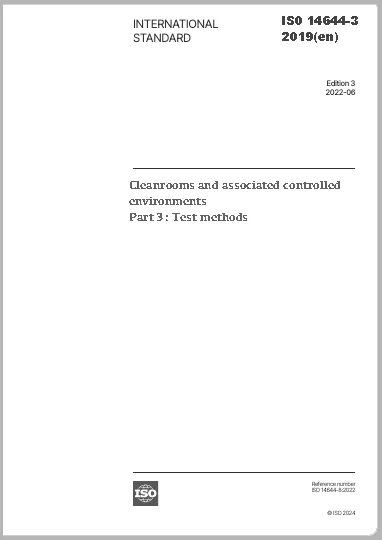
MENUISO 14644-3:2019(EN)
ISO 14644-3 is a standard within the ISO 14644 series that provides **guidelines for testing and evaluating the performance of cleanrooms and controlled environments**. It focuses on the methods and procedures for verifying the air cleanliness levels defined in ISO 14644-1, such as particle concentration and airflow. The standard outlines testing techniques for measuring airborne particles, such as using particle counters, and provides guidelines for the calibration and maintenance of the equipment used in these tests. ISO 14644-3 also includes recommendations for testing environmental conditions like temperature, humidity, and pressure, which can affect cleanroom performance. The goal of this standard is to ensure that cleanrooms are regularly tested to verify that they comply with the necessary cleanliness and operational standards and to ensure they are functioning effectively to meet their intended use, whether in pharmaceuticals, biotechnology, or semiconductor manufacturing. This standard is essential for validating the performance of cleanrooms during initial commissioning and as part of ongoing monitoring and maintenance programs.

Foreword
ISO (the International Organization for Standardization) is a worldwide federation of national standards bodies (ISO member bodies). The work of preparing International Standards is normally carried out through ISO technical committees. Each member body interested in a subject for which a technical committee has been established has the right to be represented on that committee. International organizations, governmental and non-governmental, in liaison with ISO, also take part in the work. ISO collaborates closely with the International Electrotechnical Commission (IEC) on all matters of electrotechnical standardization.
The procedures used to develop this document and those intended for its further maintenance are described in the ISO/IEC Directives, Part 1. In particular, the different approval criteria needed for the different types of ISO documents should be noted. This document was drafted in accordance with the editorial rules of the ISO/IEC Directives, Part 2 (see www.iso.org/directives).
Attention is drawn to the possibility that some of the elements of this document may be the subject of patent rights. ISO shall not be held responsible for identifying any or all such patent rights. Details of any patent rights identified during the development of the document will be in the Introduction and/or on the ISO list of patent declarations received (see www.iso.org/patents).
Any trade name used in this document is information given for the convenience of users and does not constitute an endorsement.
For an explanation of the voluntary nature of standards, the meaning of ISO specific terms and expressions related to conformity assessment, as well as information about ISO's adherence to the World Trade Organization (WTO) principles in the Technical Barriers to Trade (TBT) see www.iso.org/iso/foreword.html.
This document was prepared by ISO/TC 209, Cleanrooms and associated controlled environments.
Any feedback or questions on this document should be directed to the user’s national standards body. A complete listing of these bodies can be found at www.iso.org/members.html.
This second edition of ISO 14644-3 cancels and replaces the first edition (ISO 14644-3:2005), which has been technically revised. The main changes compared to the previous edition are as follows:
Clause B.7 has been simplified and corrected to address concerns over its complexity and noted errors;
guidance concerning classification of air cleanliness by airborne particle concentration has been moved to 14644-1[1]
the text of the whole document has been revised or clarified to aid in application.
A list of all parts in the ISO 14644 series can be found on the ISO website.
This corrected version of ISO 14644-3:2019 incorporates the following corrections:
cross-references have been corrected in Table A.1, B.4.4, C.1, C.4.2 and C.4.3;
the wording has been changed in B.2.1 a), Table B.2;
old Figure B.2 has been removed.
Introduction
Cleanrooms and associated controlled environments provide control of contamination to levels appropriate for accomplishing contamination-sensitive activities. Products and processes that benefit from the control of airborne contamination include those in such industries as aerospace, microelectronics, pharmaceuticals, medical devices, healthcare and food.
This document sets out appropriate test methods for measuring the performance of a cleanroom, a clean zone or an associated controlled environment, including separative devices and controlled zones, together with all associated structures, air treatment systems, services and utilities.
NOTE Not all cleanroom parameter test procedures are shown in this document. The procedure and apparatus for the test carried out for the air cleanliness classes by particle concentration and for macroparticles are provided in ISO 14644-1,[1] and specifications for monitoring air cleanliness by nanoscale particle concentrations are provided in ISO 14644-12.[8] The procedures and apparatus to characterize other parameters, of concern in cleanrooms and clean zones used for specific products or processes, are discussed elsewhere in other documents prepared by ISO/TC 209 [for example, procedures for control and measurement of viable materials (ISO 14698 series), testing cleanroom functionality (ISO 14644-4[3]), and testing of separative devices (ISO 14644-7[4])]. In addition, other standards can be considered to be applicable. Other cleanliness attribute levels can be determined using ISO 14644-8[5] (levels of air cleanliness by chemicals), ISO 14644-9[6] (levels of surface cleanliness by particle concentration) and ISO 14644-10[7] (levels of surface cleanliness by chemical concentration).
FAQ
Q: What does ISO 14644-3 mean?
A: In the ISO14644 category, ISO 14644-3 provides guidelines on how to test and monitor cleanrooms and regulated environments. This means it gives direction on cleanliness tests, sampling methods for airborne particles, ventilation operations, and measuring devices appropriate use. Furthermore, it considers other criteria such as air speed, humidity, and temperature, which contribute to verification of cleanroom conditions indicated in ISO14644-1.
Q: What do ISO 3 cleanroom standards mean?
A: ISO 3 cleanroom standards denote one of the greatest cleanliness levels stated in ISO 14644-1, where air that a cleanroom contains should not exceed 1000 particles of 0.5 micron and bigger in one cubic meter of air. Cleanrooms with such a regulation find application in such sectors as semiconductor manufacture, aerospace, and biotechnology due to the importance of minimal airborne particle contamination. ISO 3 cleanrooms are under constant observation and checking to conform to the cleanliness standards.
Q: What is the latest version of ISO 14644?
A: The latest version of ISO 14644 is represented by ISO 14644-1:2015 and ISO 14644-2:2015. ISO 14644-1:2015 describes how cleanrooms are classified in accordance with airborne particles concentrations, and ISO 14644-2:2015 determines how the cleanroom performance should be monitored. Both revisions correlate with the current practices in the field of cleanroom design and operation to ensure compliance with cleanliness and contamination control standards.
Q: What does ISO 14644-2 mean?
A: In the ISO 14644 series, it gives direction for verifying and monitoring cleanrooms and regulated environments. This means that it describes how to check airborne particles concentration level, air speed, humidity, and other environmental factors that have an impact on cleanliness. In addition to giving guidelines on proper testing methods for cleanroom verification, it also helps with maintaining cleanroom class.
Q: What is the recent version of ISO 14644?
A: The recent version of ISO 14644 is represented by the revisions made in 2015 to ISO 14644:1 and ISO 14644:2. The first version describes how cleanrooms should be classified according to particle concentration, and the second serves as the guideline for monitoring. The two revisions are based on contemporary cleanroom practices of checking and verifying contaminants' impact on environment cleanliness.
Q: What are the ISO cleanroom requirements?
A: ISO cleanroom requirements mainly consist of ISO 14644 standards, which contain requirements for cleanroom design, operation, and maintenance. It includes classification system based on airborne particles count (ISO 14644-1), cleanroom monitoring methods (ISO 14644-2), and effective cleanroom performance evaluation methods (ISO 14644-3). The application of these requirements allows pharmaceutical, electronics, and aerospace industries to effectively cope with contamination issues and ensure necessary cleanliness in cleanrooms.