+86 13638632902
 Jason@cleanroomequips.com


 MENU
MENU
What Are the Benefits of Using a HEPA filter? The Short Answer

What are the benefits of using a HEPA filter? Strip away the jargon and the answer is short: one correctly chosen filter takes out at least 99.97% of airborne particles at 0.3 micron, keeps people and products safe, spares your equipment, and keeps auditors happy. That mix of health value, operational value, and plain financial sense explains why HEPA filtration is still the final barrier of choice in cleanrooms, hospitals, and labs — and why it keeps creeping into homes and offices.
• Captures 99.97% of particles at 0.3 µm (H13, EN 1822) [1]
• Holds iso 14644 cleanroom classes and satisfies GMP Annex 1 [4]
• Cuts filter spend and downtime: 3–5+ year life with F5–F9 pre-filtration [2]
These benefits of using a HEPA filter sort neatly into eight groups: health and allergy relief, contamination control in cleanrooms, less maintenance and downtime, protection for downstream equipment, predictable energy behavior, ISO and GMP compliance, long service life when pre-filtration is handled properly, and a measurable return on investment. We will work through eACH one with real figures, leaning on Deiiang™ cleanroom filter data along the way.
What Are the Benefits of Using a HEPA Filter at a Glance?
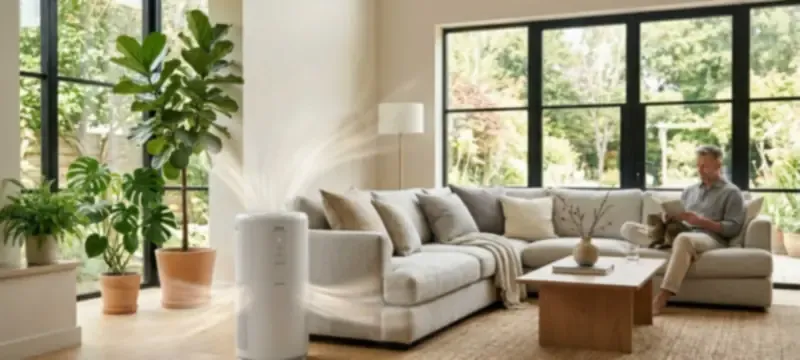
It helps to see the whole picture before diving into any single part of it. The table below lines up the eight benefits of using a HEPA filter, what actually drives each one, and a figure you can verify on site.
| # | Benefit | Mechanism | Typical quantified result |
|---|---|---|---|
| 1 | Health and allergy relief | Mechanical interception, diffusion, impaction | 99.97% of particles at 0.3 µm (H13, EN 1822) [1] |
| 2 | Cleanroom contamination control | Final filtration at supply air terminal | ISO 14644 Class 5–8 air quality maintained [3] |
| 3 | Reduced maintenance and downtime | Dust captured upstream of room and equipment | Fewer cleaning cycles, shorter downtime windows |
| 4 | Protection of downstream equipment | Clean air protects coils, fans, sensors | Lower repair frequency, longer service intervals |
| 5 | Predictable energy behavior | Pressure drop stable when sized to rated airflow | Rated flows from 1,000 to 2,500 m³/h per filter |
| 6 | ISO and GMP compliance | Certified H13/H14 media plus in-situ leak testing | Passes DOP/PAO scan tests per EN 1822 / Annex 1 |
| 7 | Long service life | F5–F9 pre-filters take the dust load | 3–5+ years typical cleanroom service life |
| 8 | Measurable ROI | Lower reject rate, fewer repairs, less downtime | Commonly 1–3 year payback in regulated plants |
| Benefit | Typical result |
|---|---|
| Health and allergy relief | 99.97% @ 0.3 µm (H13) |
| Cleanroom control | Holds ISO 14644 Class 5–8 |
| Less maintenance | Fewer cleaning cycles |
| Equipment protection | Longer service intervals |
| Predictable energy | 1,000–2,500 m³/h rated |
| ISO / GMP compliance | Passes DOP scan tests |
| Long service life | 3–5+ years with pre-filter |
| Measurable ROI | 1–3 year payback |
None of that depends on marketing copy. Every row rests on a rating, a standard, or an operating number someone can measure with a manometer or a particle counter. That testability is precisely what separates a true high efficiency particulate air filter from the "HEPA-like" products that borrow the name.
Health and Allergy Benefits

The benefits of using a HEPA filter people notice first are the physical ones: air that feels different and allergy triggers that stop triggering. Because the media works mechanically — interception, impaction, diffusion — and not through electrostatic charge that fades with age, the efficiency on day one holds through to the last week of service.
Two standard H13 filter cartridges, the workhorses behind most residential and commercial air cleaning. The pleated glass fiber media packs a huge capture area into a small frame, which is why the same basic format scales from a bedside purifier to a cleanroom ceiling.
For allergy sufferers, the practical payoff is a step change in exposure rather than a marginal improvement. Room air cycles through the media again and again, so the allergen load never gets a chance to rebuild between passes.
Fig.1 — Two standard HEPA filter cartridges side by side; the pleated media format used from home purifiers up to cleanroom terminals.
Capturing Allergens at 0.3 Micron
Pollen, dust mite debris, mold spores, and pet dander span roughly 0.3 µm to 10 µm and beyond. HEPA testing centers on the most penetrating particle size, about 0.3 µm, because that is where capture is genuinely difficult. A filter rated 99.97% at 0.3 µm does even better against particles both larger and smaller.
| Allergen | Typical size range | Captured by H13 HEPA? |
|---|---|---|
| Pet dander | 1–10 µm | Yes, >99.97% |
| Pollen | 10–100 µm | Yes, effectively total |
| Dust mite debris | 0.1–10 µm | Yes, 99.97% at MPPS |
| Mold spores | 2–10 µm | Yes, >99.97% |
| Combustion particles | 0.01–1 µm | Yes, 99.97%+ at the 0.3 µm test point |
| Allergen | Size | Captured? |
|---|---|---|
| Pet dander | 1–10 µm | Yes, >99.97% |
| Pollen | 10–100 µm | Effectively total |
| Mite debris | 0.1–10 µm | 99.97% at MPPS |
| Mold spores | 2–10 µm | Yes, >99.97% |
| Combustion PM | 0.01–1 µm | 99.97%+ |
Run the numbers and the exposure story is compelling. A portable purifier rated at 300 m³/h in a 30 m² room with 2.6 m ceilings turns the air over about three times an hour. Each pass leaves a mere 0.03% of the allergen load behind, so the room settles at a small fraction of outdoor levels. Sensitive occupants typically feel the change within days, not weeks.
Respiratory and Cardiometabolic Protection
Particles under 2.5 µm slip past the body's upper defenses, lodge deep in the lungs, and pass into the bloodstream. Years of that exposure adds respiratory and cardiovascular strain. Continuous HEPA filtration lowers the inhaled dose — a difference that matters most for children, older adults, and anyone with asthma.
Not everyone reading this manages a cleanroom, of course. The same H13 media shows up in three very different worlds:
| Setting | Typical product | What users care about most |
|---|---|---|
| Home / office | Portable purifier, HVAC insert | Allergy relief, noise, filter cost |
| Commercial HVAC | Duct-mounted or fan filter unit | Coil protection, pressure drop |
| Cleanroom / pharma | Terminal HEPA with DOP test port | iso class, GMP compliance, audit trail |
| Setting | Top concern |
|---|---|
| Home / office | Allergy relief, noise |
| Commercial HVAC | Coil protection, Δp |
| Cleanroom / pharma | ISO class, GMP audit |
Contamination Control in Cleanrooms
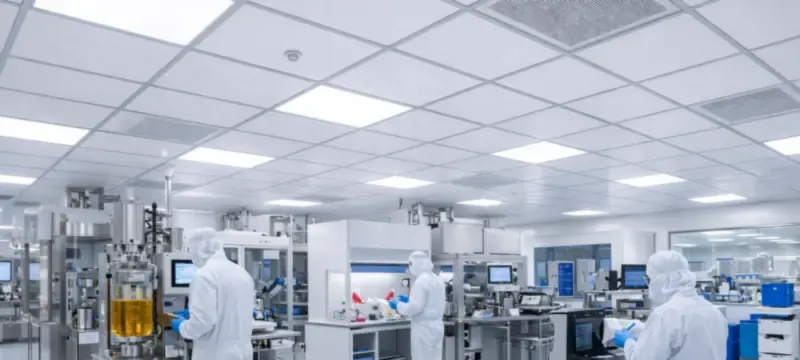
In regulated manufacturing, what are the benefits of using a HEPA filter? The answer here carries a hard commercial edge: without terminal HEPA filtration, an iso 14644 cleanroom cannot hold its class [3]. Every cubic meter of supply air has to arrive essentially particle-free, and only certified H13 or H14 media can promise that.
Holding ISO 14644 cleanliness classes
One 610 × 610 × 120 mm HEPA unit rated at 1,000 m³/h supplies a full air change for a small iso 7 room within minutes. Bigger formats — 1220 × 610 × 120 mm at 1,800 m³/h, or 610 × 610 × 150 mm deep-pleat units at 2,500 m³/h — cover larger zones with fewer installation points.
Efficiency by filter class, alongside the cleanroom grades each one typically serves:
The gap between 99.97% and 99.995% looks like a rounding error until you flip it into penetration. At H13, three particles in every 10,000 get through; at H14, fewer than one. Push 100,000 m³ of air per day through the room and that difference becomes thousands of particles kept away from the process, daily.
Verified Integrity: The DOP Test Port
Fig.2 — Deiiang™ DOP integrated HEPA supply terminal, viewed from below; the built-in test port sits upstream of the media for in-situ PAO/DOP scan testing.
A rating on a datasheet proves nothing about installation. A filter seated badly or a seal nicked during handling will leak unfiltered air, and a 0.1% leak is enough to undermine a Class 5 zone. That is why Deiiang™ DOP integrated filters ship with a built-in test port upstream of the media.
Commissioning teams inject PAO/DOP aerosol and scan the downstream face to confirm zero bypass. For a facility manager, the port converts "trust me" into "test me": what used to be a duct-disassembly project becomes a one-hour annual re-test, in line with GMP expectations.
"It's new, so it must be tight." A fresh filter whose initial pressure drop reads more than 20% above the nameplate value almost certainly has a bypass leak at the gasket or sealant — not dirty media. Scan-test before commissioning, and start with the four corners of the frame. Field crews locate roughly 90% of leaks along the sealant line; the media itself is rarely the culprit.
Protection of Downstream Equipment and Reduced Downtime
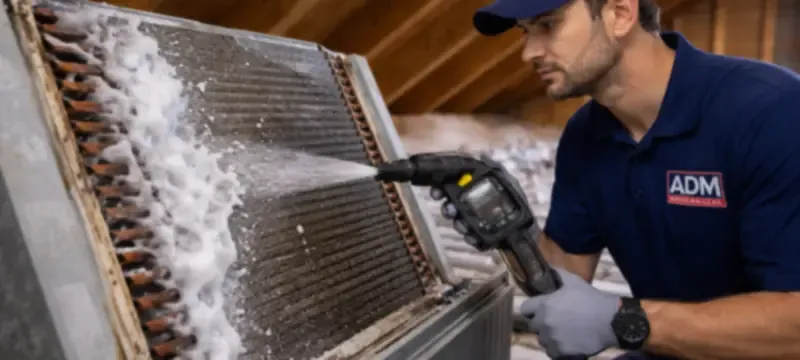
The benefits of using a HEPA filter don't stop with the air people breathe. Everything sitting downstream — fan coils, heat exchangers, sensors, optical instruments, product surfaces — receives the same cleaned air.
Keeping Coils, Fans, and Instruments Clean
Dust on heat exchanger fins slowly strangles heat transfer and pushes fans to work against a pressure penalty of their own making. In electronics and pharma plants, dust on lenses, sensors, and moving stages translates into false readings and micro-scratches. Clean supply air stops the fouling at its source.
Less Maintenance, Fewer Shutdowns
Operators who move to properly sized terminal HEPA filtration tend to report the same pattern:
- Fewer surface-wiping and deep-cleaning cycles
- Longer intervals between coil and duct cleaning
- Fewer particle-count excursions mid-production
- Shorter, more predictable qualification runs
In a mid-size pharma suite, each avoided shutdown can be worth tens of thousands of dollars in lost batch time. Hold that thought — it feeds straight into the ROI discussion below.
Energy and Pressure Drop Considerations
Any honest accounting of the benefits of using a HEPA filter has to confront the energy question. HEPA media adds pressure drop, and pressure drop costs fan power. The saving grace is that the penalty is predictable — and tamed fairly easily with the right selection.
How Much Pressure Drop Does a HEPA Add?
A clean H13 panel generally starts at 200–250 Pa at rated flow and gets replaced somewhere around 450–500 Pa. The trick is to run the filter at, or a touch below, its rated airflow.
The arithmetic is friendlier than it looks: fan power follows P ≈ Q × Δp / (3600 × η). Take a 1,000 m³/h filter at Δp = 250 Pa with fan efficiency at 0.6 — that is roughly 116 W absorbed per filter. Forty such filters running 8,760 hours a year draw about 40,600 kWh. Shave the average pressure drop 20% through oversized media and clean pre-filters, and the bank saves on the order of 8,000 kWh a year.
Fan power per 1,000 m³/h filter (Δp = 250 Pa, η = 0.6)
Same filter running 20% below rated airflow
Pull just 800 m³/h through a 1,000 m³/h-rated 610 × 610 × 120 mm unit and face velocity drops 20%, pressure drop eases by roughly a third, and the media lasts longer because the dust spreads across more area over time.
Matching Filter Size to Airflow
| Format (W × H × D, mm) | Rated airflow (m³/h) | Best suited for |
|---|---|---|
| 610 × 610 × 120 | 1,000 | Small ISO 7 rooms, FFU banks |
| 1170 × 570 × 120 | 1,500 | Long wall modules |
| 1220 × 610 × 120 | 1,800 | Large ceiling grids |
| 610 × 610 × 150 | 2,500 | Deep-pleat, high-flow zones |
| 915 × 610 × 150 | 1,900 | Deep-pleat, medium zones |
| Format (mm) | Flow (m³/h) |
|---|---|
| 610 × 610 × 120 | 1,000 |
| 1170 × 570 × 120 | 1,500 |
| 1220 × 610 × 120 | 1,800 |
| 610 × 610 × 150 | 2,500 |
| 915 × 610 × 150 | 1,900 |
Frame material deserves as much thought as size. Aluminum frames keep weight and cost down for standard HVAC duty; galvanized steel handles heavier industrial service; stainless steel earns its price in corrosive or high-purity pharma environments. All three carry the same certified media pack.
Slight oversizing is a perfectly legitimate tactic: a 150 mm deep-pleat unit carrying 1,500 m³/h sits well below its 2,500 m³/h rating, so pressure drop stays low and service life stretches. Jason.peng, product designer at Deiiang™, recommends this "rate high, run lower" approach for any site running 24/7.
Compliance with ISO and GMP Standards
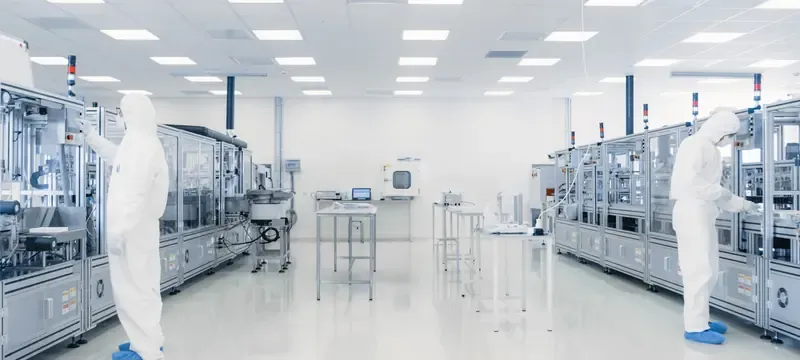
In pharma, biotech, and medical device plants, the benefits of using a HEPA filter include staying in business. EU GMP Annex 1 demands filtered supply air for grade A and B zones, with integrity testing built into qualification [4]. ISO 14644-1 sets the particle limits the filter must hold [3]. EN 1822 and ISO 29463 govern how H13 and H14 classes are tested and labeled [1][2].
Annex 1 also calls for unidirectional airflow of 0.36–0.54 m/s — typically 0.45 m/s — in grade A zones. Read that closely and it is really a face-velocity spec for the HEPA ceiling itself: a fully covered H14 grid delivering filtered air at a steady, uniform velocity is the physical foundation of the laminar zone. Filter choice and airflow compliance are one conversation, not two.
In practice, compliance works like a chain, and every link has to hold:
- Certified media class: H13 (99.97–99.99% at 0.3 µm) or H14 (99.995–99.999%) [1]
- Structural integrity: aluminum, galvanized steel, or stainless steel frames; PU two-part sealant; EVA hot-melt separators
- In-situ leak testing via DOP test port
- Documented airflow and pressure records for audit trails
Seen that way, a filter purchase is also an audit artifact. Picking a supplier who hands over consistent test reports removes a good deal of friction come inspection day.
Longer Service Life with Proper Pre-Filtration
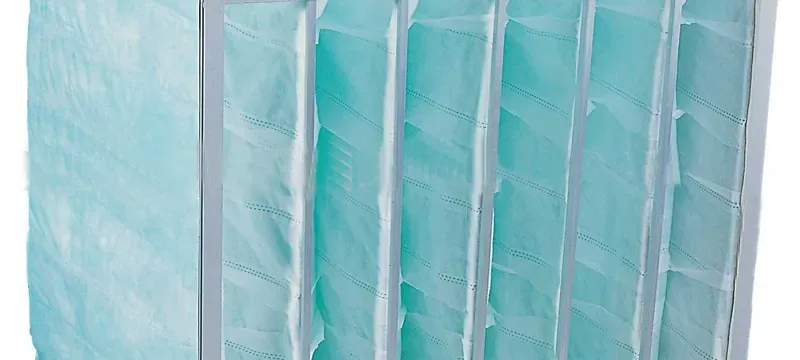
Ask any cleanroom veteran about the fastest way to kill a HEPA filter, and the answer will be the same: feed it raw outside air with no pre-filter. Coarse and fine dust chokes the sub-micron media quickly, pressure drop climbs, and life collapses. The fix, by comparison, is cheap and simple.
Why F5–F9 Pre-Filters Matter
An F7 or F8 bag filter upstream grabs the bulk of the 1–10 µm dust long before it reaches the HEPA layer, leaving the HEPA to handle only what slips past — a small slice of the total load. Bag filters cost a fraction of a HEPA panel and swap out in minutes, so the two-stage arrangement wins on economics every time.
The media pack itself is built to endure when treated with a little respect. Deiiang™ filters pair ultra-fine glass fiber paper with PU two-part polyurethane sealant, EVA hot-melt separators, and a spray-coated diamond-mesh protective screen. The assembly tolerates up to 70 ℃ and 80% relative humidity, so heat and moisture are rarely what retires a filter early. Dust load is.
Deep-pleat formats stretch that endurance further. The extra media depth in a 150 mm cartridge spreads the same dust across more surface, which keeps pressure drop low for years instead of months.
Fig.3 — A deep-pleat HEPA filter cartridge seen from the side; the 150 mm media pack spreads the dust load and holds pressure drop low over long service life.
Deiiang™ medium-effect bag filters (F5–F9 per EN 779) are the usual pairing. A large-format 592 × 592 × 381 mm bag unit handles 2,050 m³/h — a good match for a single terminal HEPA's duty. Across the company's cleanroom projects, terminal HEPA life has stretched from under 2 years without pre-filtration to 3–5+ years behind well-maintained F7/F8 stages.
| Configuration | Typical HEPA life | Relative filter spend |
|---|---|---|
| No pre-filter | 1–2 years | High (frequent HEPA changes) |
| F5/F6 pre-filter | 2–3 years | Medium |
| F7/F8 pre-filter | 3–5+ years | Lowest total cost |
| Configuration | HEPA life |
|---|---|
| No pre-filter | 1–2 years |
| F5/F6 pre-filter | 2–3 years |
| F7/F8 pre-filter | 3–5+ years |
ROI: The Full Cost-of-Ownership Picture
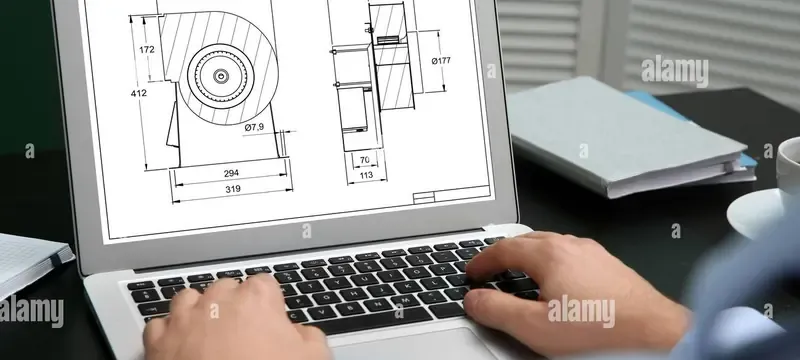
The last item on the list of benefits of using a HEPA filter is the one that wins over the budget holder. Total cost of ownership sets filter spend against everything it avoids: fewer HEPA replacements, less cleaning labor, fewer equipment repairs, fewer batch losses, and lower reject rates.
A Worked Calculation Example
Picture a pharma packaging suite with 20 terminal HEPA units at 1,000 m³/h each. Say a HEPA panel costs 150 USD installed, and pre-filtration runs 30 USD per filter point per year.
- Without pre-filtration: HEPA life of 18 months. Over 5 years: 3.3 change-outs × 20 filters × 150 USD ≈ 10,000 USD, plus three shutdowns at two shifts each.
- With F7/F8 pre-filtration: HEPA life of 4 years. Over 5 years: 1.25 change-outs × 20 × 150 ≈ 3,750 USD, plus about 3,000 USD in pre-filters, and a single shutdown.
- The gap: roughly 3,000–4,000 USD in direct spend, plus two production shutdowns avoided.
5-year filter spend, 20-unit suite (relative)
Same suite behind F7/F8 pre-filters
Then there is the yield side, which usually dwarfs the filter line item. Suppose contamination-driven rejects fall from 0.8% to 0.3% on a line producing 10 million units a year at 5 USD each. That saving is worth about 25,000 USD a year — more than the suite's entire five-year filter budget from the example above, and it is the number most ROI spreadsheets quietly leave out.
Even valuing each avoided shutdown at a conservative 8,000 USD, the pre-filtration strategy repays its cost many times over. The same logic applies to equipment: one prevented coil or instrument repair often tops a full year of filter budget.
"HEPA filters are too expensive for the benefit." Reality: next to downtime, cleaning labor, rejects, and compliance risk, the filter price is a rounding error. Over a 5-year horizon, a properly engineered HEPA system with pre-filtration is usually the cheapest way to hold a cleanroom class.
Checklist: Getting the Full Benefits of Using a HEPA Filter
FAQ
What are the benefits of using a HEPA filter in a cleanroom?
A certified H13 HEPA removes 99.97% of particles at 0.3 µm from the supply air, letting the room hold its ISO 14644 class and meeting GMP Annex 1 requirements for filtered air in grade A/B zones. The DOP test port also makes integrity checks quick.
How does a HEPA filter help with allergies?
It mechanically captures pollen, dust mite debris, pet dander, and mold spores across the 0.3–10 µm range. Recirculating the air repeatedly drives steady-state allergen levels well below typical trigger points.
How do I know when to replace a HEPA filter?
Watch for three triggers: final pressure drop hitting 2–2.5× the clean initial reading, airflow falling below the design minimum, or a failed integrity scan. Whichever arrives first wins — the calendar is not a sensor.
Do HEPA filters really last 5 years or more?
In cleanrooms, yes, when F5–F9 pre-filters protect them and pressure drop is monitored. Service lives of 3–5+ years are routine; without pre-filtration, expect 1–2 years.
Does a HEPA filter increase energy costs?
It adds pressure drop, so fan energy does rise. Run filters at or below rated airflow, though, and the penalty stays modest — about 116 W per 1,000 m³/h filter at 250 Pa — while reduced coil fouling claws some of it back.
What is the difference between H13 and H14 HEPA filters?
Per EN 1822, H13 is 99.97–99.99% efficient at 0.3 µm; H14 reaches 99.995–99.999%. H14 belongs in the most critical zones, such as ISO Class 5 and stricter.
Why does a HEPA filter need a DOP test port?
It lets PAO/DOP aerosol be injected upstream so the installed filter can be scan-tested for bypass leaks without tearing into the ductwork — standard practice for commissioning and GMP requalification.
How do I calculate the ROI of HEPA filtration?
Compare 5-year filter and labor spend with and without pre-filtration, then layer in avoided shutdowns, cleaning labor, equipment repairs, and reject-rate improvements. Most regulated facilities see payback inside 1–3 years.
Can a HEPA filter protect downstream equipment?
Yes. Clean supply air keeps coils, fans, sensors, and instruments free of dust fouling, trimming maintenance frequency and unplanned downtime alike.
References
- EN 1822 — High efficiency air filters (EPMI)
- ISO 29463 — High efficiency filters and filter media
- ISO 14644-1 — Cleanrooms: classification of air cleanliness
- EU GMP Annex 1 — Manufacture of sterile medicinal products
- IEST — Institute of Environmental Sciences and Technology