+86 13638632902
 Jason@cleanroomequips.com


 MENU
MENU
Can HEPA filters remove viruses? Yes — with an asterisk.
Short answer: So, can HEPA filters remove viruses riding on aerosols? Yes — HEPA filters remove viruses that travel on airborne droplets and aerosols, at least 99.97% of particles at their worst-case 0.3 micron size, and better at nearly every other size. What they don't do is kill viruses on contact, shield you from a cough at two feet, or make up for an undersized unit in an oversized room.
ID_QjDJ_rt4
A true HEPA filter takes out at least 99.97% of airborne particles at 0.3 microns [1], and the aerosols that carry viruses sit right in the middle of the size band this media handles best. So far, so simple. The asterisk: a filter captures viruses, it doesn't kill them on contact, it can't do a thing about someone coughing two feet from your face, and it only earns its keep when the airflow through the room is actually sized correctly.
What follows is the physics of how HEPA filters capture viruses well below the rated 0.3 micron size, what H13 and H14 classes really deliver, and where HEPA filters remove viruses for a living — hospitals, cleanrooms, labs — as well as where the method runs out of road. We build and test these filter assemblies every day at Deiiang, so the numbers here come off our production floor and commissioning reports, not off a brochure.
One rule of thumb before we start, because it keeps every claim below honest: an air filter works on the room, not on your body. Hold onto that distinction and the rest falls into place.
True HEPA media is rated at its worst-case particle size — 99.97% at 0.3 microns.
What "Removing a Virus" Actually Means
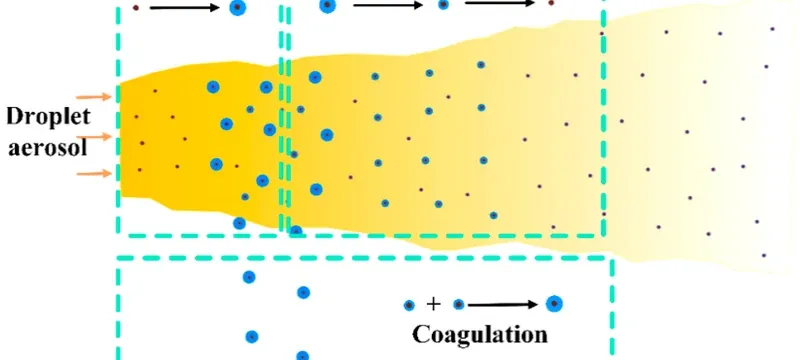
Strip the marketing away and the whole relationship between HEPA filters and viruses comes down to one biological fact: a filter is a mechanical trap. So before asking can HEPA filters remove viruses, ask how viruses actually travel — because HEPA filters capture viruses by catching the aerosol packages they ride in, not by hunting down naked virions one by one.
Viruses Travel Packaged, Not Naked
A virus almost never flies solo. Strip away everything around it and an influenza virion measures roughly 0.08 to 0.12 microns; SARS-CoV-2 about 0.1. But nobody breathes out bare virions. What an infected person expels — breathing, talking, coughing, sneezing — is respiratory droplets: water, salts, mucus proteins, and viral particles embedded in the mix.
The big droplets, anything over about 100 microns, drop to the floor within seconds and rarely travel past two meters. The small ones don't. These are the aerosols, and once they dry down to droplet nuclei they can hang in the air for hours. A 5-micron droplet sheds its water and ends up as a nucleus of 1 micron or less, viral payload still aboard. Sampling studies of exhaled breath have found that most droplet nuclei land somewhere between 0.3 and 5 microns, with a smaller share of ultrafine aerosols below 0.3 microns that can still carry viral RNA [3].
Why does this matter? Because that 0.3–5 micron band is precisely where HEPA filters remove viruses best. So the question "can HEPA filters remove viruses" turns out to be a question about aerosols — and once you see it that way, everything downstream makes more sense.
The Aerosol Size Spectrum
For context, here is how the usual airborne suspects stack up, and whether a HEPA filter catches eACH class. One honest note on the capture column: it's judged purely by where each particle sits relative to the filter's most penetrating size — below, near, or above 0.3 microns — following the efficiency curve we'll unpack in the next section. No special "antiviral" properties involved, whatever the box says.
| Particle / pathogen | Typical size | Naked or attached | HEPA capture |
|---|---|---|---|
| Pollen | 10–100 μm | Free particle | Excellent |
| Dust, skin flakes | 1–100 μm | Free particle | Excellent |
| Bacteria (e.g. TB bacillus) | 0.5–5 μm | Often attached to dust | Excellent |
| Viral droplet nuclei | 0.3–5 μm | Virus inside aerosol | Excellent |
| Tobacco smoke | 0.01–1 μm | Free particle | Very good to excellent |
| Naked virion (influenza, SARS-CoV-2) | 0.06–0.15 μm | Rarely alone in air | Very good to excellent |
| Pollen | 10–100 μm | Free particle | Capture: Excellent |
|---|---|---|---|
| Dust, skin flakes | 1–100 μm | Free particle | Capture: Excellent |
| Bacteria (e.g. TB bacillus) | 0.5–5 μm | Often attached to dust | Capture: Excellent |
| Viral droplet nuclei | 0.3–5 μm | Virus inside aerosol | Capture: Excellent |
| Tobacco smoke | 0.01–1 μm | Free particle | Capture: Very good to excellent |
| Naked virion (influenza, SARS-CoV-2) | 0.06–0.15 μm | Rarely alone in air | Capture: Very good to excellent |
Notice where viral droplet nuclei sit: squarely in the "excellent" band. HEPA filters capture viruses precisely where they actually travel, which is why the size table matters more than any antiviral claim on the packaging.
The stubborn myth here is that 0.3 microns is some kind of cutoff — that anything smaller slips through the mesh. It isn't. 0.3 microns is the most penetrating particle size, or MPPS: the one size where the filter performs worst, and "worst" still means about 99.97% for a true HEPA [1]. Particles bigger than that are caught at higher rates. So are particles smaller than that. Why smaller is easier takes a bit of physics, and it resolves most of the confusion behind whether HEPA filters remove viruses, so it's worth the detour.
The 0.3 μm Question: What MPPS Really Means
Why 0.3 μm Is the Hardest Size to Catch
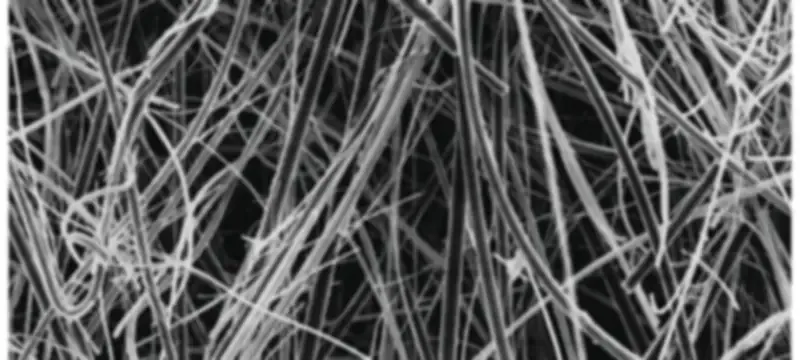
Picture a HEPA filter not as a sieve but as a thick, randomly woven forest of fibers — ultra-fine glass fiber media, individual fibers between 0.5 and 5 microns across, hundreds of layers deep. Air gets pushed through this forest, and particles get stuck by four mechanisms working side by side: inertial impaction throws the big ones into fibers, interception catches mid-size particles that graze one, diffusion makes the tiniest ones wander into fibers, and electrostatic attraction pulls charged particles in. Together, these four explain how HEPA filters capture viruses at every point on the size curve.
Inertia handles the large stuff. A heavy particle moving at speed can't corner with the air as it bends around a fiber — it plows straight ahead, hits the fiber, sticks.
The awkward middle is where things get interesting. A particle around 0.3 to 1 micron is small enough to follow the streamlines around fibers, so impaction misses. It's too big and heavy to bounce around much, so diffusion barely acts on it. And it's physically too small to graze a fiber as it passes, so interception misses too. Every fibrous filter has this dead zone, and in HEPA media it lands at roughly 0.3 microns.
0.3 microns is not a cutoff — it is the most penetrating particle size (MPPS), the filter's single weakest point. When a filter guarantees 99.97% at 0.3 microns, it is quietly promising more than that at every other size [1] [2].
The Four Capture Mechanisms
The complete picture of how HEPA filters remove viruses, dust and everything else rests on four mechanisms:
- Inertial impaction — large, heavy particles deviate from streamlines and collide with fibers.
- Interception — a mid-size particle following a streamline passes close enough that its edge touches the fiber and it sticks.
- Diffusion — very small particles get bombarded by air molecules (Brownian motion) and wander randomly across streamlines, which dramatically raises their odds of hitting a fiber.
- Electrostatic attraction — some media carry a charge that nudges particles toward fibers; glass fiber HEPA leans on the first three.
Measured efficiency across the size range, for a typical true HEPA medium, looks like this — note that the rated 0.3 micron point is the minimum, not the average:
Typical capture efficiency of true HEPA media by particle size; the MPPS dip at 0.3 μm is the rating point.
Why Smaller Particles Are Easier, Not Harder
Now the part that feels wrong until you sit with it: below about 0.3 microns, diffusion takes over completely. A 0.1 micron particle gets shoved around by gas molecules so hard that its path through the filter looks less like a flight path and more like a drunkard stumbling through that fiber forest. Give that stumble several hundred layers of fibers to cross and a collision stops being a matter of luck.
The lab data agrees. Measured penetration curves for HEPA media bottom out at 0.2 to 0.3 microns and climb steeply on both sides. A filter rated 99.97% at MPPS typically does better than 99.99% at 0.1 microns. At 0.05 microns, penetration often drops an order of magnitude below the MPPS value.
So when someone asks whether HEPA filters remove viruses smaller than 0.3 microns, the physicist's answer is that smaller is actually the easy direction. A bare 0.1 micron virion is more likely to be captured than a 0.3 micron particle of the same stuff. In plain terms, HEPA filters capture viruses more easily than the headline rating suggests, because Brownian diffusion runs the show at virion scale.
HEPA Efficiency Classes: H13 and H14 Against Virus Aerosols
Efficiency class decides how well HEPA filters remove viruses in professional settings, and the labels are not all equal. Plenty of products say "HEPA-type" on the box; that word "type" is doing a lot of work. The European EN 1822 standard and its international cousin ISO 29463 define the real classes, and two of them own professional virus-control work [2].
EN 1822 Classes and Real Efficiency
| Class | Efficiency at MPPS | Penetration | Typical application |
|---|---|---|---|
| E10 (approx. "HEPA-type") | ≥ 85% | ≤ 15% | Prefilter stages, low-cost consumer units |
| E11 | ≥ 95% | ≤ 5% | Consumer air purifiers |
| E12 | ≥ 99.5% | ≤ 0.5% | General cleanroom |
| H13 | ≥ 99.95% | ≤ 0.05% | Hospitals, pharma, isolation rooms |
| H14 | ≥ 99.995% | ≤ 0.005% | Surgery suites, labs, semiconductor |
| U15–U17 (ULPA) | ≥ 99.9995%–99.999995% | ≤ 0.000005% | Wafer fabs, atomic research |
| Class | Efficiency at MPPS | Penetration | Typical application |
|---|---|---|---|
| E10 (approx. "HEPA-type") | ≥ 85% | ≤ 15% | Prefilter stages, low-cost consumer units |
| E11 | ≥ 95% | ≤ 5% | Consumer air purifiers |
| E12 | ≥ 99.5% | ≤ 0.5% | General cleanroom |
| H13 | ≥ 99.95% | ≤ 0.05% | Hospitals, pharma, isolation rooms |
| H14 | ≥ 99.995% | ≤ 0.005% | Surgery suites, labs, semiconductor |
| U15–U17 (ULPA) | ≥ 99.9995%–99.999995% | ≤ 0.000005% | Wafer fabs, atomic research |
The American convention calls 99.97% at 0.3 microns "true HEPA," which lands between E12 and H13. For virus-bearing aerosols in healthcare, H13 is where the floor sits; H14 shows up wherever the stakes or the cleanliness spec climb higher.
Deiiang DOP Integrated hepa filter specifications
For professional installations, how the filter is built matters as much as what the media is rated. Our Deiiang DOP Integrated HEPA Filter line is a fair illustration of the specifications that actually matter for virus aerosol control.
The media is ultra-fine glass fiber paper — H13 at 99.95–99.99%, or H14 at 99.995–99.999%, at 0.3 microns — deployed as the terminal filtration stage in cleanrooms and ducted systems. Frames come in aluminum, galvanized steel or stainless steel; the last two earn their keep in hospitals, where disinfectant chemistry and humidity eat ordinary materials alive. The media pack is sealed in with two-component polyurethane, and the gasket is EVA or neoprene, because a filter that leaks at the seal voids its media rating — full stop.
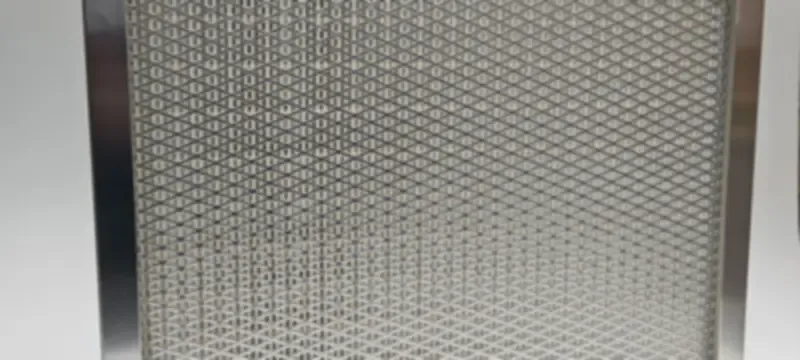
Deep-pleat H13/H14 glass fiber media in an aluminum frame, PU-sealed.
DOP integrated filter — H13 media at 0.3 μm (MPPS)
DOP Integrated Filter — H14 media at 0.3 μm (MPPS)
Airflow ratings run from 1,000 m³/h on a 610 × 610 × 120 mm unit up to 2,500 m³/h on the 610 × 610 × 150 mm deep-pleat version, with the 1170 × 570 × 120 mm at 1,500 m³/h and the 1220 × 610 × 120 mm at 1,800 m³/h in between. Every unit carries a DOP test port for in-situ aerosol challenge testing, so the commissioning engineer verifies the installed assembly — not just a factory claim about loose media. Operating limits are 70°C and 80% relative humidity, which comfortably covers normal HVAC and isolation-room duty.
Two failure modes we keep running into in the field deserve a warning, because both silently destroy the virus-removal performance someone paid for.
Media efficiency is not system efficiency. A consumer unit can carry genuine H13 media and still leak around the cartridge or through the housing. Let just 5% of the air bypass and your H13 is effectively an E12. Professional installations get verified with DOP scans on the installed unit; a card in the box that says "H13" verifies nothing at all.
Sealant shortcuts cause most leaks. In our production QA, the single most common reason a unit fails its final scan is a discontinuous PU seal between the media pack and the frame. It's why the two-component pour and its curing window get documented in our batch records.
One more note from the project files: put an F5–F9 prefilter, something like a medium-effect bag filter, upstream of every HEPA stage. A bag filter at 592 × 592 × 381 mm moving 2,050 m³/h knocks out 70–90% of the particulate mass before it ever reaches the HEPA, and that typically stretches HEPA service life two to three times over in an occupied building. When a facility asks whether HEPA filters remove viruses cost-effectively, prefiltration is the highest-return line on the drawing.
Where HEPA Filtration Is Proven Against Pathogens
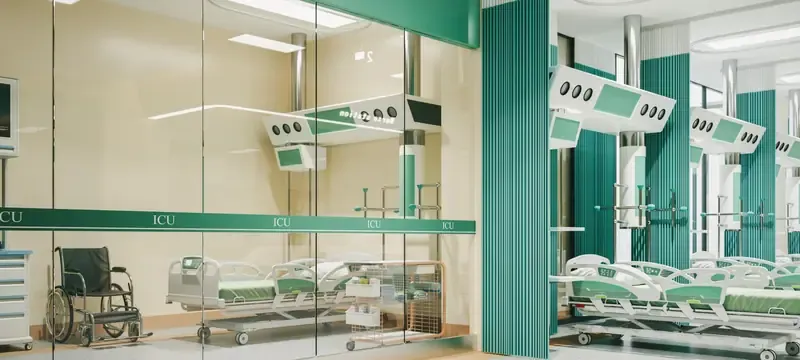
Hospitals and Airborne Infection Isolation Rooms
The clearest field proof that HEPA filters remove viruses at scale is the airborne infection isolation room. CDC guidance for AIIRs asks for at least 12 air changes per hour when air is recirculated, negative pressure against the corridor, and exhausted or HEPA-filtered air [3]. Run the numbers on a 12 ACH negative-pressure room and roughly 99% of airborne contaminants are gone in about 23 minutes; 99.9% in about 35.
Operating rooms are the other textbook case — hospital studies tie HEPA filtration with proper airflow to lower airborne bacterial counts and less surgical site contamination, and plenty of national health facility standards simply require it.
Then came 2020. Hospitals everywhere scrambled to turn ordinary wards into surge isolation capacity using HEPA-filtered negative pressure units and portable HEPA cleaners. It was the largest live test of whether HEPA filters remove viruses at scale — and it held.
A conversion we handled ourselves. Early 2023, a regional hospital in Southeast Asia needed a 28-bed febrile outpatient wing converted to negative-pressure triage inside a three-week shutdown. No dedicated exhaust ducts existed in the building, so a central HVAC retrofit was off the table. We went room-side instead: FFU modules with integrated H13 HEPA filtration, ducted to facade exhaust, sized so each 21 m² exam room — about 57 m³ — got at least 700 m³/h of filtered air. That's roughly 12 ACH, isolation-room grade. We selected the 610 × 610 × 120 mm units rated 1,000 m³/h nominal, throttled to system resistance, and the 1170 × 570 × 120 mm at 1,500 m³/h for the two biggest rooms. The DOP test ports earned their keep here: day-one commissioning scans caught two gasket leaks, both fixed in minutes, and all 34 installed filters finished below 0.01% penetration. The wing passed its ventilation acceptance two days early.
Cleanrooms and Biosafety Laboratories
pharmaceutical cleanrooms lean on the same H13/H14 filters to keep sterile products clean, with terminal HEPA units pushing unidirectional laminar airflow over Grade A filling lines. Biosafety level 3 labs go further and filter both directions — supply and exhaust — because what leaves a containment lab has to be decontaminated first. There, HEPA filters remove viruses and bacteria as an engineered containment barrier, proven by in-situ DOP testing, housed in bag-in/bag-out cabinets so no technician ever touches dirty media.

FFU modules with integrated H13 HEPA filtration, as used in the hospital conversion above.
And at the far end of the scale, semiconductor fabs run ULPA — U15 to U17, efficient down to 0.12 microns — above the wafer lines. A fab doesn't care about virology, but the engineering is identical, and it proves a point: five-nines control of sub-0.3-micron particles is routine industrial practice, not a lab curiosity.
Aircraft Cabins
Nobody thanks the air filter on a flight, which is a shame, because modern airliners push recirculated cabin air through HEPA filters and typically achieve 20 to 30 total air changes per hour, filtered, plus regular fresh-air exchange. If you want a public demonstration of HEPA filters and viruses sharing a sealed space safely, this is it: decades of scheduled airline service show HEPA filters remove viruses from recirculated cabin air at scale. Cabin studies during the pandemic kept finding the same thing: the well-mixed, HEPA-filtered cabin carried less risk than your average office or restaurant. The actual risk sat in close-range, person-to-person contact — not in the filtered air.
What HEPA Filters Cannot Do
Knowing whether HEPA filters remove viruses is only half the answer. The other half is knowing exactly where that ability ends — and the boundaries are sharper than most marketing admits.
Trapped Is Not Dead
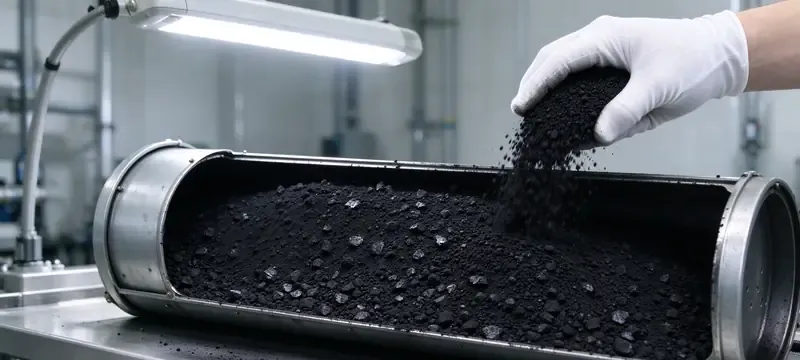
A HEPA filter is a mechanical trap. It is not a sterilizer. HEPA filters capture viruses; they don't neutralize them. Viruses caught in the fiber mat can stay infectious for hours to days, temperature and humidity depending, and researchers have pulled live virus back off used filter media in the lab.
Most of the time that changes nothing. Where it does matter: on high-risk installations — isolation rooms, BSL-3 exhaust — filter changes go through bag-in/bag-out procedures with full PPE, and spent filters from healthcare settings count as potentially infectious waste. At home, it just means changing the purifier filter with the window open, gloves on, if someone in the house was recently sick.
Masks vs HVAC: Source Control vs Air Cleaning
Can HEPA filters remove viruses the way a mask protects you? Not the same job, and mixing the two confuses a lot of buyers. A respirator is personal armor at close range. An air cleaner is room-scale risk reduction. The purifier on your desk does precisely nothing about the plume that reaches your face in the first two seconds of a cough — what it does is quietly strip virus-laden aerosols out of the room between exposures, cutting the total dose you inhale over minutes and hours.
| Protection method | Works at | Time scale | Role | Best for |
|---|---|---|---|---|
| N95/FFP2 respirator | Personal, close range | Instant | Blocks inhaled aerosols at the face | Crowded close-contact settings |
| Surgical mask | Source control + partial personal | Instant | Reduces droplet emission | Everyday source control |
| HEPA air purifier | Whole room | Minutes–hours | Reduces room aerosol concentration | Shared rooms, waiting areas |
| HVAC HEPA filtration | Whole building | Continuous | Dilutes and filters recirculated air | Facilities, clinics |
| N95/FFP2 respirator | Instant | Blocks inhaled aerosols at the face | Best for crowded close-contact settings |
|---|---|---|---|
| Surgical mask | Instant | Reduces droplet emission | Best for everyday source control |
| HEPA air purifier | Minutes–hours | Reduces room aerosol concentration | Best for shared rooms, waiting areas |
| HVAC HEPA filtration | Continuous | Dilutes and filters recirculated air | Best for facilities, clinics |
The honest framing: HEPA air cleaning works alongside masks, vaccination and ventilation. It doesn't replace any of them.
How fast a room actually gets clean is just arithmetic. The fraction removed after time t follows 1 − e^(−ACH × t), with ACH being filtered air changes per hour. Say you have a 40 m² room with 2.7 m ceilings — 108 m³ — and a purifier genuinely delivering 600 m³/h of HEPA-filtered air. That's 600 ÷ 108 ≈ 5.5 ACH. Run the table:
| Target removal | 2 ACH | 4 ACH | 6 ACH | 12 ACH |
|---|---|---|---|---|
| 63% (1 time constant) | 30 min | 15 min | 10 min | 5 min |
| 90% | 69 min | 35 min | 23 min | 12 min |
| 99% | 138 min | 69 min | 46 min | 23 min |
| 99.9% | 207 min | 103 min | 69 min | 34 min |
| 2 ACH | Time to target |
|---|---|
| 63% | 30 min |
| 90% | 69 min |
| 99% | 138 min |
| 99.9% | 207 min |
| 4 ACH | Time to target |
|---|---|
| 63% | 15 min |
| 90% | 35 min |
| 99% | 69 min |
| 99.9% | 103 min |
| 6 ACH | Time to target |
|---|---|
| 63% | 10 min |
| 90% | 23 min |
| 99% | 46 min |
| 99.9% | 69 min |
| 12 ACH | Time to target |
|---|---|
| 63% | 5 min |
| 90% | 12 min |
| 99% | 23 min |
| 99.9% | 34 min |
Two things fall out of that table. First, doubling ACH halves the wait for any target — airflow, not marketing, is what you're buying. Second, no realistic purifier is instant. Even isolation-grade 12 ACH needs about 23 minutes to clear 99%. Real protection, yes. Force field, no.
Ozone, UV and Ionizers: The Add-On Trap
The consumer purifier market has a long habit of bolting dubious gadgets next to a perfectly good HEPA filter, and post-2020 virus fear poured fuel on it.
MYTH
"Ozone generators kill viruses and purify better than HEPA." Ozone does inactivate microorganisms — at concentrations that are themselves a lung hazard. Generators strong enough to actually disinfect are not safe around people, and the EPA says exactly that about ozone generators in occupied rooms [5].
MYTH
"UV-C add-ons make the filter antiviral." UV-C works when the dose, dwell time and lamp cleanliness are right. In a consumer purifier, air crosses the UV chamber in a fraction of a second at a fraction of the dose, and a dusty lamp cuts output further. UV-C has a real job in purpose-built in-duct systems engineered around airflow and dose. As a sticker on a box, it's decoration.
MYTH
"Ionizers make HEPA filters remove viruses better." Ionizers can glue particles together — onto your walls and furniture, not into the filter — and some spit trace ozone while doing it. If a unit leads with ionization as its virus feature, keep walking.
A plain true-HEPA machine with honest airflow for the room beats all three, every time.
Buying Rules: A Practical Checklist
Buying one air purifier or specifying filters for a hospital wing — same rules either way. When a buyer asks can HEPA filters remove viruses in their specific space, this is what separates real virus aerosol control from shelf appeal.
Verify the filter class: insist on H13 (≥ 99.95% at MPPS) or better; treat "HEPA-type" as marketing.
Size by air changes, not floor claims: target 4–6 ACH (12 ACH for isolation-type use) using delivered airflow, not the sticker maximum.
Check the DOP test port: professional terminal filters should be verifiable in situ with aerosol challenge testing.
Demand sealed construction: two-component PU media sealant and EVA or neoprene gaskets; a leaky seal negates the media rating.
Plan prefiltration: F5–F9 bag or panel prefilter upstream to extend HEPA life two- to threefold.
Match frame to environment: aluminum for standard HVAC, galvanized or stainless steel for humid or disinfectant-heavy settings.
Skip ozone, ionizer and "antiviral coating" claims; spend the budget on airflow and media grade instead.
Confirm operating limits: media rated to 70°C and 80% RH covers standard duty; verify specialty media beyond that.
A standard square H13 terminal filter — the workhorse of hospital and Cleanroom HVAC.
If you only keep three things from this article, keep these in order:
1. Media class first — H13 or H14. 2. Airflow second — enough m³/h for your room to hit the ACH target from the table above. 3. Verification third — a DOP test port for anything installed professionally. Get these three right and HEPA filters remove viruses in your rooms at, or above, the rated efficiency. Everything else is garnish.
FAQ
Still have questions about HEPA filters and viruses? These eight answers cover the question "can HEPA filters remove viruses" from every angle, briefly.
Q1: Can HEPA filters remove viruses from the air?
A: Yes. A HEPA filter captures at least 99.97% of particles at 0.3 microns, its hardest size, and virus-carrying aerosols mostly fall in the 0.3–5 micron band where capture is even higher. Studies in hospitals, schools and aircraft confirm meaningful reductions with properly sized HEPA systems.
Q2: If a virus is smaller than 0.3 μm, how can a HEPA filter catch it?
A: Because 0.3 microns is not a cutoff — it is the most penetrating particle size (MPPS), the filter's weakest point. Below that size, Brownian motion makes particles wander across air streamlines and collide with fibers at very high rates. A HEPA filter rated 99.97% at 0.3 microns typically performs above 99.99% at 0.1 microns.
Q3: is hepa better than an N95 or surgical mask for virus protection?
A: They do different jobs. An N95 protects you personally at close range, instantly. A HEPA air cleaner reduces the aerosol concentration of an entire room over minutes to hours. For shared indoor spaces, use both: masks for source control, HEPA filtration to lower the background dose.
Q4: Do HEPA filters kill the viruses they trap?
A: No. A HEPA filter physically captures virus-bearing particles; the trapped viruses may remain viable for some time. That is why healthcare installations use sealed, bag-in/bag-out replacement, and spent filters from high-risk settings are handled as potentially infectious waste.
Q5: Is it safe to change a HEPA filter that has been filtering virus-laden air?
A: With basic precautions, yes. At home, open a window, wear gloves and a mask, and bag the old filter before disposal. In healthcare and laboratory settings, replacement follows bag-in/bag-out procedures with PPE so technicians never touch the loaded media.
Q6: What is the difference between H13 and H14 HEPA filters for virus removal?
A: H13 media must capture at least 99.95% of the most penetrating particle size; H14 must capture at least 99.995%. In penetration terms, H14 lets through ten times fewer particles than H13. H13 is standard for isolation rooms and pharma; an H14 HEPA filter is specified for surgery suites, containment labs and the most critical cleanroom zones.
Q7: Can a HEPA air purifier protect a whole room from airborne viruses?
A: Only if it is sized correctly. Divide delivered airflow by room volume to get air changes per hour; 4–6 ACH gives substantial aerosol removal within roughly an hour, and 12 ACH approaches isolation-room performance. A HEPA purifier too small for the room under-delivers no matter how good its filter is.
Q8: Are ozone, UV or ionizer add-ons useful with HEPA filters for viruses?
A: Generally no. Ozone generators strong enough to disinfect are unsafe in occupied spaces; consumer UV-C chambers deliver too small a dose in too short a dwell time; and ionizers mostly deposit particles on walls, sometimes while generating trace ozone. A plain H13 HEPA unit with adequate airflow outperforms all of them.
Conclusion
Can HEPA filters remove viruses? The physics says yes, without hesitation: H13 and H14 media take out virus-carrying aerosols at 99.95–99.995% efficiency, and sub-0.3-micron capture is even stronger than the headline number, because Brownian diffusion runs the show at virion scale. The field record — isolation rooms, operating theaters, biosafety labs, cleanrooms, aircraft cabins — backs the physics up. In the places it matters most, HEPA filters remove viruses as reliably as any engineered barrier in the building.
The asterisk deserves the last word too. HEPA filtration is room-scale risk reduction, not personal armor and not sterilization. It earns its place next to masks, ventilation and source control; it never replaces them.
Buy by efficiency class and verified airflow, insist on sealed construction and in-situ testability, prefilter to stretch media life, and keep walking past the ozone and ionizer gimmicks. Do that, and HEPA filters remove viruses in your building year after year — one of the very few air-quality investments with decades of lab and field evidence behind it.
References
- EN 1822-1:2019 — High efficiency air filters (EPA, HEPA, UPD) — https://www.en-standard.eu/
- ISO 29463 — High-efficiency filters and filter media for removing particles in air — https://www.iso.org/
- U.S. CDC — Guidelines for Environmental Infection Control in Health-Care Facilities (isolation rooms, 12 ACH) — https://www.cdc.gov/
- ASHRAE Standard 52.2 — Method of Testing General Ventilation Air-Cleaning Devices — https://www.ashrae.org/
- U.S. EPA — Ozone Generators that are Sold as Air Cleaners — https://www.epa.gov/
- U.S. EPA — Air Cleaners HVAC and Filters / room air cleaners — https://www.epa.gov/