+86 13638632902
 Jason@cleanroomequips.com


 MENU
MENU
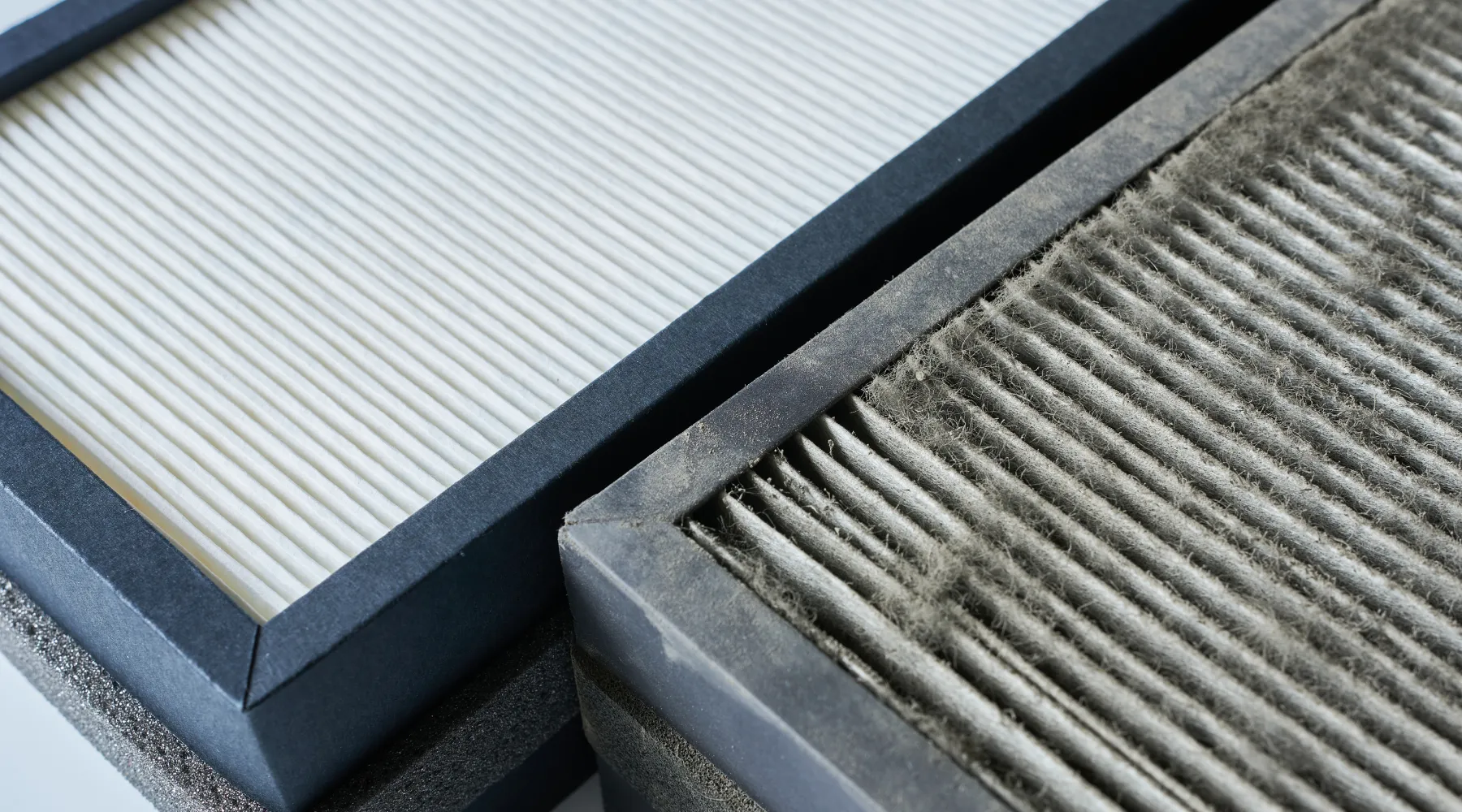
The advice concerning HVAC filter replacement is every 1-3 months. This applies to normal, low-dust buildings, operations, and filtration methods.
Every building is unique, and air filter replacement frequency should be influenced by the efficiency of the HVAC system, the type of filter, and any required pressure drop to collect the particles. Moreover, if the maximum allowable resistance is not met after the specified date, then the frequency must be altered based on recorded air filter performance.
This paper will provide information regarding the need for HVAC filter replacement in detail. It will highlight the HVAC filters' type, address how often to replace HVAC filters, and cover the time intervals required for cleanroom and HEPA filters.
Data will be shared in this paper by Deiiang™, an air filter and cleanroom manufacturer.
What Determines Air Filter Replacement Frequency?
Air filter replacement frequency is based on six separate yet relevant factors, including the type of filter media, the limits specified for it, the amount of contaminants, the number of hours of operation, the capability of the HVAC system, and the level of contamination recorded.
There is no universal calendar answer to how often to change air filter media. A lobby prefilter and a HEPA filter in a semiconductor fabrication facility experience different rates of loading of the filters and will experience consequences from airflow loss.
One approACH for determining your replacement intervals is to conduct a diagnostic procedure. Identify filter type and its rated maximum criterions; record a baseline value for the clean filter pressure drop and airflow; inspect the filter at consistent intervals; compare trends from different cycles; do not adjust schedule unless you can observe a repetitive trend.
The decision map is a tool for thinking. It does not replace the manufacturer's ratings, specifications of the system designer, or particularly relevant measurements for that facility; rather, it is a means of establishing the order in which questions should be asked.
How Do Filter Type and Efficiency Affect Service Life?
Higher efficiency filters typically result in higher initial resistance and capture smaller particles, and yet that alone will not dictate HEPA filter replacement frequency or the life of the filter. Consequently, service life is dependent upon full system information and upstream dust-loading conditions.
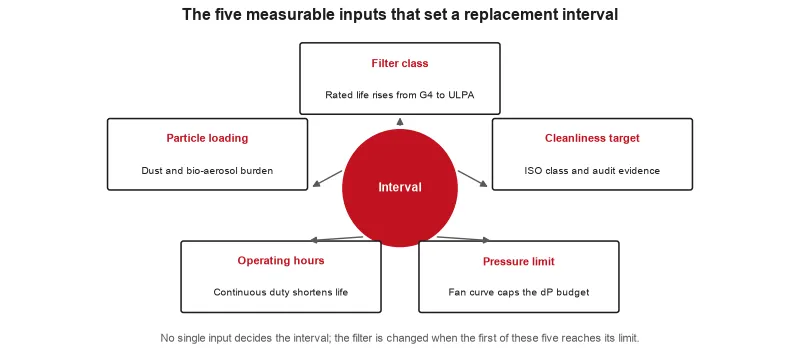
Figure 1: Decision map showing how filter class, particle loading rate, operating hours, the allowable pressure drop and the cleanliness target all feed into a single replacement interval; the mapping is illustrative only and should not be regarded as a given rule.
The same is true for media area, pleat geometry, flowrate per area, hours of operation, and pre-filtration. Thus, HEPA filter replacement frequency can stretch to many years on a filter with a large media area, provided a good pre-filtration system is functioning. Conversely, a small filter in a dusty environment can become clogged in a short amount of time.
Descriptive terms such as "a HEPA filter lasts for years" or "gets clogged in months" are simply examples and do not provide guarantees for various conditions of use. Thus, site data and manufacturers' ratings must be developed before anyone can state how often to change air filter media in a specific installation.
How Do Building Conditions and System Use Change the Interval?
Building conditions dictate particulate loading. A cooking operation yields grease and smoke; a healthcare hot zone deals with biological elements; and a computer room has normal air flow with minimal particles. Every situation dictates filter change frequency.
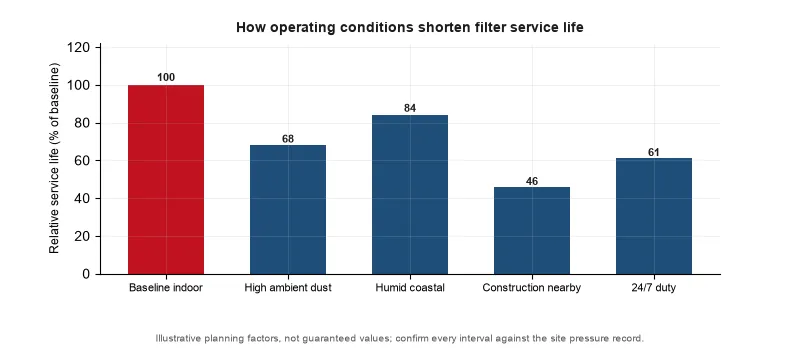
Figure 2: Relative service life by operating condition, with baseline indoor duty indexed at 100. High ambient dust (68), coastal humidity (84), nearby construction work (46) and continuous 24/7 duty (61) all shorten the interval a given filter class delivers. These factors are planning aids, not guaranteed values.
Time of operation is important, but it is not a simple mathematical relationship. 720 hours of use monthly equates to 3 times the usage of 240 hours monthly; that does not mean the loading will go up 3 times.
The example will only hold true if all conditions of concentration, flow, and operation remain the same. If not, one should use operating time as one input and perform pressure drop and air flow trending.
System constraints must also be evaluated. If an air handler cannot overcome increasing static pressure, the filter may need replacing sooner. Check the fan curve. If airflow drops below design minimum, the filter is effectively at its limit even if pressure drop remains below the rated final value.
Typical Replacement Intervals by Filter Type
The table below summarizes common HVAC filter replacement schedule estimates. Treat every time range as illustrative rather than as a standard value. Treat every trigger as conditional on the filter's rated final pressure drop, the system design, and site data.
Do not read the table as a fixed answer to how often to change air filter media. Read it as a set of starting questions. Check each numerical range against the exact filter model's data sheet and the system designer's specifications.
Table 1: Illustrative inspection and replacement planning ranges by filter type; intervals are examples, not standard or guaranteed values.
| Filter type | Typical inspection interval (example) | Replacement trigger | Basis or source |
|---|---|---|---|
| Prefilter, coarse to medium grade | Monthly visual check | Site-selected pressure-drop rise, or loading visible on inspection | Manufacturer guidance; site data takes precedence |
| Medium-efficiency bag or panel filter | Monthly pressure-drop reading | Manufacturer final pressure drop, or airflow below design | Manufacturer rating; site trend data |
| HVAC panel filter, MERV-rated | Monthly visual and pressure-drop check | Manufacturer final pressure drop, or site planning trigger | ASHRAE 52.2 MERV rating [7] |
| High-efficiency HEPA filter | Quarterly inspection of pressure drop and seals | Manufacturer final pressure drop, integrity-test failure, or process requirement | EN 1822 / ISO 29463 ratings [2][3] |
| ULPA filter | Quarterly inspection of pressure drop and seals | Manufacturer final pressure drop, integrity-test failure, or process requirement | EN 1822 / ISO 29463 ratings [2][3] |
| Filter type | Typical inspection interval (example) | Replacement trigger |
|---|---|---|
| Prefilter, coarse to medium grade | Monthly visual check | Site-selected pressure-drop rise, or loading visible on inspection |
| Medium-efficiency bag or panel filter | Monthly pressure-drop reading | Manufacturer final pressure drop, or airflow below design |
| HVAC panel filter, MERV-rated | Monthly visual and pressure-drop check | Manufacturer final pressure drop, or site planning trigger |
| High-efficiency HEPA filter | Quarterly inspection of pressure drop and seals | Manufacturer final pressure drop, integrity-test failure, or process requirement |
| ULPA filter | Quarterly inspection of pressure drop and seals | Manufacturer final pressure drop, integrity-test failure, or process requirement |
What Are Practical Starting Intervals for HVAC and Industrial Filters?
In practice, use a 90-day air filter replacement frequency for general HVAC systems and inspect every month, then modify as required. If filters appear to be heavily loaded after 60 days, it is recommended to reduce the duration of the interval. If they appear to be clean after 90 days, the procedure should be extended after two consistent cycles.
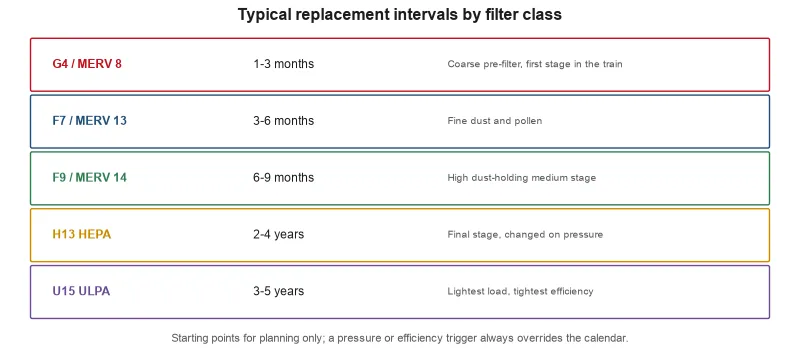
Figure 3: Interval comparison by filter class - the ladder runs from a G4/MERV 8 pre-filter at 1-3 months through F7/MERV 13 at 3-6 months and F9/MERV 14 at 6-9 months to H13 HEPA at 2-4 years and U15 ULPA at 3-5 years. The range is large, so applying any single number to every installation will be wrong in at least some cases.
Given manufacturer's ratings and limits, the Deiiang catalogue contains data required for industrial air filter maintenance as follows. Note, however, that the given values of the specified models are catalogued data and should be verified by product designer Jason.peng against the current revision of the datasheet before use in a specification.
The Deiiang high-efficiency filters (H13/H14) size 592×592×292 mm has the rated volume of 2500 m³/h with the filtration surface of 20.04 m² and the resistance ratings of ≤200 Pa (H13) or ≤220 Pa (H14), with the final resistance indicated in the catalogue at values of 400–600 Pa.
The Deiiang DOP filters of size 610×610×150 mm have also a rated volume of 2500 m³/h and have the initial resistance of ≤200–220 Pa and the final resistance values of 400–600 Pa. They do have a built-in DOP test port on the outlet side which is sealed with a rubber plug.
Deiiang super high efficiency class U15/U16/U17 filters have a size of 610×610×50 mm, a rated air volume of 450 m³/h, a media area of 7.13 m², and the initial resistance of ≤150–170 Pa, with final resistance of 400–600 Pa.
The final resistance value of 400–600 Pa is an advertised catalogued value of all models from Deiiang. It does not mean that it serves as a replacement value per the calculation since each site may establish its own planning trigger; however, it will be a value based on the site's needs instead of the catalogue.
Why Should HEPA Filter Replacement Frequency Be Based on Performance?
In general, the process allows for loading the HEPA filters until the pressure drop reaches a certain level or an integrity test indicates that there is a leak. A purely calendar-based HVAC filter replacement schedule does not only increase costs but also introduces unnecessary risks.
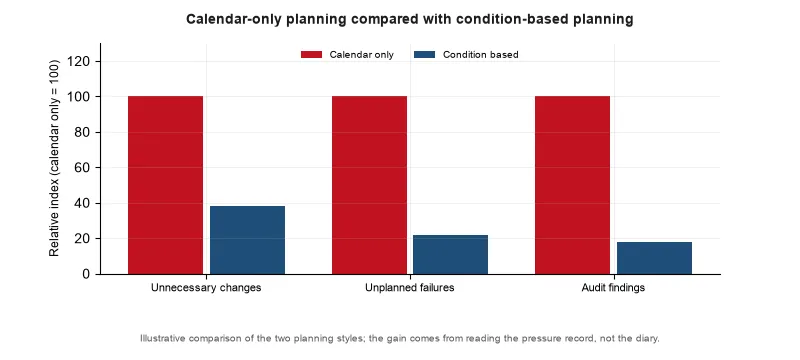
Figure 4: Calendar-only planning indexed against condition-based planning across three outcomes. Unnecessary changes, unplanned failures and audit findings each sit at 100 under a calendar plan, and at 38, 22 and 18 once the pressure record drives the decision. The comparison is illustrative of the two planning styles.
According to the product catalog, the values of performance are indicated as H13 = 99.97%–99.99% and H14 = 99.995%–99.999% at 0.3 µm as well as U15 to U17 values at 0.12 µm. These numbers refer to catalog values.
EN 1822 and ISO 29463 classify filters based on their performance at the most penetrating particle size. Depending on the classification, the functionality of the filters will vary and the requirements will differ. The classification at the most penetrating particle size shall not be equated with the efficiency claim at the defined size of a particular particle without having evidence of the performance of that particular filter.
Therefore, each efficiency statement of every given model of Deiiang filters should be integrated with the corresponding model data. After the provision of the above-mentioned values, make sure to verify the model data and details of the standard design.
To initiate the process of changing the filter, apply the combination of requirements: the pressure drop must be constant, the air must flow as expected, and the integrity test must be positive. Otherwise, the filter is functioning properly and shall be changed when the data permits it.
How to Set an HVAC Filter Replacement Schedule
An air filter change schedule that actually holds up uses both calendar reminders and criteria for condition-based activation. Either one alone cannot do the job.
Calendar-and-condition-based maintenance workflow is demonstrated in the diagram below, where scheduled inspections are done, pressure-drop and airflow checks performed, plus the date of any change is documented.
How Can Teams Build a Reliable Inspection and Change Routine?
Build an air filter change schedule following these simple steps.
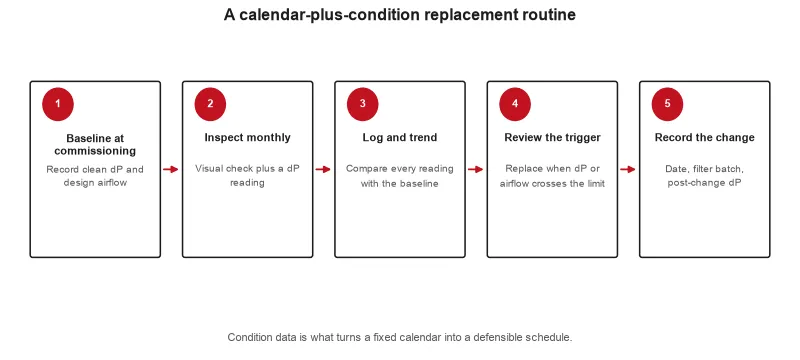
Figure 5: Calendar-and-condition-based maintenance workflow showing scheduled inspections, pressure-drop and airflow checks, and documented change dates; the workflow shown is generic and must be tailored to the site.
Assign one person to perform inspections of all the filter banks in a given month.
Record date, pressure drop, measurable airflow, and visual inspection.
Compare all the readings obtained to the clean-filter baseline and the last pressure drop for the filter as rated by the manufacturer.
replace filters when a site planning trigger has been reached or even sooner when the airflow drops below a predetermined design level.
Document filter change information such as date and part number used.
Review the filtration log quarterly and make changes to intervals when two consecutive cycles show consistent results.
Which Operating Records Help Refine the Schedule?
Log the pressure drop trends of each filter bank on a monthly basis.
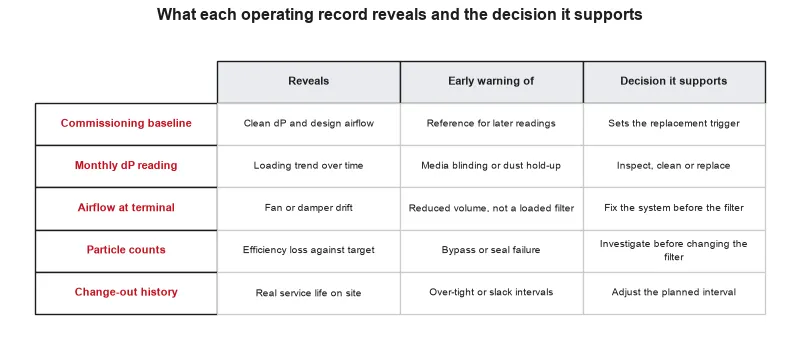
Figure 6: What each operating record reveals. The commissioning baseline, monthly pressure reading, terminal airflow, particle counts and change-out history each support one specific scheduling decision, from setting the replacement trigger to adjusting the planned interval.
Log the fan energy consumption before and after a filter change has taken place, subject to metering.
Log the downstream particle counts of the HEPA filters as the quality system requires.
Log changes in production or occupancy which can affect the loading of the filters.
Log filter part numbers and relevant information about pressure drop.
Once twelve months have passed, you will notice some trends and patterns. If a filter reaches its planning trigger at an average of four months, set the HVAC filter replacement schedule to four months instead for future filter changes.
How to Use Pressure Drop and Performance Data
Pressure drop is one of the most reliable routine indicators for determining when to change air filters. The pressure drop across a filter in its clean state is known. As the filter becomes loaded, the pressure drop increases. The final pressure drop specified by the manufacturer determines the operating limits.
Once the baseline has been established, the reading after the Deiiang H13 combined high-efficiency filter must be equal to or less than 200 Pa; for the H14 it must be less than or equal to 220 Pa. It is necessary to record the actual reading because this may not equal the catalogue maximum.
How Should Pressure Drop Guide a Replacement Decision?
The manufacturer or designer determines the operational limits of airflow, fan capability, and process requirements, but filters remaining in the pressure drop limits may not be acceptable if airflow conditions are less than design.
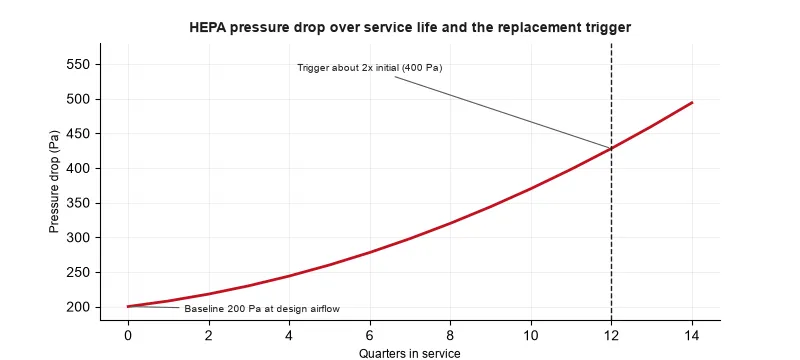
Figure 7: Pressure drop trend over time with a replacement trigger drawn at about twice the initial pressure drop; the planning trigger used is just an example of how to use a planning trigger, and it is not used by all manufacturers.
Some users set their planning trigger based on a pressure drop limit of about 80 percent so that the actual change out is performed before the limit is reached. This is an example of a planning trigger and not an industry standard. Please do not misrepresent it as an established threshold.
If you choose to use a trigger such as this, please reflect the trigger accurately. The following calculation gives the percentage of the specified pressure drop limit that has been reached; it is not a physical measurement showing that dust loading has taken place.
(Current pressure drop − Initial pressure drop) ÷ (Specified final pressure drop − Initial pressure drop) × 100 = Percentage of specified increase achieved.
Example: (320 − 180) ÷ (400 − 180) × 100 = 64 percent. It simply indicates the level of pressure drop has gone through almost two-thirds of the rise but does not mention anything specific about how many grams of dust are being preserved.
Not to be replaced until the pressure drop reaches the required value set by the manufacturer, unless airflow has gone below the minimum required for design purposes, or if there are any signs of damage or moisture in the filter.
What Other Measurements Confirm Filter Performance?
Different measurements serve different purposes, and they cannot be substituted for one another.
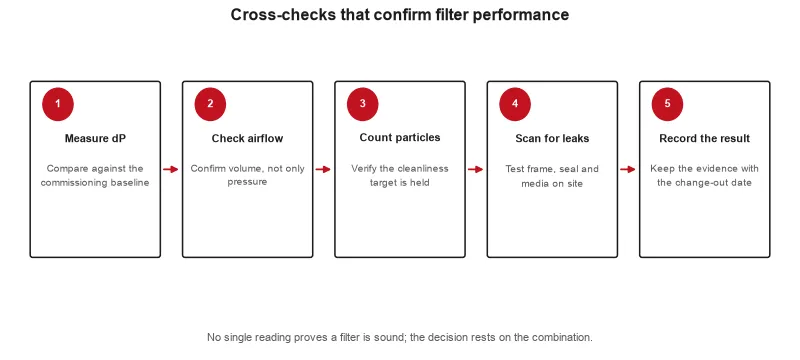
Figure 8: Cross-checks that confirm filter performance - differential pressure against the baseline, airflow at the terminal, particle counts against the cleanliness target, a leak scan of frame and media, and a written record of the result. No single reading proves a filter is sound.
The room particle count shows if the cleanroom is fit for a particular classification but does not in itself prove that the filter is whole or leaking.
Airflow tests provide confirmation that the system is supplying the design air volume through the filter and that the resistance has not increased to the point where the fan is unable to function.
A testing procedure for filter integrity involves an aerosol challenge and scan test. The test specifies which aerosol and method of choice based on project requirements [3][5].
Not every installation needs to use the same testing procedure at the same frequency. The specific requirements will depend on the quality control plan and the specific project.
Cleanroom Air Filter Replacement Planning
Cleanroom air filter replacement is regarded as a process change instead of routine maintenance. Replacements should be based on the quality control system, applicable regulations, and validated procedures.
This information is derived from the facility's own monitoring program and change control procedures.
Table 2: A sample of the cleanroom filter surveillance plan; the frequencies used are simply examples and should subsequently be replaced by the validated plan for the facility.
| Cleanroom area | Monitoring evidence (example) | Replacement consideration | Post-change verification |
|---|---|---|---|
| Critical iso 5 zone | Continuous or frequent particle monitoring per site plan | Trend deviation, integrity test failure, or predefined limit | According to facility change control and validated procedure |
| ISO 6 zone | Routine particle monitoring per site plan | Trend deviation, integrity test failure, or predefined limit | According to facility change control and validated procedure |
| ISO 7 zone | Routine particle monitoring per site plan | Trend deviation, integrity test failure, or predefined limit | According to facility change control and validated procedure |
| iso 8 zone | Periodic particle monitoring per site plan | Scheduled review, product defect, or predefined limit | According to facility change control and validated procedure |
| Cleanroom area | Monitoring evidence (example) | Replacement consideration |
|---|---|---|
| Critical ISO 5 zone | Continuous or frequent particle monitoring per site plan | Trend deviation, integrity test failure, or predefined limit |
| ISO 6 zone | Routine particle monitoring per site plan | Trend deviation, integrity test failure, or predefined limit |
| ISO 7 zone | Routine particle monitoring per site plan | Trend deviation, integrity test failure, or predefined limit |
| ISO 8 zone | Periodic particle monitoring per site plan | Scheduled review, product defect, or predefined limit |
How Should Cleanroom Conditions Inform Filter Changes?
Cleanroom particle loads, occupancy levels, and the level of process activity within the cleanroom change over time. A cleanroom working continuously and with high traffic levels should utilize filters that differ from those used in a facility that operates only during one shift, particularly when the process involved is fully automated.
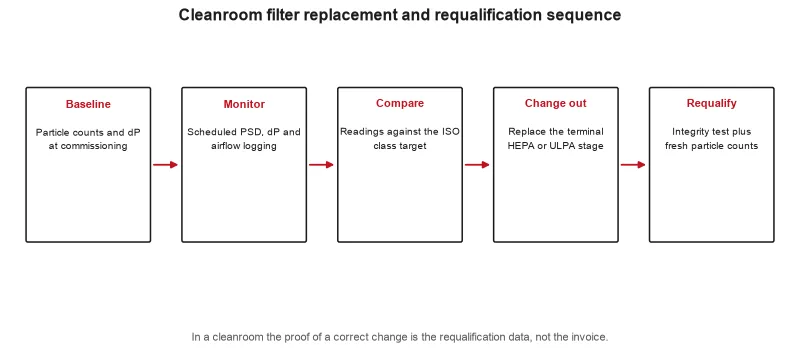
Figure 9: Cleanroom maintenance sequence illustrating the mapping of filter replacement to verification actions; the scope of verification and requalification adheres to the facility's quality system rather than following a prescribed methodology.
Use trend data rather than calendar dates to decide when to change air filters. If the particle count values remain consistent and the pressure drop value is well below the limit, continue to use that filter for critical operations.
If the count goes up, or the pressure drop goes up quickly, investigate before deciding. Investigating the counts should separate the causes. A rising particle count could occur due to a filter leak, a seal failure, a change in pressure-balance, or a change in the process. If you are going to rule out the filter causing the particle counts, you need to be sure before you replace the filters.
What Checks Are Needed After Cleanroom Filter Replacement?
Once cleanroom air filter replacement has been completed, the following checks are typical. The specific checks must be consistent with the quality system of the facility and the validated procedures.
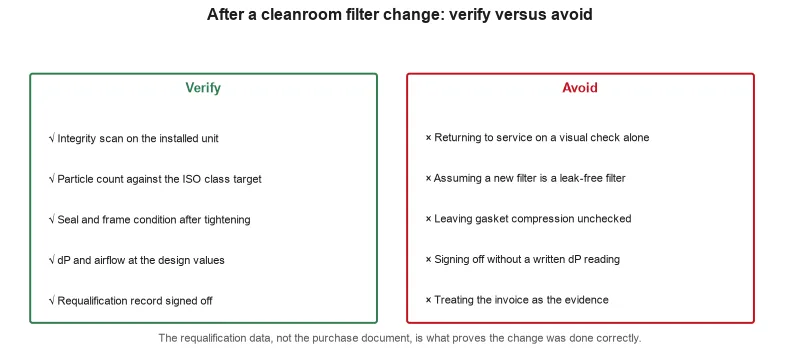
Figure 10: What to verify and what to avoid after a cleanroom filter change - an integrity scan, a particle count against the iso class target, seal and frame condition, dP and airflow at the design values, and a signed requalification record, set against the short-cuts that leave a room formally out of specification.
Record the part number and serial or batch number of the new filter, as well as the initial pressure drop across the new filter. Determine if you can measure the filter performance by airflow measurement at the supply terminal or diffuser compared to what the design intended.
Perform in-place integrity testing, using the data and an aerosol challenge size intended for this project, and the scanning method agreed upon.
Perform particle counts at the locations specified in the monitoring plan, at the defined frequency. Confirm the pressure differentials between zones are as specified in the design criteria. Document findings and compare to the pre-change measures prior to going back to normal operations.
Whether or not to perform some level of requalification is dependent on the quality system. Don't assume that every filter change will require the same level of requalifying the area for operations. Perform as did the risk, the validated procedure, and any applicable regulations.
HEPA Filter Replacement and Standards
There are a number of international standards that are reference for HEPA filter change demonstration and acceptance testing of the HEPA filter. Use the standard that best matches your procedure per your application, your procedure, and any applicable regulatory requirement.
Table 3: Summary of the standards relevant to HEPA filter classification and testing, and the claims supported in this article.
| Standard | Scope | Supports which claim in this article |
|---|---|---|
| EN 1822 (as applicable) | Classification and performance testing of HEPA and ULPA filters [2] | HEPA/ULPA class designation and classification based on MPPS |
| ISO 29463 (as applicable) | High-efficiency filters and filter media [3] | HEPA/ULPA classification and testing methods |
| iso 14644-1 | cleanroom classification based on particle concentration [1] | cleanroom classification only |
| iso 14644-3 | cleanroom test methods [4] | Airflow, pressure, and particle count test methods |
| IEST-RP-CC001 | Best practices for HEPA and ULPA filters [5] | Guidance for testing, selection, and use of filters |
| MIL-STD-282 | Military filter legacy test methods [6] | Historical context of HEPA test methods |
| ASHRAE 52.2 | HVAC filter testing and MERV rating [7] | MERV ratings for filters in general ventilation applications |
| ISO 16890 | Classification of general ventilation filters based on ePM [8] | Current classification for general ventilation applications |
| EN 779 | Historical context of classification of general ventilation filters [9] | Withdrawn and superseded by ISO 16890 |
| Standard | Scope |
|---|---|
| EN 1822 (as applicable) | Classification and performance testing of HEPA and ULPA filters [2] |
| ISO 29463 (as applicable) | High-efficiency filters and filter media [3] |
| ISO 14644-1 | Cleanroom classification based on particle concentration [1] |
| ISO 14644-3 | Cleanroom test methods [4] |
| IEST-RP-CC001 | Best practices for HEPA and ULPA filters [5] |
| MIL-STD-282 | Military filter legacy test methods [6] |
| ASHRAE 52.2 | HVAC filter testing and MERV rating [7] |
| ISO 16890 | Classification of general ventilation filters based on ePM [8] |
| EN 779 | Historical context of classification of general ventilation filters [9] |
Which Standards Apply to HEPA Filter Classification and Testing?
EN 1822 and ISO 29463 are both applicable standards to HEPA and ULPA classification. In both standards, HEPA and ULPA filters are classified based on the performance of the filters during testing at the most penetrating particle size. The performance testing requirements vary based on the classification of filters.
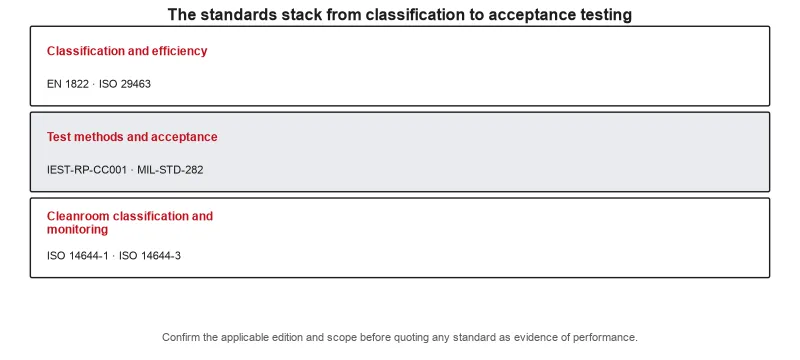
Figure 11: The standards stack, from classification and efficiency (EN 1822, ISO 29463) through test methods and acceptance (IEST-RP-CC001, MIL-STD-282) to cleanroom classification and monitoring (ISO 14644-1, ISO 14644-3). Confirm the applicable edition before quoting any of them as evidence.
For this reason, class designations should not be defined based on a single efficiency value unless the product test report includes that information. If a catalog indicates a value based on a fixed particle size, reference it using the catalog value and include the testing procedure.
Before referencing an established standard, confirm the proper edition and section to be certain that the standard is current. Standards can be updated, and older versions may be obsolete and not appropriate for use. EN 779 should remain easily identified as historical documentation.
What Evidence Supports a HEPA Filter Change or Continued Use?
Some evidence to offer continued use consists of consistent pressure drop less than specified limits, normal airflow, and passing in-place integrity tests. However, room particle counts can serve as supporting evidence for a classification claim, but not necessarily for filter integrity.
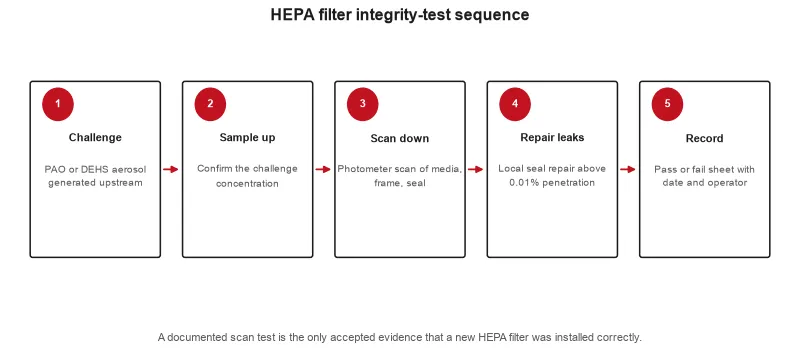
Figure 12: HEPA filter integrity-test sequence showing aerosol challenge, upstream concentration measurement, downstream scan, and pass-or-fail decision against the applicable standard.
Evidence that suggests replacement consists of pressure drop equal to or exceeding the maximum limit, airflow that is below the design specification, failure of the integrity test, visible damage, or a specific requirement from a process or regulation.
It is important to record both positive and negative evidence. For example, if a filter is replaced even though it still meets the specifications, that information should also be documented. This will give you a record of when filters should ideally be replaced without having to guess.
Industrial Air Filter Maintenance and HVAC Filter Selection
Industrial air filter maintenance differs significantly from maintenance performed in residential settings. Industrial systems continuously run, use more particles, and have a stricter downtime requirement. Therefore, selection and maintenance should be coordinated together.
Use the selection matrix for discussion purposes in industrial air filter maintenance, not for specification purposes. Final selection should be based on design specifications, air flow, acceptable resistance levels, types of contaminants, and specific application requirements.
It is worth noting that classification systems should not be used interchangeably. EN 779 has been retired and replaced by ISO 16890 for general ventilation purposes [8]. The classification scheme of ISO 16890 is based on ePM1, ePM2.5, and ePM10. In correspondence, the MERV classification scheme is used in ASHRAE 52.2 [7]. It is important not to use a comparative approach when considering these two classifications as the two cannot be converted on a one-to-one basis.
EN 1822 and ISO 29463 are used for classification in HEPA and ULPA [2][3]; these classifications do not pertain to general ventilation filtration categories.
How Should Contractors Select Filters for Industrial Systems?
When deciding when to change air filters, use the following process.
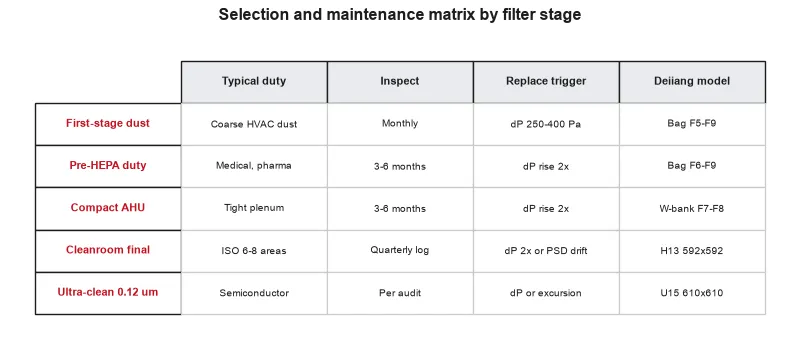
Figure 13: Selection and maintenance matrix - each filtration stage (first-stage dust, pre-HEPA duty, compact AHU, cleanroom final and ultra-clean 0.12 um) is listed against its typical duty, inspection interval, replacement trigger and a representative Deiiang catalogue model. Grade suggestions are conditional on the design specification.
Determine the filtration efficiency requirements in relation to the application, the design criteria and specification, and any other standard that is applicable.
Calculate the system volumetric flow and the pressure drop across the filter.
Select the filter class according to the specifications, rather than using a generic calculation.
Check the specifications against the data sheet to ensure that the dimensions, airflow rating, and both initial and final pressure drop hold true.
Verify that the fan can deliver the specified airflow at the specified loading conditions.
How Can Maintenance Teams Reduce Premature Replacement?
In order to avoid wasting labor and money in industrial air filter maintenance through premature replacement, follow these tips.
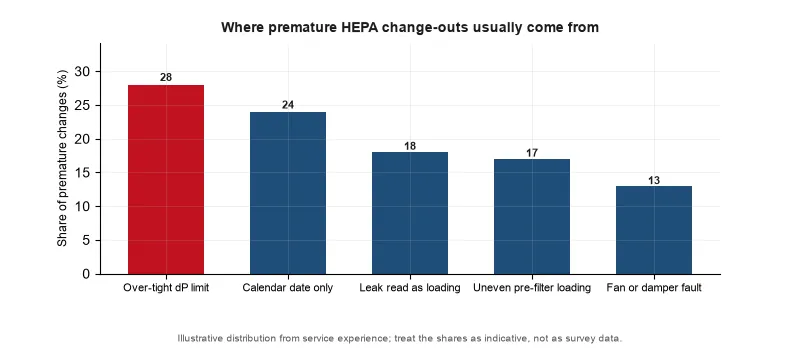
Figure 14: Where premature HEPA change-outs usually come from - an over-tight pressure limit (28%), changing on the calendar date alone (24%), a leak misread as loading (18%), uneven pre-filter loading (17%) and a fan or damper fault (13%). The shares are illustrative of service experience rather than survey data.
Use proper pre-filtration before implementing high-efficiency stages.
Ensure that all frames and gaskets are properly sealed so that bypass air does not result in overloading of the final filters.
Monitor the pressure loss on a monthly basis and switch them out according to the actual data observed rather than on the basis of a set schedule.
Train staff on how to conduct inspections of the filters and how to replace them without doing any damage.
Store replacement filters in the original packaging in a clean, dry area.
Review records on a yearly basis to determine how frequently the filters need to be replaced.
Replacement Procedure, Case Study, and Cost Control
Safe filter replacement will only happen if the correct process is followed, as discussed in the case profile below. The case profile is the project-reported account of what the project team measured.
Case Profile: pharmaceutical packaging cleanroom with an ISO 6 goal and a historical class 1000 designation. Historical class designations and ISO classifications are not equivalent, and ISO 6 is the standard used for approval.
Project reported issues: high ambient particulate counting, limitations in the height of the plenum, and exact limits for pressure drop to maintain laminar flow.
Deiiang provided low-profile H14 combo filters (592 mm × 592 mm × 292 mm, 2500 m³/h, catalogue initial pressure loss ≤220 Pa, 20.04 m² of media area) with silicone-free seals and pre-filters F7. Each filter underwent individual DOP testing before shipment.
Reported particle counting results: particle counting shifted from an ISO 7 level to stable ISO 6 values, and there were energy savings realized as a result of a reduced initial pressure loss.
What Steps Make Filter Replacement Safe and Verifiable?
In order to help keep your air conditioning unit working properly, you must shut the unit down before applying lockout/tagout procedures.
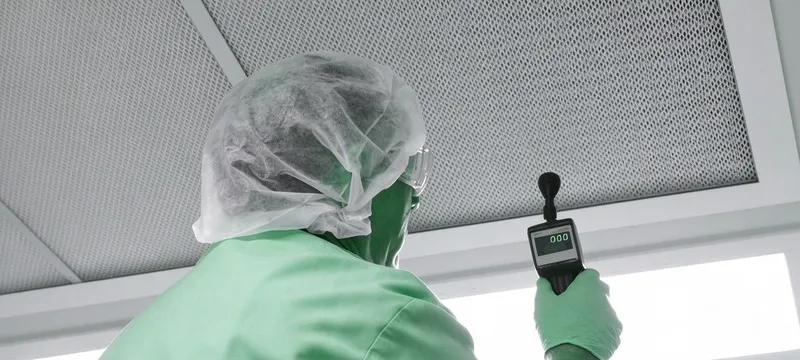
Figure 15: Illustrative photograph of post-change verification - a technician scanning a terminal HEPA filter with a handheld particle counter. The image is representative of the kind of verification activity described in the case profile and is not a photograph of that project; the before-and-after values quoted in the case profile are project-reported.
You must wear personal protective equipment (PPE) such as gloves and eye protection while working on the air conditioning unit.
Remove and bag the old filter to prevent dust contamination during equipment changeout. Perform a housing inspection of the unit before going further with cleaning or replacement.
The next step is to install the new filter and verify that the gasket seals and frame alignments are correct. Record the part number and/or serial number of the valve and write down the pressure readings once again.
The last step is to power on the device as well as perform other necessary tests and ensure airflow along with pressure reading falls within acceptable parameters.
What Should a Deiiang Project Case Study Document?
A Deiiang project case study must document the application, project date, and target classification, including any legacy class label maps that should apply to the ISO class being utilized for acceptance purposes.
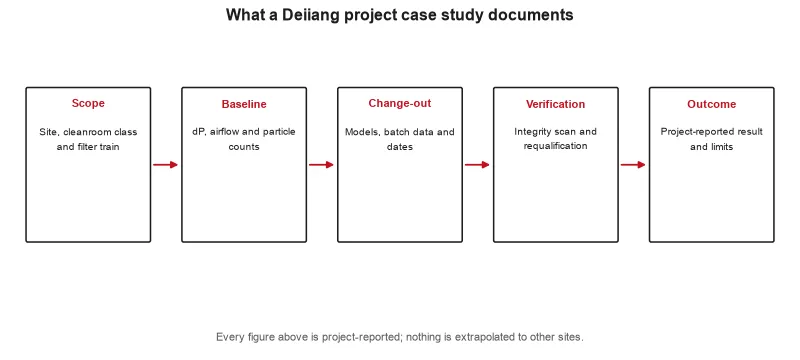
Figure 16: The five parts of a documented case study - scope and filter train, baseline measurements, the change-out record, verification data, and the project-reported outcome with its stated limits.
All baseline and follow-up measurement procedures used, including sampling sites and instrument types used, should be documented as well.
Also, it is important to document information on what results were actually measured by the Deiiang team or project and what results were reported by a customer.
Photographs of the project and customer name should be included only if authorized permission was given by the project or customer.
If there are no supporting records available or no written approvals present, it is necessary to present this information in illustrative format clearly.
Frequently Asked Questions
How often should I change my air filter?
For standard residential and light commercial HVAC filters, the plain answer to how often to change air filter media is to replace them every one to three months; however, these intervals can vary by system and should be checked monthly for any need for replacement. Filters used in industrial settings or with high efficiency or cleanroom applications abide by manufacturer limits, system requirements, and/or performance specifications, rather than adhering to a pre-set timeframe.
How often should I replace HVAC filters?
For guidance on how often to replace HVAC filters in residential and light commercial buildings, the usual figure is every one to three months; however, it is important to take note of the load, as this can greatly affect how quickly the filter will clog with contaminants. You can usually determine the recommended final pressure drop by checking the filter specification chart. If airflow drops below design, dive deeper and see if you should replace your filter sooner than normal.
How often should cleanroom air filters be replaced?
Cleanroom air filter replacement is dictated by a facility's quality system and does not have a set timeframe. When pressure drop exceeds the recommended levels it is time to make the change; if integrity testing does not pass, or if there are other requirements for exchange, you need to replace your filter.
How do I know when to change air filters?
Locate the final pressure drop surrounding the filter design; use the filter specifications to establish a clean filter baseline. You then need to consistently check the drop and use the airflow to determine when to replace your filter. Simple visual inspection does not count; accurate pressure drop measurements and airflow are imperative to follow the protocol.
Can an air filter be cleaned and reused?
The vast majority of modern disposable filters (including HEPA filters) are designed only for disposal after they are used. Cleaning them can damage the media or void the warranty. Some metal washable pre-filters can be cleaned, but in these instances, the manufacturer direction must be followed.
Does a higher-efficiency filter need changing more often?
Not necessarily. Filters designed with higher efficiency tend to have higher initial resistance, but their lifespan depends on the area of the media used, as well as upstream loading, airflow, and hours of operation. With effective pre-filtration, HEPA filters may remain in service for many years depending on the level of pre-filtration.
References
- [1] iso 14644-1:2015, Cleanrooms and associated controlled environments — Part 1: Classification of air cleanliness by particle concentration. International Organization for Standardization. https://www.iso.org/standard/53394.html
- [2] EN 1822 series, High efficiency air filters (EPA, HEPA and ULPA) — Classification, performance testing, marking. European Committee for Standardization. Verify the applicable part and edition before citing. https://www.beuth.de/
- [3] ISO 29463 series, High-efficiency filters and filter media for removing particles in air — Classification, performance testing and marking. International Organization for Standardization. https://www.iso.org/standard/67205.html
- [4] iso 14644-3:2019, Cleanrooms and associated controlled environments — Part 3: Test methods. International Organization for Standardization. https://www.iso.org/standard/67326.html
- [5] IEST-RP-CC001, HEPA and ULPA Filters. Institute of Environmental Sciences and Technology. https://www.iest.org/
- [6] MIL-STD-282, Filter Units, Protective Clothing, Gas-Mask Components and Related Products: Performance-Test Methods. United States Department of Defense.
- [7] ASHRAE 52.2, Method of Testing General Ventilation Air-Cleaning Devices for Removal Efficiency by Particle Size. ASHRAE. https://www.ashrae.org/
- [8] ISO 16890 series, Air filters for general ventilation — Technical specifications, requirements, and classification system based upon particulate matter efficiency (ePM). International Organization for Standardization. https://www.iso.org/standard/57855.html
- [9] EN 779:2012, Particulate air filters for general ventilation — Determination of the filtration performance. Withdrawn and superseded by ISO 16890; cited for historical context only.