+86 13638632902
 Jason@cleanroomequips.com


 MENU
MENU
Introduction
Surely in winter you need to replace air filters more often, because more running time and lower ventilation rates mean more particle loading. If you wait until a date on the calendar to change air filters in winter, that leads to damage in the system, higher fan power usage, and poor indoor air quality.
That is the quick answer, with all the necessary details described below.
The guidelines include nine chapters covering loadings in winter, the HVAC filter replacement schedule, the indications that a filter needs attention, differences in filter types, cleanroom practice, procurement, and future planning.
In regards to the catalogue information it is important to note that the catalogue data is defined as catalogue data; project results are defined as project data; and illustrations are noted as illustrative. EACH figure is always listed within the corresponding chapter.
Why winter changes air-filter loading
Winter does not affect the filter element, but it makes changes to the air which goes through the filters, the running hours of fans, and the circulation of particles inside the room. These three factors will determine the proper time for winter air filter replacement instead of the calendar month.
It relies on the use of runtime records, occupancy data, and air filter pressure drop measurement readings in order to determine when a filter has definitely reached the end of its effective lifespan.
How winter operating conditions affect filter loading
In colder climates, the lifetime of a furnace in operation can be greater than 1,000 hours in the corresponding heating season [7]. For example, a furnace that recorded 300 hours of operation in October may record between 500 to 700 hours of operation in January.
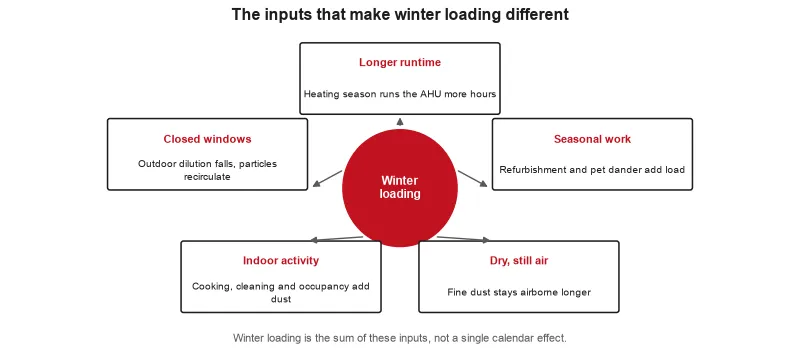
Figure 1: The inputs that make winter loading different - a hub diagram linking longer heating-season runtime, closed windows, indoor activity, dry still air and seasonal work, all feeding the same filter load.
Due to the fact that the same volume of air flows through the filter in every hour, the accumulation of particulates occurs much faster.
Closed windows reduce dilution ventilation. Particles produced by cooking, cleaning, pets, and people indoors are returned through the return air section instead of being expelled outside. Renovation work carried out in winter can produce even more construction debris that will ultimately be trapped in the airstream.
To illustrate the point, a 1 inch pleated MERV 8 air filter that is normally rated for 600 to 1,200 runtime hours may need to be replaced every four to six weeks during a harsh winter. At the same time, a 4 inch media filter, with the same conditions applied, may last anywhere between six to twelve months, depending on the specific circumstances [7].
Why a winter calendar alone cannot set replacement timing
Calendar-only winter air filter replacement will not take into account the fact that equipment and the amount of occupied hours are different. For instance, two buildings are located on the same street but will load the filters in completely different manners, as one of them will work continuously whereas the other one will only be operating during times of occupancy.
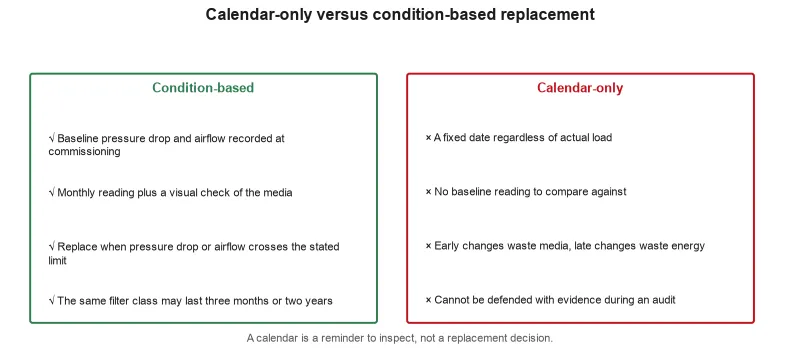
Figure 2: Side-by-side comparison of calendar-only and condition-based replacement practice.
Calendar replacement will disregard the fact that some extenuating circumstances exist. For instance, a filter may tear and bypass its frame much earlier than anticipated, depending on a dust-generating process unique to that particular filtering application.
Condition-based replacement utilizes airflow restriction, physical assessment, and documentation of air use in establishing when to change air filters. In this situation, the schedule only serves as a reminder for needed inspection and not the determining factor for when the actual replacement will occur.
Building an HVAC filter replacement schedule
The HVAC filter replacement schedule consists of establishing a specific time frame for replacement which can be modified based on the measurement of conditions. The guidelines provided by the manufacturer and readings taken by way of static pressure have an influence on the final decision in this process.
The adjustment process is the same every time when monitoring its condition:
Measure Static Pressure → Determine Baseline → Monitor Time in Operation/Occupancy → Determine If Change Is Needed
As shown in the HVAC filter replacement schedule table, beginning intervals for each type of filter are starting recommendations. Do not treat the values listed in the table as strict requirements because each system has its own air loading process.
Table 1: HVAC filter replacement schedule comparison
| Type of Filter | Starting Time | Adjustment Measurements | Verification Method |
|---|---|---|---|
| 1″ Pleated Prefilter | 1-3 months | Runtime hours, number of animals, building activity | Physical assessment; static pressure |
| 2″ Pleated Prefilter | 3-6 months | Occupancy rate; local particle concentration | Observation; measurement of static pressure |
| 4″ Media Filter | 6-12 months | Runtime hours; amount of dust particles | Static pressure; airflow measurement |
| Bag Filter F5-F9 | 6-12 months | Volume of dust and condition of prefilter | Measurement of static pressure and observation |
| HEPA H13/H14 | 18-24 months (or static pressure level) | Operating hours and performance evaluation | Static pressure sensitivity and DOP scan |
| Type of Filter | Starting Time | Verification Method |
|---|---|---|
| 1″ Pleated Prefilter | 1-3 months | Physical assessment; static pressure |
| 2″ Pleated Prefilter | 3-6 months | Observation; measurement of static pressure |
| 4″ Media Filter | 6-12 months | Static pressure; airflow measurement |
| Bag Filter F5-F9 | 6-12 months | Measurement of static pressure and observation |
| HEPA H13/H14 | 18-24 months (or static pressure level) | Static pressure sensitivity and DOP scan |
Set a practical schedule for common building filters
Prefilters are changed more often than final filters because they catch all of the larger particles first. Using a prefilter effectively allows for an increase in downstream airflow loads that can eventually lead to the reduced lifespan of the HEPA filter.
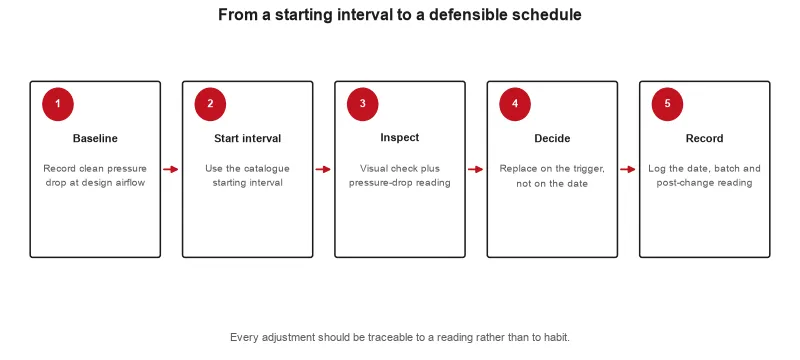
Figure 3: Workflow from baseline interval to inspection and adjustment, showing the loop between pressure-drop measurement and schedule revision.
Deiiang catalog numbers and specifications for the 592×592×381 millimeter six-bag medium efficiency filter specify airflow of 2,050 m³/h and media area of 3.18 m², with the resistance starting off at less than 50 Pa for the F5 and less than 100 Pa for the F8. The filter is designed to allow for a maximum resistance of between 250 and 400 Pa.
Data source: Deiiang™ Technical Catalogue, validated by our internal testing lab for this specific filter model.
In a practical sense, the filters will be checked on a monthly basis during high-demand periods and the air filter pressure drop registered at each visit. The final filter to operate will be selected based on its past performance.
Adjust intervals using occupancy and operating records
The records kept through actual operation convert calendar estimating into the evidence that tells you when to change air filters. Each service visit needs to log information like date, operating hours, pressure-drop readings and inspection notes.
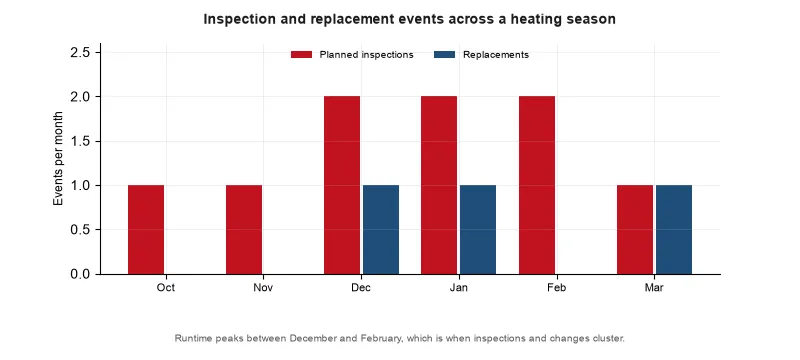
Figure 4: Grouped bar chart of planned inspections and replacement events month by month across a heating season.
A gradual increase in air filter pressure drop during a thirty-day period at constant airflow indicates normal filtering performance. A sudden change or spike in the pressure drop would require your immediate attention.
The current conditions at the location, especially during the heating season, impact operation of filters. When using standard scheduling methods, additional staff or people add to the activities in the building, resulting in more particulates in the air and more heating use, which changes when to change air filters.
Signs that a filter needs attention
Visual inspection and performance measurement answer different questions. A grey filter may not necessarily indicate it is fully loaded, and a white filter may not mean it is clean. Both must be checked against the initial clean baseline that has been set during the commissioning process.
The following conditions warrant attention:
Pressure drop greater than or equal to the manufacturer's critical resistance point
Damage to the media such as tears, holes, or gaps in the frame seal
Decreased air flow or increased fan speed while holding the air flow at a constant rate
Dust streaks and bypass around the frame
Use pressure drop and airflow to assess loading
The air filter pressure drop is the resistance across the filter as air travels through it. According to Deiiang catalogue data on the H13 combined high efficiency filter, the maximum initial pressure drop must not exceed 200 Pa and the final pressure drop limit should be between 400 and 600 Pa.
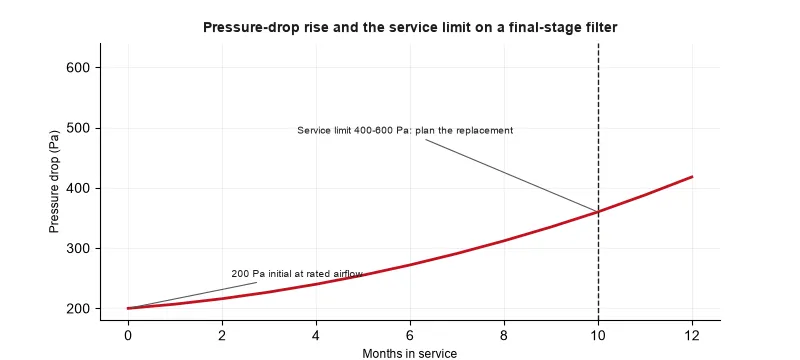
Figure 5: Pressure-drop trend chart with service-limit concept, showing clean baseline, gradual loading, and replacement trigger.
When the initial pressure reading after installation is taken it can then be termed as the baseline level. This is how every subsequent reading from then on is compared. It is a rule of thumb to set a doubling of the initial pressure reading as the service limit in the industrial HVAC filter maintenance industry.
If the system is moving its design volume, its airflow verification procedure should be done. If there is a decrease in airflow while keeping the fan speed constant, then either the filter has a blockage in it or some other form of restriction has been created.
Recognize bypass, damage, and abnormal system symptoms
Bypass occurs when the air goes around the air filter rather than through it. In this case, the pressure drop may appear to be acceptable whereas the filtration efficiency is failing, because the air that does not get filtered passes downstream.
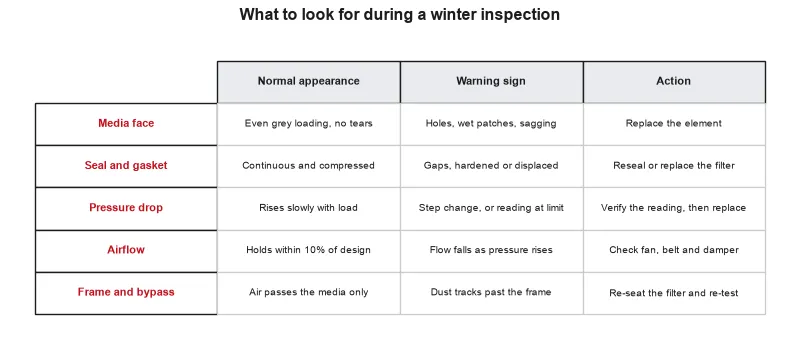
Figure 6: Winter inspection matrix - what a normal media face, gasket, pressure-drop reading, airflow reading and frame look like, the warning sign for each, and the action to take.
A damaged filter should be replaced even if the pressure drop does not exceed the recommended limits.
It is important to note the remedial action taken. If the cause of the replacement is bypass, either the installation method or quality of seals would most likely require modification before sizing the replacement filter.
Choose replacement timing by filter type
Disposable and reusable filters represent a different set of criteria. Reusable filters can be washed and reinstalled, whereas disposable filters are simply replaced. There is no standard interval because the type and quantity of dust, as well as system specifications, will vary across multiple sites.
Table 2 outlines a comparison of the service indicators and replacement criteria by filter type, as well as identifying the recommended test criteria in each case.
Table 2: Filter-type replacement comparison
| Filter type | Service Indicator | Replacement Criteria | Verification |
|---|---|---|---|
| Disposable Panel Prefilter | Visible dust; pressure drop | Pressure limit or visible loading | Visual; pressure drop |
| Reusable Prefilter | Pressure drop after cleaning | Cleaning returns to baseline | Pressure drop after wash |
| Bag Filter F5-F9 | Pressure drop trend | Final resistance 250-400 Pa | Pressure drop |
| HEPA H13/H14 | Pressure drop; integrity testing | Pressure limit; failed scan | DOP scan; pressure drop |
| ULPA U15-U17 | Pressure drop; integrity testing | Pressure limit; failed scan | Particle count scan |
| Filter type | Replacement Criteria | Verification |
|---|---|---|
| Disposable Panel Prefilter | Pressure limit or visible loading | Visual; pressure drop |
| Reusable Prefilter | Cleaning returns to baseline | Pressure drop after wash |
| Bag Filter F5-F9 | Final resistance 250-400 Pa | Pressure drop |
| HEPA H13/H14 | Pressure limit; failed scan | DOP scan; pressure drop |
| ULPA U15-U17 | Pressure limit; failed scan | Particle count scan |
replace prefilters and general HVAC filters appropriately
In staged filtration, the final stage of filtration is protected by the previous stages of filtration. The prefilter catches larger, coarse particles, the medium filter captures the smaller and finer compounded particles, while final filtration captures what may be remaining.
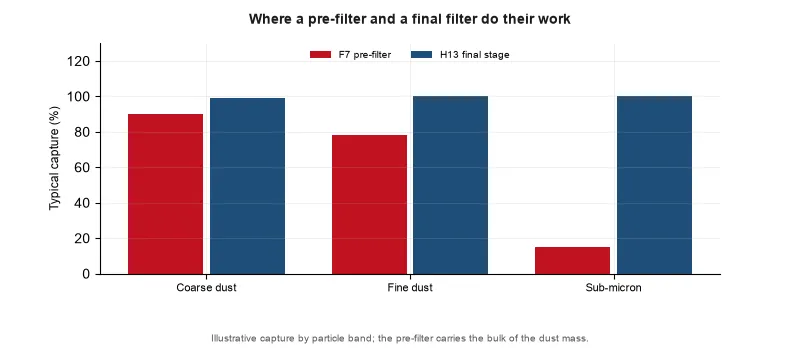
Figure 7: Typical capture by particle band for an F7 pre-filter and an H13 final stage, showing that the pre-filter carries the bulk of the dust mass.
Medium-efficiency bag filters by Deiiang are catalogue rated F5 through F9, comparable to MERV 8, 11, and 13. The 592 by 592 by 381 mm implementation of a 6-bag model is able to supply an air flow rate of 2,050 m³/h with a media area of 3.18 m².
While the EN 779 standard has been officially withdrawn, it is nonetheless referenced here in the context of obsolete installations. In all new product designs, specifications should reference only the new standard ISO 16890 [1].
Determine HEPA filter replacement frequency
HEPA filter replacement frequency depends upon pressure drop, integrity testing and the manufacturer's operating limits. If installed correctly, a HEPA filter may be operational for years, although the decision about when to change the filter should be based upon measurements rather than age.
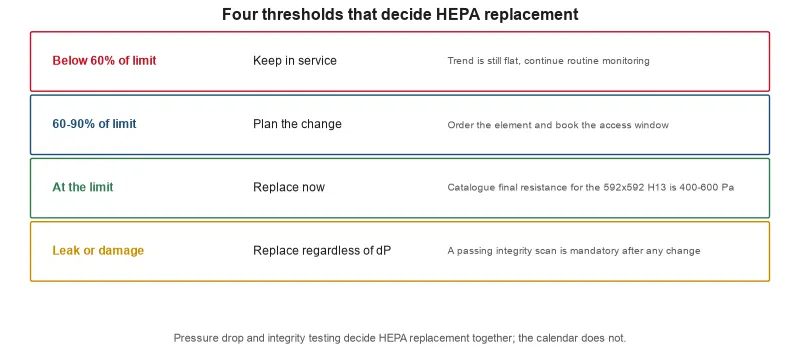
Figure 8: HEPA replacement thresholds - keep in service below 60% of the limit, plan the change from 60-90%, replace at the limit, and replace immediately for a leak or damage regardless of pressure drop.
Deiiang's line of high efficiency filters has a catalogue rating of H13 ranging from 99.97 to 99.99% at 0.3 µm and H14 from 99.995 to 99.999% at 0.3 µm.
As soon as the pressure drop reaches the final resistance of 400 to 600 Pa, the HEPA filter replacement frequency question answers itself: the filter needs to be replaced. The same applies if integrity testing shows failure of the filter, regardless of the pressure reading.
The classification of EPA, HEPA and ULPA filters is according to EN 1822-1:2019, and ISO 29463 provides the same international classification [2]. Both of these employ particle counting techniques for determination of the efficiencies of each classification.
Cleanroom air-filter replacement
When planning cleanroom air filter replacement, it is critical that the room classification is maintained both during the replacement process as well as post replacement. If replacement causes a violation in contamination control, this is considered a failure even if the filter itself is entirely appropriate.
Cleanroom air filter replacement for terminal HEPA units also adheres to the pressure drop specifications and integrity testing methodology similar to standard HVAC systems, but with more stringent documentation and mandatory recovery verification before the room is put back into use.
iso 14644-1 sets the particle classes established for the room, while iso 14644-3 describes the procedures used for air flow measurements, filter leak tests, classification of rooms, and recovery testing protocols.
Plan cleanroom air filter replacement without compromising control
Authorization is the first step in the process. The facility custodian authorizes the maintenance to be performed, with the aim of minimizing the amount of time that the room is shut down.
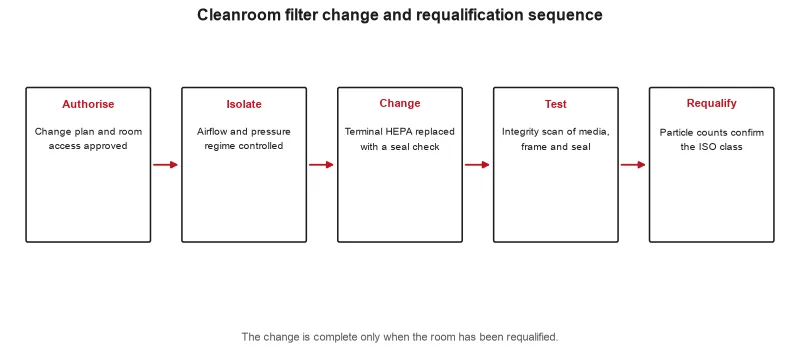
Figure 9: Cleanroom replacement workflow from change authorization through recovery verification.
The systems in process of the filter change are secured. The newly acquired filters shall be inspected for any damage prior to being installed, and the gaskets shall be checked for proper seal compression against the sealing frame.
Cleanroom filter maintenance is not finished until the room recovers to the class standard set for that room, and recovery testing is practiced to determine how fast the cleanroom returns to cleanliness following the loss of control.
Apply cleanroom filter maintenance and integrity checks
Cleanroom filter maintenance consists of prefilter maintenance, pressure drop evaluations, and some type of integrity testing of terminal filters. The IEST-RP-CC001 provides directions for the construction and performance standards for HEPA and ULPA filters.
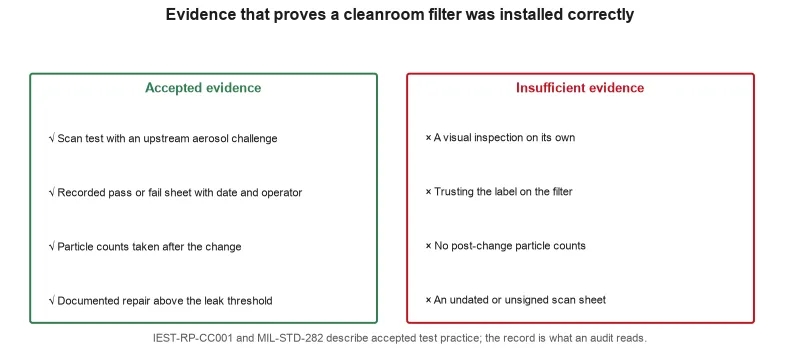
Figure 10: Accepted versus insufficient evidence that a cleanroom filter was installed correctly, from a documented scan test to an undated sheet.
The DOP test was originally introduced in MIL-STD-282 and is still the basis for a number of HEPA filter leak tests. However, in recent times, it has become necessary to use different aerosol substances depending on the concern with DOP residues.
Expert Tip from Jason.peng, Deiiang Product Designer: "Based on my experience, terminal HEPA filters in winter cleanrooms fail less frequently due to dust, and more because of improper seal compression caused by thermal contraction. Always remember to check the seal tension 24 hours post filter change-out, at the time the equipment is at operational temperature."
Every test result is documented. The documentation includes the serial number of the filter, the date of the test, the penetration of the filter, and the corrective action taken.
Industrial HVAC filter maintenance in winter
Industrial HVAC filter maintenance is a different problem: these facilities experience significantly greater levels of dust loading and operating hours when compared to commercial buildings. The winter season does not provide any relief from process dust in facility operations, but simply increases the heating demand.
As a result, documented maintenance triggers must be established for industrial HVAC filter maintenance during the winter season. Deiiang provides various types of pre-filters, HEPA filters and ULPA filters; catalog information determines the medium-efficiency specification, and field measurements must be taken to develop precise intervals of filter maintenance.
Adapt service practices to industrial operating conditions
The presence of process dust and issues related to continuous operations makes a big difference. In other words, a facility that operates 168 hours a week will load its filter almost seven times faster than a facility that operates 24 hours a week in the same ambient dust concentration.
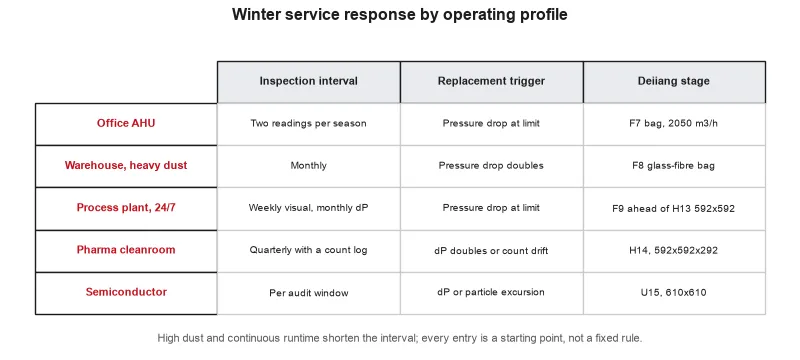
Figure 11: Winter service response by operating profile - inspection interval, replacement trigger and matching Deiiang stage for an office AHU, a heavy-dust warehouse, a 24/7 process plant, a pharmaceutical cleanroom and a semiconductor line.
Fixed scheduled intervals need to be replaced with the following documented triggers for all types of filters:
- Prefilter: when the pressure drop exceeds 2x the clean resistance
- Medium filter: 250 Pa to 400 Pa at the final resistance
- HEPA: when the final resistance reaches 400 Pa to 600 Pa, or an integrity test fails
Use a real project case to illustrate winter maintenance
One major pharmaceutical packaging cleanroom using a class 1000 / iso 6 environment experienced extreme ambient particle loads, limited plenum height, and strict pressure-drop limits needed to maintain laminar flow.
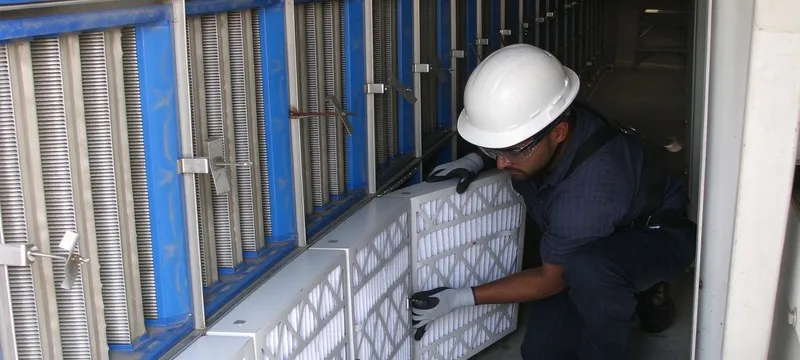
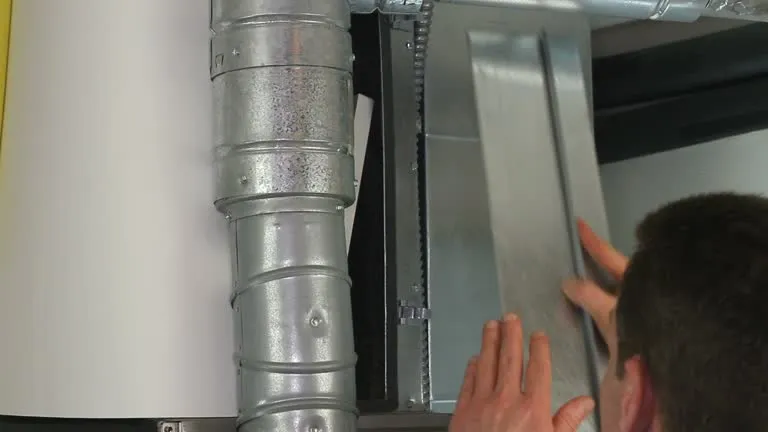
Figure 12: Illustrative photograph of the kind of plant-room service visit described here - a technician checking a filter stage before a change-out. Representative of the work described rather than a record of one specific site.
Deiiang provided low-profile combined high-efficiency H14 filters, with model dimensions of 592 mm x 592 mm x 292 mm, a rated airflow of 2,500 m³/h, an initial resistance of 220 Pa or less, and a media surface area of 20.04 m².
The vents had silicone-free gaskets and F7 pre-filters, and the filters underwent DOP scan tests prior to shipment. As noted in the project report, the number of suspended particles began at an iso 7 level and ended up at an ISO 6 level, with energy savings attributed to the low initial pressure drop.
Select and install replacement filters
The new filter must be compatible with the present specifications, including dimensions, efficiency class, airflow capacity, and pressure drop characteristics. Therefore, the new filter must be physically compatible with the system in question.
Table 3 lists comparison information that needs to be collected and recorded for all replacement filters.
Table 3: Procurement comparison for replacement filters
| Requirement | Submittal evidence | Site check | Acceptance record |
|---|---|---|---|
| Dimensions | Catalogue drawing or tolerance values | Measurement of dimensions | Actual measurement of dimensions |
| Efficiency Class | Certificate of testing, as outlined by either EN 1822 or ISO 16890 | Verification of label | Record of the actual certificate |
| Airflow rating | Catalogue specification | Measurement of system airflow | Record of commissioning |
| Pressure drop | Initial resistance value | Reading after installation | Pressure drop log |
| Seal condition | Specification of gaskets | Visual and compression testing to confirm condition | Installation check |
| Requirement | Site check | Acceptance record |
|---|---|---|
| Dimensions | Measurement of dimensions | Actual measurement of dimensions |
| Efficiency Class | Verification of label | Record of the actual certificate |
| Airflow rating | Measurement of system airflow | Record of commissioning |
| Pressure drop | Reading after installation | Pressure drop log |
| Seal condition | Visual and compression testing to confirm condition | Installation check |
Verify fit, efficiency, airflow, and pressure-drop data
Fit is the first criterion. The gasket must fit squarely against the sealing surface.
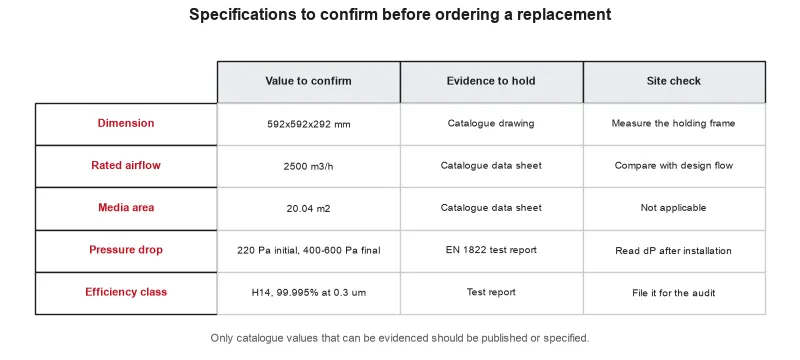
Figure 13: Annotated filter specification comparison showing dimensions, efficiency class, airflow, and pressure-drop data.
HEPA filters are confirmed by their classification under EN 1822 and ISO 29463. In the case of general ventilation filters, the ISO 16890 ePM classes supersede the outdated EN 779 grades [1][2].
Rated airflow and initial pressure drop should be compared with system design. A filter rated for a different airflow will not be able to deliver the operational efficiency that it claims at its nominal flow.
replace filters safely and confirm correct installation
Equipment must be locked out before filter housing access, including site lockout procedures. The open ductwork must be covered to avoid contamination during the replacement process.
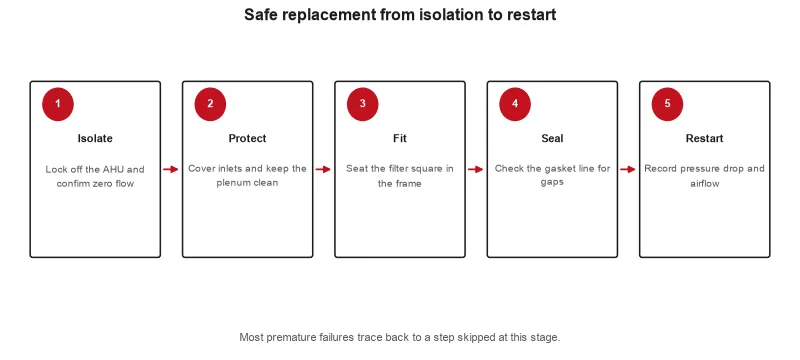
Figure 14: Installation sequence from isolation and filter removal through seal inspection and restart checks.
Filters should be installed only in the direction indicated by arrows pointing towards the correct airflow. Never force the frame into position, as this will damage the media and reduce effectiveness because of potential bypass.
After starting the system, it is important to confirm the airflow has been restored as well as check the recorded pressure drop against the expected clean pressure drop reading. Record the installation date, serial number of the filter, and baseline reading.
Improve winter maintenance planning
Good winter air filter replacement planning makes it possible to combine labour, inventory and inspection activities before the peak of the heating season. A filter that has failed in January should already have been on the shelf in October.
Trend data also helps refine frequency over time, enabling sites that can log runtime each month to extend intervals where loading is low and shorten the interval where loading has occurred at a rapid pace.
The thrust is not to replace filters more. The objective is to replace filters at the correct time, which will help prevent changing filters too soon or too late.
Prepare a seasonal inspection and spare-filter plan
Perform maintenance checks before peak heating season. In areas with cold climates, peak heating season runs from November to March, so October is a good month to check baseline pressure drop for the coming season.
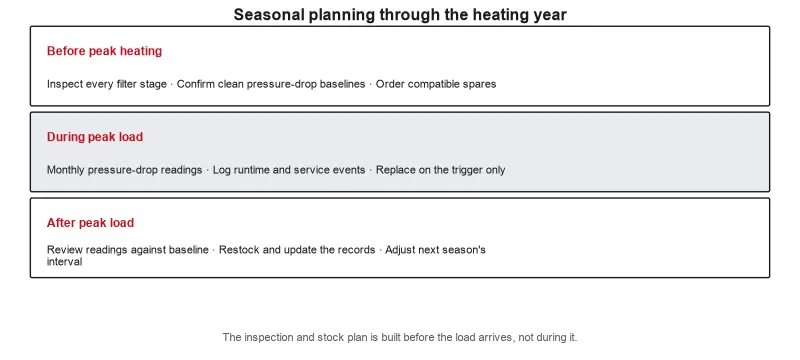
Figure 15: Three-phase planning chart for the heating year - what to do before peak load, during peak load and after peak load.
Order only approved compatible filters. An approved replacement filter must match the size, efficiency class and airflow rating of the filter that it will replace. A substitute filter that fits but does not provide enough airflow is not an approved replacement filter.
Winter Readiness Checklist
| Item | Action | Responsibility | Status |
|---|---|---|---|
| Prefilter pressure drop | Measurement | Technician | ☐ |
| Spare filters | Verified model and number | Storekeeper | ☐ |
| Baseline recording | Initial clean pressure drop | Commissioning engineer | ☐ |
| Fans and belts | Maintenance and adjustments | Mechanical fitter | ☐ |
| Seal and gasket stock | Confirm supply | Procurement officer | ☐ |
| Inspection schedule | Schedule inspections | Facility management | ☐ |
| Documentation | Update maintenance logbook | Planner | ☐ |
| Item | Action | Status |
|---|---|---|
| Prefilter pressure drop | Measurement | ☐ |
| Spare filters | Verified model and number | ☐ |
| Baseline recording | Initial clean pressure drop | ☐ |
| Fans and belts | Maintenance and adjustments | ☐ |
| Seal and gasket stock | Confirm supply | ☐ |
| Inspection schedule | Schedule inspections | ☐ |
| Documentation | Update maintenance logbook | ☐ |
Review costs and performance after each replacement
Check the before-and-after readings. If the replacement does not bring the airflow back to the baseline value, there may be a problem with the system elsewhere.
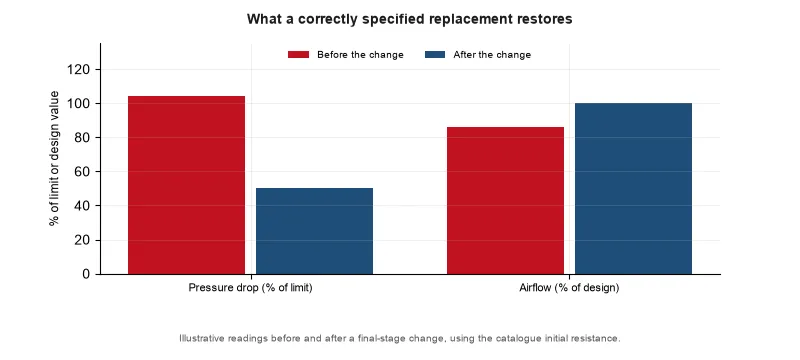
Figure 16: Before-and-after comparison of pressure drop, shown as a percentage of the limit, and airflow, shown as a percentage of design, across a final-stage change.
Evaluate the filter life in relation to the intended operating period. If the filter has reached its limits early on a regular basis, it may be because the planned replacement interval is too long or the dust loading has increased.
The pressure drop across the dirty filters increases the energy used by the fan, so bringing the system back to clean conditions will decrease that energy consumption. Ensure that the maintenance sheet is updated with the measured reading.
Frequently Asked Questions
Do air filters need to be replaced more often in winter?
To the question "do air filters need to be replaced in winter", the answer is generally yes in most buildings. More running hours during the heating season means that particulate loading is higher for a given operating hour. replace the filter based on the measured pressure drop and the manufacturer's limits rather than based upon a calendar date for winter.
How often should I check my HVAC filter during winter?
Generally, you should check the HVAC filter on a monthly basis during peak heating season. The frequency should be adjusted to the local particulate loading as well as the running hours, and the filter should be replaced once the specified service limit has been reached in accordance with pressure drop.
Can I clean a disposable air filter instead of replacing it?
No. Disposable filters are designed for one use, and washing them causes damage to the media structure. The washable pre-filters for this application are an entirely separate product, which must be cleaned according to the manufacturer's instructions.
Does a dirty filter always mean the HEPA filter must be replaced?
No. The HEPA filter will only have to be replaced when the pressure drop has reached its final resistance or the filter has failed an integrity test. The presence of visible dirt does not warrant replacement on its own.
How is cleanroom air filter replacement verified?
The replacement is confirmed by conducting an installation check for fit and seal, along with a measurement of the pressure drop and an integrity test on the installed filter. The room must have recovered to the required iso class before it is released for use.
Which standards apply to air-filter testing and cleanroom performance?
The EN 1822-1 and ISO 29463 standards classify HEPA and ULPA filters, while ISO 16890 covers general ventilation filters. ISO 14644-1 defines the classes of cleanrooms, while ISO 14644-3 describes the respective methods for testing airflows, leak testing, and recovery.
References
- [1] ISO 16890-1:2016, Air filters for general ventilation — Part 1: Technical specifications, requirements, and classification system based on the efficiency of particulate matter (ePM). International Organization for Standardization.
- [2] EN 1822-1:2019, High-efficiency air filters (EPA, HEPA, and ULPA) — Part 1: Classification, performance testing, and marking. CEN; and ISO 29463-1:2024, High-efficiency filters and media for the removal of particles from the air — Part 1: Classification, performance testing, and marking. International Organization for Standardization.
- [3] iso 14644-1:2015, Cleanrooms and associated controlled environments — Part 1: Classification of air cleanliness by concentration of particles; iso 14644-3:2019, Part 3: Test methods. International Organization for Standardization.
- [4] ASHRAE Standard 52.2-2017, Method of Testing General Ventilation Air-Cleaning Devices for Removal Efficiency by Particle Size. ASHRAE.
- [5] IEST-RP-CC001, HEPA and ULPA Filters. Institute of Environmental Sciences and Technology; MIL-STD-282, Method for Testing HEPA Filters. U.S. Department of Defense.
- [6] U.S. Environmental Protection Agency / ENERGY STAR, guidance on the maintenance and inspection intervals of the filter in a furnace and air-conditioning unit.
- [7] ASHRAE Handbook — HVAC Systems and Equipment, chapter focusing on the use of air filters in addressing particulate pollution; and the U.S. Department of Energy guidance on the duration of operation of heating equipment during winter months.