+86 13638632902
 Jason@cleanroomequips.com


 MENU
MENU
Can HEPA filters be washed? The reality, according to the engineering principles in place with regards to HEPA systems, is that most HEPA filters cannot actually be washed. Unless a manufacturer specifically states that their filter is rated to be cleaned using water and indicates the process for doing so, water may corrode the filter media and/or cause leaks to develop in the filter. With cleanroom type environments, a terminated, wet filter must be replaced with a new one and it must be checked for leaks before being returned to service.
Introduction
That answer is applicable to terminal cleanroom HEPA filter installations found in cleanroom environments, but the correct answer may change if there is a washable HEPA filter available for your use that the manufacturer has approved to be cleaned. The key is to differentiate between the two filter classifications because while one is designed for critical use, the other is designed for non-critical environments which has entirely different construction processes involved. The purpose of the succeeding sections is to provide a damage assessment and maintenance decision path in addition to replacement criteria in order to address the issue of can HEPA filter be washed for your environment.
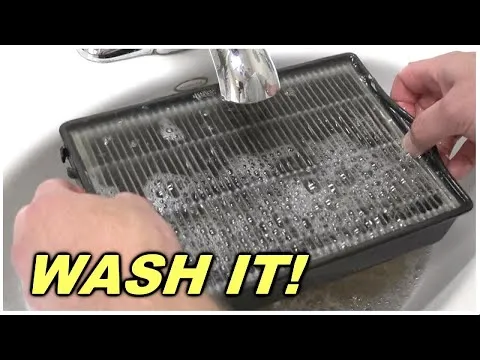
The Short Answer: Why Washing is Generally Not Permitted
The short answer to the question “can HEPA filter be washed” is that washing is generally discouraged: field cleaning does not validate any level of filtration efficiency or leak-tightness for terminal cleanroom H13/H14 filters. A filter that appears to be clean after washing may in fact have had the placement of its media shifted, deformation of its pleats, or altered adhesion of the media to the filter frame itself which will not create visible damage nor be indicated with a simple airflow test.
One common misperception is that aerosol challenge testing is the only means available for validating that a filter has been properly validated. This is incorrect. The differentiation between the factory efficiency classification testing and the installed filter leak scan processes is that one establishes the efficiency classification of the filter before it is shipped and the other checks to see if it is leak free after the assembly has been made. However, understanding if the filter passed its leak scan in the field does not mean that it again has a complete factory efficiency classification for washing as both processes are differently accredited even though they are both useful processes in their own right.
- If the filter is a terminal HEPA in a cleanroom or regulated environment, do not wash; conduct an assessment in which the terminal HEPA would need to be replaced after the assessment.
- If the filter is a manufacturer-certificated washable HEPA filter, then use the validated cleaning procedure in accordance with the manufacturer's instructions, ensuring to dry and verify the filter after cleaning.
- If the filter is a washable pre-filter which lies before a HEPA stage, washing of the filter may be carried out according to the specifications of the filter. However, this does not mean that the HEPA filter downstream from the pre-filter can be washed.
The Fragility of High-Efficiency Media
Deiiang's combined H13/H14 filters utilize ultrafine glass-fiber media along with a separator-less pack using EVA hotmelt spacers. The reason for this type of media is that it will capture MPPS particles more accurately depending on which media the filter belongs to, the testing method used, and the airflow conditions in which the classification testing has taken place. There is no MPPS value that is universal for all grades of high efficiency media.
Therefore, wet-damage mechanisms are in a separate category to the classification question. HEPA filter water damage starts when water loading causes an additional weight on the media pack and the handling forces. Collected dust can move again within the pleat arrangement. After the drying process, the pressure drop of the filter may alter from its figure before it was wet. The mentioned phenomenon happens through physical and mechanical actions and has nothing to do with the chemical interactions.
The presence of brief water does not always lead to failures. If the outside cases get wet, it does not mean that the filter media gets wet as well. However, in case water reACHes the media pack of a filter which cannot be washed, the drying process will not give the desired effect of full restoration. Thus, one needs to examine the filter according to the specific instructions provided by the manufacturer. It is generally preferable to replace the non-washable terminal unit instead of attempting to provide HEPA filter maintenance which may lead to overstating the evidence but also protect the safety instructions.
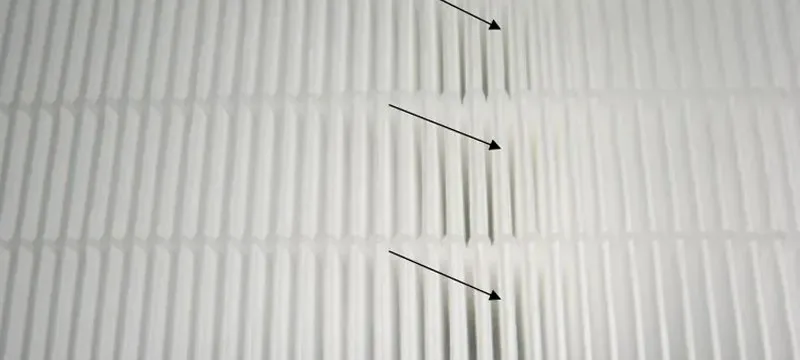
Figure 1: A schematic of dry pleats versus an exemplary wet pleat with airflow paths illustrated.
First Check: What Does the Manufacturer Actually Permit?
One needs to be able to differentiate between a washable pre-filter, a washable appliance filter, and a terminal cleanroom HEPA filter. The first step for each decision regarding HEPA filter maintenance is to consult the datasheet of the exact unit for the following operating conditions: water tolerance, detergent compatibility, maximum temperature, drying methods, validation methods, and limitations of the product within certain type of cycle duration.
The upper limit of relative humidity for a Deiiang product which is listed in the H13/H14 products should not be considered as a water tolerance indicator. This means that a filter can withstand humidity levels of 80% on an ambient level, but it does not mean that it can withstand immersion in water or pressure washing. To confirm whether an exposure to water will cause an operational failure to a filter, an operator can utilize three checklist questions:
Technical Breakdown: What Makes Your HEPA Filter Unique
It's pretty straightforward to understand the specifics surrounding the HEPA filters from Deiiang. Each of the installations is a multi-component installation that involves several different technologies for making the HEPA filters including media and pleat technology, frame technology, as well as potting and sealing technology. It follows from this that if any of the parts of the filter fail, the overall quality and proper functioning of the filter will be severely compromised.
The relevant products of Deiiang help us understand the technology behind the HEPA filters. For example the H13/H14 combined HEPA filter is made using ultra fine glass fiber media which uses an un-separating pack as well as EVA (ethylene vinyl acetate) hotmelt spacers, PU two-part sealing, ABS frame and EVA or neoprene gasket. Additionally, the DOP (dioctyl phthalate) SE (special edition) filter uses the same glass fiber media but has aluminum or galvanized folding frame, inlet pipe, control valve and DOP testing port. The super high efficiency filter uses ultra fine glass fiber media from HV (HV Ultrafine Glass Fibre) as well as thermoplastic spacers and hard anodization.
Understanding these factors will help define the differences between rated efficiencies of each of these Deiiang filters, and the differences in the use of the technologies that were described in the previous paragraph. Each of these filters carries its unique risk of HEPA filter water damage due to water in each of their separate components that are used and there will not always be visible damage that can be identified when an inspection is made.
Sealants and Structural Integrity
Understanding what goes into the sealant that goes into the HEPA filters from Deiiang is very important. For the H13/H14 filter that is tied in the article, the filter is made using a two-part sealant of polyurethane, an ABS frame and EVA or neoprene gaskets. Water may cause some gasket materials to soften or swell and the mechanical performance of cleaning may create gaps at the media-to-frame junction. These should not be assumed as results of Deiiang testing, but rather as potential failure modes to analyze. No information on compatibility or aging of actual Deiiang assemblies through multiple wetting is claimed here.
There are three practical points to inspect for post-exposure assessment.
- Media to frame junction: look for any separation, bubbling, or discoloration of the area along the sealed perimeter.
- Gasket seating and compression: ensure the gasket still provides even compression on the housing interface.
- Signs of water reaching the pack: search for any signs of moisture, staining, and dust patterns being present at the pack.
Leak paths may occur at the media pack, frame, gasket, or at the inlet opening. Different detection methods apply for each one of them. A visual inspection done after cleaning would not suffice to prove the integrity of the seals.
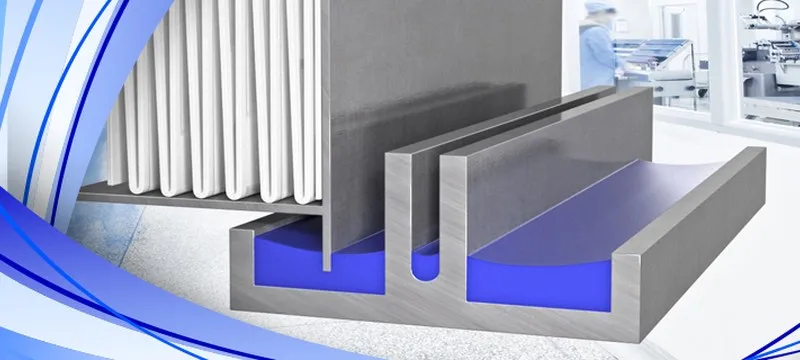
Figure 2: A more detailed image showing media-to-frame seals and manual gasketing.
How Water Exposure Can Become an Installed-Filter Failure
By understanding the possible sequential failures that could happen to the HEPA filter saturating as the media becomes heavier, and the dust being retained on the filters becoming displaced in between the pleats. The major issue occurs once the media has dried and the pleats are compressed or distorted, resulting in the filter exhibiting constant resistance to airflow. In addition, the local issues that take place could be the result of damaging the pleats or the seal interface of the filter, possibly failing their airflow or leak testing process.
It is important to define the difference between HEPA filter water damage and condensation occurring on the exterior surfaces of a filter housing. Condensation that occurs on the outside of a filter housing is an issue relating to humidity in the system, not moisture saturation in the media of the filter. Media saturation implies that moisture is able to penetrate into the filter pack.
Simply drying the filter does not prove that the fiber configuration, pleating or sealing remains intact and operationally effective. According to technical specifications provided by Camfil, after drying a filter that has been wet results in an increased pressure drop of the filter when compared to the pressure before exposure to water, and any filter that was unable to dry for 48 hours or longer would potentially develop mold growth within the media during this time period.
H13/H14 and U15-U17: Ratings Are Not Wash Instructions
According to Deiiang catalogue figures, combined efficiency for the H13/H14 filter is represented as 99.97 to 99.99 percent at 0.3 µm and 99.995 to 99.999 percent, respectively. The Super High Efficiency Baffle Free models are quoted at 0.12 µm with U15 at 99.999 to 99.9995, U16 at 99.9999 to 99.99995, and U17 at 99.9999 to 99.999995 percent.
These figures come from catalogue. The EN 1822 classification relies on more penetrating particle size testing, which is determined through an appropriate test under applicable testing conditions. There is no fixed MPPS range for any specific product. The stated fixed particle size percentages cannot be used as interchangeable evidence of an EN 1822 classification.
The dismissal of such classification by the user consumes extra time and makes it difficult for facilities to comply with certain standards. Users must therefore insist on a specific and verifiable EN 1822 classification for the model in question along with the identifying characteristics, method of testing, and rated air pressure for which the classification applies.
The existence of differences in standard classifications adds complexity to the efficacy of filter evaluation. For instance, the designation of H14 filter rating does not imply that it is superior to H13. The classification addresses the particle removal performance of the filter.
Washable/GM HEPA vs. Single-Use HEPA: How to Evaluate the Claim
The search terms "can HEPA filter be washed", "washable HEPA filter" and "reusable HEPA filter" demonstrate a demand from the market, as people want to save costs. Some products claim to be washable, but a genuine washable HEPA filter is one whose washability is documented by the manufacturer through documented wash policies and cleaning performance information. There should be a distinction made between the use of the term washable HEPA filter and single use terminal filter based on characteristics defined by specifications and not assumptions based on media type or category of products.
The term GM is not a universal definition in the field of HEPA filtration, and it is not proof of a washable HEPA filter. If GM is used by any manufacturer as it pertains to their products, that definition would need to be referenced in their documentation. Absent that, it cannot be interpreted otherwise. Hence, the focus of this paper is on specifications relative to the specifications/hyperbole used.
A Specification-Based Comparison Buyers Can Use
In the chart below, a comparison is made within three product categories: a regular glass fiber terminal HEPA filter (represented by the Deiiang construction type), a documented washable HEPA filter product, and a washable pre-filter. When there cannot be a universal statement, "it varies by model, please request documentation" is used.
| Criterion | Standard Glass-Fiber Terminal HEPA | Documented Washable HEPA Version | Washable Prefilter |
|---|---|---|---|
| Medium | Ultrafine glass-fiber paper; separator-free package with EVA hot-melt spacers (Deiiang catalog) | Different standards per model; see documentation for requirements | Bag or panel filter medium of glass-fiber or synthetic |
| Frame and seal | ABS frame, PU two-part sealant, EVA or neoprene gasket (Deiiang catalog) | Specifications are different per model; please see the documentation | Specifications are different per model; commonly a metal or plastic form |
| Allowed moisture exposure | Not given for washing; 80% RH and 70 degrees Celsius are operating limits | Stated in operating manual | Usually allowed according to information from the prefilter technical sheet |
| Post-cleaning verification | Not applicable for non-washable units; field leak tests are necessary for maintenance procedures | Performed according to the procedures outlined by the manufacturer; the method has to be included in the specifications | Typically visual inspection is performed and efficiency standards are not required |
| Typical application | Cleanroom terminals for filtration, pharmaceutical, semiconductor, hospital | Residential or light commercial air purification; possibly some industrial applications | Generally performed upstream of HEPA filters in HVAC and cleanroom air handling |
| Relative initial cost | Moderate to high | Specifications are different per model; please see the documentation | Low |
| Operational note | Do not wash; must be replaced if damaged, a test fail, or exceeding pressure/flow limits | Wash according to instructions; verify after process has been completed | Washing prefilter does not make HEPA filter washable |
| Criterion | Terminal HEPA | Washable / Prefilter |
|---|---|---|
| Medium | Ultrafine glass-fiber paper with EVA hot-melt spacers | Varies by model; request documentation |
| Frame and seal | ABS frame, PU two-part sealant, EVA or neoprene gasket | Varies by model |
| Moisture exposure | Not given for washing; 80% RH and 70°C are operating limits | Varies by model; prefilter usually washable |
| Post-cleaning verification | Not applicable; field leak tests required after maintenance | Varies by model; visual only for prefilter |
| Typical application | Cleanroom, pharma, semiconductor, hospital | Residential, commercial, or upstream pre-filtration |
| Relative cost | Moderate to high | Varies by model; prefilter low |
| Operational note | Do not wash; replace on damage or test fail | Washing prefilter does not make HEPA washable |
Table 1: Single-Use HEPA Specification Comparison Table.
The table above indicates the separation of the pre-filtration and HEPA components along with their HEPA filter maintenance instructions. All instructions for maintaining a HEPA filter must be handled one stage at a time. This is one of the prevalent confusions relating to whether or not one can clean a cleanroom HEPA filter in facility deliberations.
Legitimate Washability Claims vs. Marketing Shortcuts
Legitimacy in a washable HEPA filter claim will identify the precise model, method of wash, number of wash cycles, drying conditions, and evidence of performance following cleaning. The mere claim of being rinseable or reusable does not and cannot constitute an assertion of whether the cleanroom installation is a HEPA filter that is genuinely washable.
Buyers are advised to always request tests that are pertinent to the intended use after wash. A test constituting the efficiency of a washable HEPA filter before wash cannot be deemed sufficient. The pertinent question is whether or not the filter will continue to perform at its rated efficiency after the stated number of cleanings.
Claims vs Evidence Chart
- Claim: "washable" — Supporting evidence needed: manufacturer-specific cleaning method and cleaning cycle limitation.
- Claim: "reusable" — Supporting evidence needed: efficiency test results after cleaning at the specified particle size.
- Claim: "HEPA-style" — Supporting evidence needed: conforming EN 1822 or ISO 29463 classification report; otherwise, treat as unverifiable.
The Hidden Costs of Attempting to "Clean" a HEPA Filter
The evaluation takes a shift when one considers implementation costs as opposed to the purchase price. The cleaning of terminal cleanroom HEPA filters entails contamination risk, cost of testing failure, and cost of labor which results from HEPA filter maintenance and a probability of production delay, as well as costs related to re-qualification. The cleaning process may depending on the current condition of the filter not necessarily exceed the costs of replacement. However, the costs incurred in failure is higher than that of cleaning.
Integrity Testing and Regulatory Compliance
Cleanroom HEPA Filter Integrity Testing involves both end-user testing and factory efficiency testing. The latter process indicates that the filter passed its initial efficiency test prior to shipment while the former ensures that the installation is not leaking. Deiiang explains that all combined filters go through rigorous factory testing but that still does not replace the need for installed verification.
For field testing, the selection and conditions of aerosol(s) used to test must comply with the facility's established HEPA filter maintenance procedure. The standard iso 14644-3 includes protocols for testing cleanrooms, one of them being testing filter leakage. The protocol specified in the qualification process of a facility determines the protocol out of the ones outlined in the ISO 14644-3 that would apply to that facility.
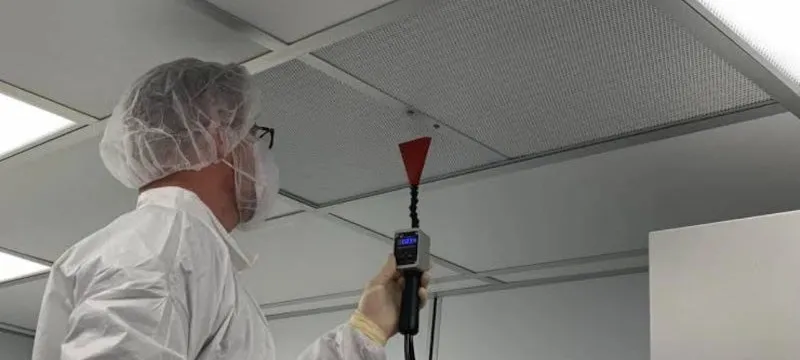
Figure 3: A picture of a technician scanning a cleanroom HEPA filter with DOP/PAO testing methods. Caption clarifies distinctions between factory and field testing.
A Transparent Cost-of-Failure Calculation
The calculation that follows serves the purpose of illustration. The figures provided here do not represent true prices; they are hypothetical figures. All costs pertaining to downtime as well as re-qualification costs are excluded. The breakdown of costs for each line item of $200 is provided below to avoid the risk of double-counting of the installation and testing costs.
| Path | Line Item | Cost | Remarks |
|---|---|---|---|
| Direct Replacement | New filter | $300 | H14 combined unit filter, example price |
| Direct Replacement | Installation & post-installation test | $200 | Includes cost of labor for installation and one (1) field leak scan |
| Direct Replacement | Total | $500 | Base cost for the Replacement Path |
| Taking A Cleaning Procedure (Failed) | Cleaning labor | $120 | Labor for taking apart, cleaning, drying and putting back together |
| Taking A Cleaning Procedure (Failed) | Repeat field leak test | $200 | Cost for one (1) field leak scan following the cleaning process |
| Taking A Cleaning Procedure (Failed) | Replacement filter | $300 | New H14 unit after failed testing |
| Taking A Cleaning Procedure (Failed) | Additional labor for installation | $200 | Cost for installation and retesting |
| Taking A Cleaning Procedure (Failed) | Total | $820 | Failed path, excluding duration of downtime |
| Difference | $320 | Cost of failed cleaning option before factor of downtime |
| Path | Line Item | Cost |
|---|---|---|
| Direct Replacement | New filter | $300 |
| Direct Replacement | Installation & post-installation test | $200 |
| Direct Replacement | Total | $500 |
| Cleaning (Failed) | Cleaning labor | $120 |
| Cleaning (Failed) | Repeat field leak test | $200 |
| Cleaning (Failed) | Replacement filter | $300 |
| Cleaning (Failed) | Additional labor for installation | $200 |
| Cleaning (Failed) | Total | $820 |
| Difference | $320 |
Table 2: Example of a Cost Comparison — Direct Replacement vs. Cleaning Attempt.
The calculations reflect taking the attempted cleaning path to be more costly than the direct replacement path and testing, in the illustrative case. In the event that an attempted cleaning is successful, the operator avoids the cost of replacing the filter unit and incurs only that of labor involved in the cleaning and testing activities on the new filter unit. Whether or not to proceed depends on the documented washability of the filter unit in question and the tolerance to failure of the given site. The probability of success will not be treated as a defined metric, since this is contingent upon a filter and situation.
Common Washing Myths, Briefly Corrected
Myth: "Drying restores the integrity of the filter." Fact: Drying does not guarantee that the fiber configuration, pleat design, or seal integrity are acceptable. Don't put back into service a non-washable terminal filter just because it appears to be dry or clean.
Myth: "A clean-looking filter is a good filter." Truth: Just because it looks clean does not mean that it is efficient or leak-proof. You must test the filter using the appropriate method to verify its performance.
Myth: "A washable pre-filter means that the HEPA is washable." Fact: The pre-filter is separate from the HEPA stage. The washing of the pre-filter does not affect the HEPA filter cleaning requirements.
Proper Maintenance: Strategies to Extend Service Life
Replacing the "cleaning" concept with load reduction, airflow trending, inspections, and documented decisions is the best approach to HEPA filter maintenance. Filters should be replaced based on damage, failed integrity tests, or pressure-drop and airflow limits rather than appearance or time.
The difference between manufacturer ratings and site-specific alarm limits is crucial for HEPA filter maintenance planning. Deiiang lists initial resistance ratings of ≤200 Pa for H13 and ≤220 Pa for H14, while final resistance is 400-600 Pa. These are the catalog values and are not specific site limits.
The Role of Pre-filtration (F5-F9)
Deiiang's historical EN 779 catalog information at 0.5 µm indicates F5 = 45%, F6 = 65%, F7 = 85%, F8 = 90% and F9 = 95%. EN 779 is historical categorization. ISO 16890 has now become the standard for defining new systems for most ventilation filter categories, meaning that those descriptions of figures provided with this document are no longer the basis for specifying new systems, but are nevertheless a way of understanding their performance.
Using a six-bag filter of size 592 × 592 × 381 mm as an example, the catalog lists the data for this filter at 2,050 m³/h, 3.18 m², initial resistance lower than 50 Pa for F5 and lower than 100 Pa for F8, and a final resistance of between 250 Pa and 400 Pa. For the fiberglass model, the material can function at maximum temperatures of 150°C, and with the synthetic version, it is 80°C.
It is easy to see the logic behind pre-filtration. Capture of particle load upstream will decrease the amount of dust entering in the terminal filter, and thereby will lower its pressure drop. Pre-filtration is often an economical way to increase the life of the terminal filter. To properly evaluate any specific case in any facility, the following data should be known: the particle load in the atmosphere, dates of pre-filters change, pressure drop curves, terminal pressures at corresponding flow rates, and operating periods. Without this information, no individual percentage increase can be established based on the data.
| Grade | Efficiency at a 0.5 µm | Example | Airflow | Filter Size | Starting Resistance | End Resistance |
|---|---|---|---|---|---|---|
| F5 | 45% | 592 × 592 × 381 mm, 6 bags | 2,050 m³/h | 3.18 m² | <50 Pa | 250–400 Pa |
| F6 | 65% | Various | Various | Various | 50–<100 Pa | 250–400 Pa |
| F7 | 85% | 592 × 592 × 381 mm, 6 bags | 2,050 m³/h | 3.18 m² | 50–<100 Pa | 250–400 Pa |
| F8 | 90% | Various | Various | Various | <100 Pa | 250–400 Pa |
| F9 | 95% | Various | Various | Various | <100 Pa | 250–400 Pa |
| Grade | Efficiency at 0.5 µm | Starting / End Resistance |
|---|---|---|
| F5 | 45% | <50 Pa / 250–400 Pa |
| F6 | 65% | 50–<100 Pa / 250–400 Pa |
| F7 | 85% | 50–<100 Pa / 250–400 Pa |
| F8 | 90% | <100 Pa / 250–400 Pa |
| F9 | 95% | <100 Pa / 250–400 Pa |
Table 3: Deiiang F5–F9 Pre-Filter Data (Old EN 779).
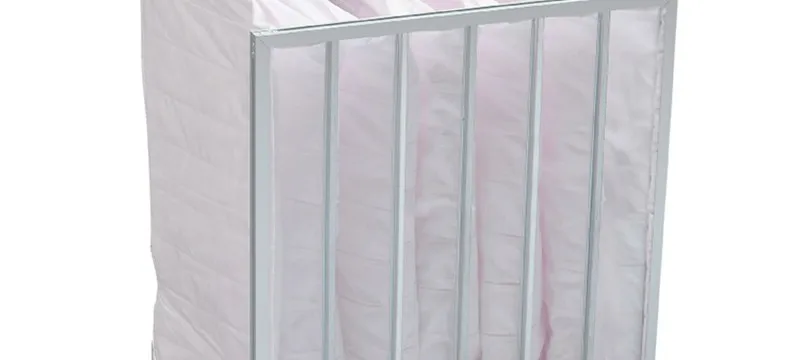
Figure 4: Conceptual diagram showing the previous results of particles entering before and after pre-filtration; indicate illustrative and not a service life prediction measured reading values.
Pressure-Drop Trending: Initial, Final, and What Changed
A routine cleanroom HEPA filter pressure-drop monitoring procedure includes the following sequence. The baseline measurement must be made when clean filters are installed; the known airflow must be noted, measurement point, date, and the condition of the pre-filter must also be noted at the time of the reading. The corresponding readings in trend must be at the same airflow since pressure drop will vary according to airflow and a measurement taken at a different airflow rate cannot be compared directly. Watch for step changes in addition to trends because a sudden drop in readings will indicate failure of media or seals, whereas gradual increases in readings will show normal loading.
It should be noted that differential pressure of the terminal filter must be separated from the total pressure drop across the filter train when trending HEPA filter maintenance data. A total reading across the pre-filter, HEPA, and any gas-phase filter will relate to the performance of the system and not specifically to that of HEPA alone. For determining the need for HEPA filter maintenance, measure the differential pressure of the terminal filter itself where the installation has a specific point of measurement.
Deiiang's combined filter catalogue states initial resistance values for H13 and H14 filters of up to 200 Pa and 220 Pa, respectively, as well as final resistance readings in the range of 400 to 600 Pa under conditions specified for each model. For example, in the case of the model with dimensions 592 mm x 592 mm x 292 mm and that has 4 folds, and which measures up to 200 Pa, it also has the same final resistance range. Please note that 400 to 600 Pa is not a set value. The airflow in the system and the specifications of the fan and housing must all be taken into account when determining what point will trigger action in a system. Therefore, if the HEPA filter is operating with low airflow, the effective limit may be reached at a lesser drop in pressure than the catalog provided final resistance.
replace, Test, or Continue: An Operator Decision Path
The decision-making process for a washable HEPA filter begins with the state of the filter. If the external portion of the filter housing has water on it, but the media has not been wet, conduct an inspection of the gasket and the housing interface, record findings, and continue monitoring. If the glue has been wet or if there are any other problems, it will be necessary to isolate the filter and consult with the manufacturer and the facility's SOPs. If the model number is specifically given as a washable HEPA filter model, then the validated instructions and steps for cleaning must be followed. If the model number isn't a wash model, then the filter must be replaced.
If the filter has evidence of a damage or irregularities in its installation, it must be replaced and given a requalification. In the event of exceeding the acceptable limits for pressure drop at the facility where the terminal filter is located, assess the upstream filter conditions before concluding that the terminal filter has failed. If the readings established by the plant are within prescribed performance limits, then continue to monitor the same.
The steps taken, in text form: (1) Determine if water penetrated the media. (2) Review the washable HEPA filter classification for the model used. (3) If the filter is washable, conduct the necessary procedures. (4) If not or if there has been damage or failure of the testing equipment, replace and requalify. (5) If there has been an increase in the pressure drop, investigate upstream filter conditions. (6) If everything else has met normal standards, proceed with monitoring the operation.
Vacuuming, Compressed Air, and Wet Wiping: Three Different Risks
The use of vacuuming equipment on the media with a nozzle can result in the clipping of fibers and consequently result in the liberation of contaminants. The pressure of water flowing through intact media does not automatically evacuate the material deposited on the media, although there is a high likelihood of the process leading to release through the techniques mentioned. The cleaning of an approved surface is different than vacuuming the filter media.
When compressed air is delivered onto the media, there are likely to be damages to the pleats of the media or liberated materials. The force may even create pinholes on the media or separate the media from its sandwiched material. Additionally, even with reduced pressure, the potential for damage in that area has to be taken into consideration.
Wet wiping the media will cause moisture to enter the pleat structure and could drive contaminants further into the fiber structure. This is a continuing problem of HEPA filter water damage and is completely avoidable.
| Method of Cleaning | Primary Risk | Safer Method |
|---|---|---|
| Vacuuming media | Physical abrasion, particles dislodged, leaks | Do not vacuum the media; only clean the exterior of the housing according to standard operating procedures. |
| Using compressed air on the media | Punctured pleats, creation of pinholes, and release of contaminating particles | Do not use compressed air on the media. |
| Wet wiping media | Introduced moisture and movement of contaminants | Do not wet wipe the media; only clean outer surfaces according to SOP. |
| Method | Risk | Safer Action |
|---|---|---|
| Vacuuming media | Abrasion, dislodged dust, leaks | Do not vacuum media; clean housing only |
| Compressed air | Punctures, pinholes, particle release | Do not use compressed air on media |
| Wet wiping | Moisture and contaminant movement | Do not wet wipe media; clean outer surfaces |
Table 4: Method of Cleaning, Risks Involved, and Safer Methods of Action.
Case Study: Pharmaceutical Packaging Facility (class 1000/iso 6)
This case study is summarized from project records provided and not a complete detailed measurement report. class 1000 is an older term that was used for ISO 6. In this case, project records were labeled iso 7 for the baseline and ISO 6 for the project. The purpose of this study is to demonstrate the difference between a filter that appears serviceable and one that is verified.
Project Challenges: Particle Load, Plenum Space, and Airflow
The extremely high ambient particulate load required a strong cleanroom HEPA filter capacity. Also, there was insufficient plenum height to use standard depth filter housings. At the same time, there was a strict requirement for pressure drop in order to maintain the airflow.
ISO 7 is based on supplied case data. Before and after counts, sampling dates, operating conditions, and scans will not be published unless the original records are confirmed. Where a record cannot be disclosed, the reporting presented should be in the form of a summarized account of the project rather than a measured reporting of results.
Deiiang's Solution and Verification Plan
SUPPLIED UNIT:
Deiiang supplied H14, high-efficiency filters, dimensions being 592 × 592 × 292 mm, rated capacity of 2,500 m³/h at 20.04 m² filtration area and ≤ 220 Pa initial catalog resistance. The installation included also the silicone-free sealing gaskets and the F7 upstream pre-filters. The request for silicone-free sealing came as a result of the use of hydrogen peroxide vapor for decontamination and possible degradation of the standard sealing gaskets subjected to repeated exposure.
The final selection of the H14 filter, dimensions 592 × 592 × 292 mm, rated capacity of 2,500 m³/h and at 20.04 m² filtration area was driven also by the fact that it could meet the airflow and efficiency needs while offering an initial catalog resistance of ≤ 220 Pa. The necessity for the installation of the F7 pre-filter stage was justified due to the presence of ambient particles resulting in the capture of coarse particles upstream. DOP scan testing by unit use is attributed to the record of the project as being a factory test record prior to shipping, and not as being a record after installation. Leak testing, which is specific to the installation activities, remains its own separate field activity, which occurs after the completion of the qualification process.
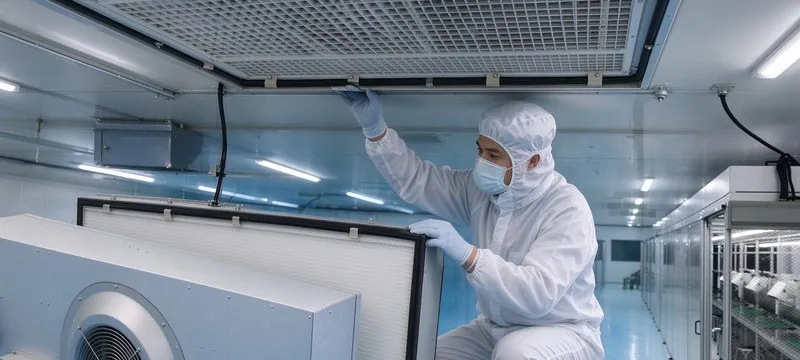
Figure 5: Case-study on-site photo showing the installed H14 filter and gasket seating in the pharmaceutical packaging cleanroom.
Results, Evidence, and Limits of the Claim
The outcome supplied involves particle counts transitioning from ISO 7 baseline to stable ISO 6. It is stated that there were measurable energy savings due to low initial pressure-drop; however, kWh, fan-power, measuring time and baseline comparison data were not provided. Users must first obtain records before declaring a quantified savings. If the records are not available, low catalog initial resistance will be beneficial for minimizing fan pressure demand but this will not be declared as a quantified savings.
Actual before and after particle counts, testing conditions, and scan reports should be added to this section only when authenticated project records are available for publication.
In the absence of authenticated particle count information, the narrative written about the design approach and verification plan will not be considered as a quantified performance claim.
It is imperative that the terminal HEPA filter be thrown away instead of washed, unless the model used for washing the filter has been verified and approved. Filters should be replaced based on any damage, failure when subjected to integrity testing or due to pressure drop or airflow, and never because of appearance or the outcome of elapsed times.
The clients should be advised that dimensions, rated airflow, class, initial and final resistance, gasket compatibility as well as testing specification requirements should be included on the order form to ensure that the new HEPA filter matches the installation and meets the qualification specifications.
Possible inclusion of assistance from Deiiang's engineering team.
A Replacement Specification Checklist for Buyers
Combined high-efficiency filter is one of two design options cited in the case study, specifically the 592 × 592 × 292 mm, 2,500 m³/h, H14 filter designed for an indoor space. The other option is the DOP Integrated H13/H14 filter which has been designed for restricted height applications. This option is size 610 × 610 × 120 mm and is rated for 1,000 m³/h with an 11.32 m² face area and an initial resistance of ≤200-220 Pa and a final resistance of 400-600 Pa.
The two options are different in terms of both air-flow and dimensions, but the DOP Integrated Filter comes with the added components of a section of inlet pipe, adjustment valve, an outlet-situated DOP test point, and outside PEF insulation. Thus, one cannot substitute the DOP Integrated Filter for the combined filter; it is a unique choice made due to a different design limitation.
Prior to ordering, be sure to check the following items:
An RFQ checklist is available as long as the site is compatible for download.
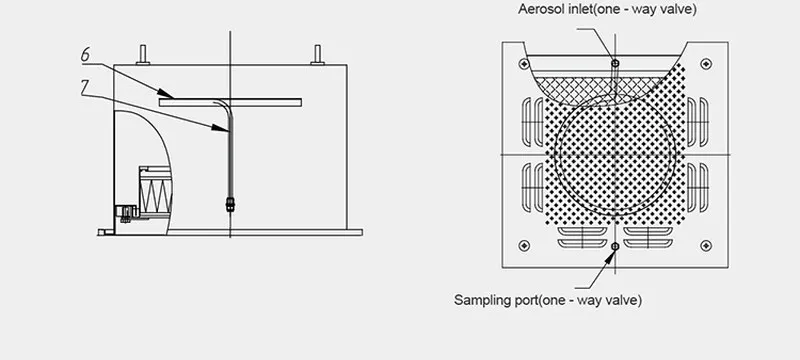
Figure 6: Product dimensions for the DOP Integrated Filter.
Authors and reviewers: Jason.peng serves as technical reviewer for this article. The role of a reviewer is not an independent certification.
Conclusion: When to replace Your HEPA Filter
If you have been wondering whether a HEPA filter can be washed, the operational takeaway is that cleanroom HEPA filter replacement should proceed based on damage, failed integrity tests, or pressure-drop and airflow limits — not on appearance or elapsed time. A washable HEPA filter only makes sense when its manufacturer has documented the cleaning procedure, the cycle limit, and the post-cleaning performance evidence. For every other unit, the safest and most defensible approach to HEPA filter maintenance is replacement, followed by installation verification.
FAQ-Style Quick Reference
Is it possible to clean a HEPA filter?
The answer is no, unless the manufacturer has specifically approved such a cleaning procedure.
What happens if a HEPA filter gets wet?
The first point of differentiation is to determine whether it is the external casing that has been affected, or the media. If the media has gotten wet, and the product is not rated as being water tolerant, it is necessary to get rid of the filter.
What is the actual situation regarding washable HEPA filter products?
Certain products do exist, but they are not valid alternatives to the use of certified terminal filters in cleanroom or regulated applications.
Is it alright to vacuum the media?
No, it is not, because vacuuming can cause damage to the media and free any accumulated dust. Cleaning is allowable only in accordance with standard operating procedures.
Can compressed air be used?
No. It cannot, because compressed air causes the pleats to be damaged and pinholes to develop.
How much pressure drop should occur before replacement becomes necessary?
The replacement pressure drop should follow your standard operating procedures plus the specific model's final resistance.
Does an F7 pre-filter allow for washing of HEPA filters?
No. The pre-filter and HEPA filter are independent of one another.
Is leak testing required after replacement?
Leak testing addresses classification based on airborne particle concentration; however, it does not describe any specific washing prohibitions or universal testing schedules. Follow the facility's qualification protocol for the applicable installed-filter test requirements.
References and Technical Sources
- [1] iso 14644-1:2015 — Cleanrooms and associated controlled environments — Part 1: Classification of air cleanliness by particle concentration. International Organization for Standardization. iso.org/standard/53394.html. Addresses classification by airborne particle concentration; it does not define washing prohibitions or universal test schedules.
- [2] iso 14644-3:2019 Cleanrooms and Associated Controlled Environments Testing Methods defines the testing methods utilized including that of filter leakage testing however the specific method utilized is based on the facility's qualification process. iso.org/standard/60598.html
- [3] EN 1822-1:2019 High Efficiency air filters EPA, HEPA, and ULPA Classification, Performance Testing, Markings. The European Committee for Standardization defines what is required in filter classification, testing however it does not authorize washing the product. webstore.ansi.org/standards/din/dinen18222019
- [4] EN 1822-4 And EN 1822-5 Testing Procedures For The Testing of Filter Elements and Filter Media. Filter elements and filter media are covered by these testing procedure parts of EN 1822.
- [5] ISO 29463-1 High Efficiency Filters and Filter Media To Remove Particles From Air defines both classification and performance testing requirements for high-efficiency filters and filter media.
- [6] IEST-RP-CC001 HEPA & ULPA Filters verifies different aspects between the available different filter types. Be sure to check the current edition and any statements that need to be verified. iest.org/Standards-RPs/Recommended-Practices/IEST-RP-CC001
- [7] EN 779:2012 Particulate Air Filters for General Ventilation Determination of the Filtration Efficiency Procedure. A legacy classification that has been replaced by ISO 16890 in most regions. The Deiiang F5-F9 catalog uses a legacy basis. shop.standards.ie — EN 779:2012
- [8] Deiiang combined efficiency filter catalog, integrated DOP filter catalog, super high efficiency baffle-free filter catalog, F5-F9 prefilter catalog. You must double-check reference to current editions and date to ensure that publication is consistent with your reference documentation.
- [9] Camfil Technical Bulletin — FAQ: HEPA & ULPA Air Filters. Used as the basis for the observation that a wetted filter which is allowed to dry can still show a higher pressure drop than before, and that prolonged wetness may support microbial growth.