+86 13638632902
 Jason@cleanroomequips.com


 MENU
MENU
Cleanroom Pressure Differential is a critical factor that I have found to be a main stabilizer for HVAC systems that I have designed for various pharmaceutical and electronic cleanrooms. A stable Cleanroom Pressure Differential is really the only thing that stands between a perfectly sterile batch of product and a disastrous contamination event.
Why Stability Matters: Beyond the Gauge Reading
So if the HEPA filters are the lungs of your facility then this pressure gradient is the constant breath of the air in your cleanroom pushing all the contaminants away. The failure of this basic control would likely trigger an alarm but in many cases would be considered a major failure and would probably result in the production being halted as the facility would not be considered to be meeting the iso 14644-3 cleanroom standards.
Regulatory Compliance Requirements
For iso 14644-3:2019 for cleanrooms the minimum pressure difference between adjacent cleanliness classes must be 10 Pa and must be tested for at points 1.2 m above floor level and at least 1 m from supply and return grilles.
For sterile areas, as described in EU GMP Annex 1 (2023), clean production areas must be at a minimum of 15 Pa lower than non-clean areas. For Grade A/B areas, active control using a closed-loop system must be used as the standard method of control.
The electronic records of pressure measurements must be traceable, auditable and stored for a minimum of 3 years as per 21 CFR Part 11 of the FDA for pharmaceuticals.
The Mechanics of Airflow Containment
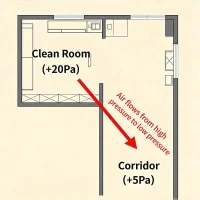
Visualizing airflow direction driven by pressure differences.
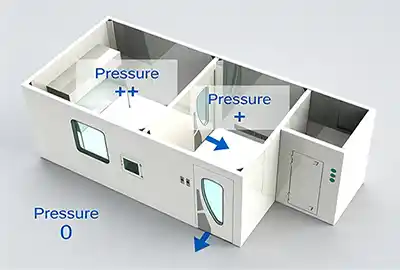
The physics behind this work involve the movement of air from areas of high pressure to low pressure. The simple diagram provided above indicates that by keeping the static pressure (the air pressure not in motion) inside a cleanroom at a higher level than in a corridor (e.g. +20 Pa inside the cleanroom and +5 Pa in the corridor) any leakage through cracks in the construction or through doors will move outward from the cleanroom. Thus, preventing entry of dust and micro-organisms against the natural flow of air.
More so, selecting the right Cleanroom pressure differential control architecture during the design phase is also critical to mitigate later instability problems and costly retrofits, as noted in issues related to the wrong selection of control architecture in Deiiang™’s past projects.
Categorizing Control Methods
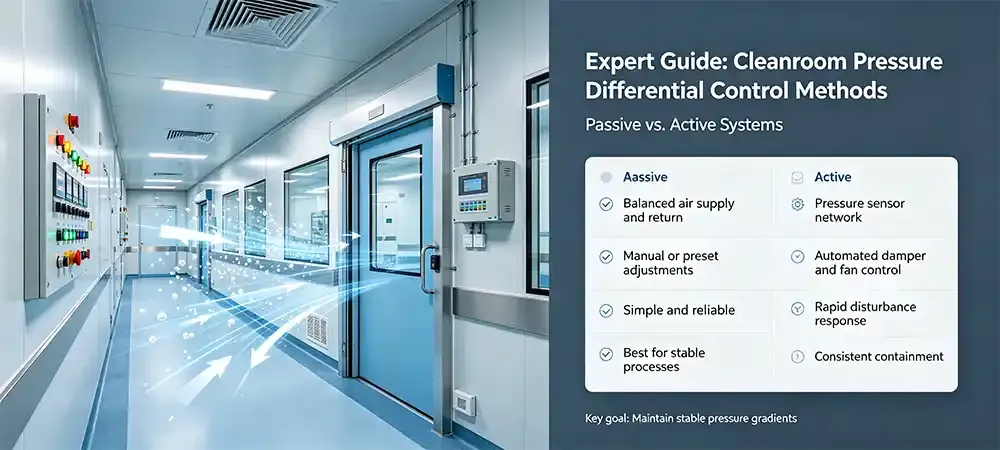
When speaking with Facility Managers, I group control methods into two broad categories (with a third method that serves the middle ground of needs) – based on their speed of response and cost: Static (or ‘Passive’) methods and Dynamic (or ‘Active’) methods.
System Architecture Overview
Passive Control (Static): Passive systems use mechanical balancing and are designed with constant air volume (CAV) valves and manual dampers.
Active Control (Dynamic): Uses Variable Air Volume (VAV) components to create the cleanroom and utilize feedback loops with pressure sensors and motorized actuators to control airflow in real time to counteract differential pressure variations.
Hybrid Control: A mix of fixed supply air with variable return regulation. Typically is used to balance cost with performance in cleanrooms that are ISO 7 and below.
In summary, eACH of these architectures can provide very different levels of control for your facility, and thus influence the level of operational resilience you can expect to achieve. Below we further outline each of the previously described architectures, as well as the mechanical means by which these architectures attempt to control Cleanroom pressure differential to achieve their control objectives.
wtD4o6E22bE
Deep Dive: Passive (Static) Control
The passive approach to Controlling in Cleanrooms utilizes a traditional method of “progressive offset”. The offset is achieved during the TAB (Testing, Adjusting, and Balancing) phase of commissioning when the supply air is set to a fixed volume and exceeds the volume of the exhaust air. This offset is discharged through various leakage paths or a specially designed weighted relief damper to create the necessary Cleanroom Pressure Differential.
Passive / Open-Loop System
Constant Supply (CAV)
→Cleanroom
→Mechanical Relief Damper
→Constant Exhaust
Linear path without data feedback. Stability relies entirely on mechanical consistency.
The Advantages: Low capital expenditure (CapEx) and fewer electronic points of failure. This is typically sufficient for a standard iso 8 storage area or corridor.
The Operational Risks: This passive system is “blind” to changes in airflow as it assumes constant airflow for all time. As HEPA filters load up with dust, their resistance to airflow increases. Thus the supply of fresh air decreases, while the exhaust fan pulls air at the same rate, thus reducing the positive pressure in the room. To maintain compliance, this passive system requires to be rigorously manually re-balanced as the filters are cycled. I have seen rooms drop from +15 Pa to +2 Pa over a filter cycle.
Jason’s Field Note
Many clients opt for passive control in core production zones in order to save on initial capital expenditure, however by the time of the next GMP audit (6-12 months later) pressure drift over filter life cycles will have caused problems leading to failure of audit. The cost of retrofitting plus production downtime in fact ends up being 2 times the initial price difference. Passive control is suitable for corridors and other low risk storage areas but not for critical process rooms.
Deep Dive: Active (Dynamic) Control
Active control is needed for mission-critical applications such as GMP fill-finish lines or biosafety labs. Such control systems are based on a Closed-Loop Feedback System. These systems measure and then act as opposed to guessing.
The Closed-Loop Feedback System utilizes a high-precision differential pressure transmitter (DPX), such as Deiiang’s CCY11 model (±0.5%FS) differential pressure transmitter, and a programmable logic controller (PLC) such as a Siemens S7-1200 or a 6ES7288 Smart series PLC. The system's feedback loop compares measured variables to set points, which in this application is the room pressure. If the system detects any differences (or "error") then the system initiates a correction, which in this application is via fast acting actuators.
These may be supply air or return air damper actuators that are remotely operated by a 2-10V signal sent by the PLC (or other system's controller). In the end, airflow is modified until the optimal pressure is reached and then maintained within set parameters.
Active Control Feedback Loop
1
Detection
Sensor reads actual pressure (e.g., +18 Pa)
2
Computation
PLC calculates error vs. Setpoint (+20 Pa)
3
Correction
Actuator modulates damper position
4
Result
Pressure stabilizes to Setpoint
Continuous Cycle: The system samples and adjusts multiple times per second.
Active Cleanroom pressure differential control offers the greatest benefit in terms of resilience to open process doors. Instant detection of corresponding pressure drop by sensors and corresponding increase in supply by VAV boxes ensures corresponding compensation. In addition, by means of corresponding “setback modes”, the total volume flow can be reduced at night and on weekends for energy saving purposes, while at the same time maintaining the required pressure differences.
Deiiang Project Case: Wuhan Pharmaceutical GMP Workshop Retrofit
A 1,200m² oral solid dosage (OSD) manufacturing facility previously employed passive pressure control. The Grade C area consistently failed stability testing as the pressure dropped from +15 Pa to +4 Pa as the HEPA filters became clogged with dust during the annual GMP audit.
Upgrading the facility to operate with an active closed-loop pressure control system utilizing Deiiang CCY11 differential pressure transmitters and a Siemens PLC to manage process control, door operation and I/O functions enabled sufficient pressure stability to pass GMP audits with zero non-conformities even with door opening/closing. Operating the system in a night setback mode of operation reduced energy consumption by 22% in night time mode of operation.
Comparison: Passive vs. Active
Choosing the right path. In my consulting I have the option of advising based on risk tolerance or Opex vs. Capex. So for example someone running a class 100,000 (ISO 8) assembly area can opt for a passive solution. However someone handling potent compounds or requiring an iso 5 area is going to need an active solution. The only safe solution.
| Feature | Passive / Static Control | Active / Dynamic Control |
|---|---|---|
| Control Logic | Open-loop (Fixed Airflow) | Closed-loop (Feedback Driven) |
| Initial Investment | Lower | Higher (30-50% premium) |
| Stability Precision | Low (Drifts ±5 Pa easily) | High (Maintains ±1 Pa) |
| Dynamic Response | Non-existent | Immediate auto-correction |
| Maintenance | High (Frequent re-balancing) | Low (Sensor calibration only) |
| Efficiency | Fixed (Constant energy use) | High (Variable speed potential) |
| Ideal Application | ISO 7/8, Low Risk, Cost-sensitive | ISO 5/6, GMP, Bio-Safety |
Deiiang pulled data from his project at over 120 cleanrooms across 3 years. It shows passive systems for humidity control are a pretty cheap up-front fix at 30-40% less cost than active systems, but that you have to rebalance them manually every 3-6 months which in turn requires labor and results in downtime that in the end adds up to 25% of the initial investment annually.
Active systems for humidity control cost a 30-50% higher initial investment, but as a result of their setup of sensors and a control unit, the annual maintenance labor is cut by 60% and their energy consumption is reduced by 20-30% through the use of setback modes. Deiiang estimates that for ISO 7 or higher cleanrooms, the total cost of ownership for active systems for humidity control over a 5-year period is about 18% lower than for passive systems.
Industry-Specific Selection Guide
| Industry Scenario | Cleanliness Grade | Recommended Control Method | Pressure Setpoint Reference | Compliance Basis |
|---|---|---|---|---|
| Pharmaceutical aseptic filling | ISO 5 (gmp grade a) | Active closed-loop control | +20 to +25 Pa | EU GMP Annex 1 |
| Pharmaceutical weighing & compounding | ISO 7 (gmp grade C) | Hybrid (fixed supply + variable return) | +15 Pa | EU GMP Annex 1 |
| Electronics SMT assembly | ISO 8 | Passive control | +10 to +12 Pa | iso 14644-1 |
| BSL-3 biosafety lab | ISO 7 | Active closed-loop negative pressure | -15 to -20 Pa | WHO Biosafety Guidelines |
| Food packaging workshop | ISO 8 | Passive control | +8 to +10 Pa | FDA Food Code |
Ultimately, your choice defines your facility's reliability. Active systems transform your Cleanroom Pressure Differential from a manual headache into a managed, automated asset.
Strategic Layouts: Bubble, Cascade, and Sink
Once you have selected a control method, it is time to define the pressure hierarchy or “map” that your control system will follow. As HVAC designers, we typically employ three different strategies to protect either the product or the environment.
However calculating the required airflow offset is critical to implementing Cleanroom Pressure Differential. We use the orifice equation: Q = C * A * √(2ΔP/ρ). Therefore, in order to hold +15 Pa with a leakage area of 0.1 m² an offset of 100-150 CFM would be required. This simple math underpins all our cleanroom design decisions.
Airflow Offset Calculator
Use the orifice equation to estimate the required supply-exhaust airflow offset to maintain your target pressure differential based on estimated room leakage area.
Pressure Differential Airflow Offset Calculator
Troubleshooting: Tuning for Stability
Even the best of hardware can fail when there is a failure in logic. Most of my work today consists of resolving issues with the “hunting” damper and alarm issues that continue to activate, even when technicians are simply entering the room.
Common Pressure Stability Problems
| Fault Symptom | Root Cause | Troubleshooting & Resolution Steps |
|---|---|---|
| Zero or reversed pressure reading | HEPA filter clogging, duct leakage, fan rotation direction, or reversed sensor tubing | 1. Check filter pressure drop 2. Verify fan rotation and airflow direction 3. Confirm high/low pressure ports on the sensor |
| Fluctuating pressure and nuisance alarms | Door seal failure, sampling port near supply/return grille, adjacent room pressure interference | 1. Inspect door gaskets and seals 2. Relocate sensor to a neutral zone at 1.2 m height 3. Add 15–30 second alarm delay |
| Pressure slowly drops over weeks | Pre-filter/HEPA loading, supply airflow decay, or damper linkage slip | 1. replace loaded filters 2. Re-balance supply and exhaust flows 3. Verify damper actuator calibration |
| Negative room pressure unstable | Exhaust fan speed variation, insufficient fresh air makeup, or door opening sequence issues | 1. Interlock supply and exhaust fans 2. Stabilize fresh air volume 3. Use closed-loop pressure control for BSL and potent compound areas |
The Oscillation Issue: If your actuator is moving every second, it will fail prematurely.
Fixing Unstable Pressure Readings: Implementing Deadbands & Delays. By giving a control system some ‘breathing room’ it is possible to implement and control a pressure system. I would suggest setting a deadband of ±1 Pa around the setpoint of 20 Pa. This would mean the controller does nothing until the pressure reads outside of the 19-21 Pa band. Also it is suggested that an alarm time delay of 15-30 seconds is implemented. A door opening causes a momentary drop in pressure. This is physics not a failure. So prevent nuisance alarms that train staff to ignore warnings.
PID Tuning Tips: When it comes to pressure in the air, stay away from high Derivative (D) gain values, as air pressure measurement values contain lots of noise. Thus rely on Proportional (P) action for control, and Integral (I) action for the steady-state error. High-quality air pressure sensors, such as the Deiiang™ CCY11 (response <400ms), allow for the cleanest possible signals required for exact PID-tuning.
Jason’s Field Note
As Jason noted, there is so much more to get a stable pressure reading than to get a controller to work. He said in his experience about 90% of unstable pressure reading problems are not related to the controller itself. The problems that cause these kinds of problems are generally with the sensor installation. To achieve stable pressure reading, do not install pressure sampling port under a supply diff, near return grilles, in corners etc. Instead install the sampling port in a neutral part of the room. Typically this would be about 1.2m (4ft) above finished floor level. Avoid locations near doorways, in high use areas and in areas where people are constantly passing through. Typically this would be about 1.2m (4ft) above finished floor level.
Ideal Response to Door Event
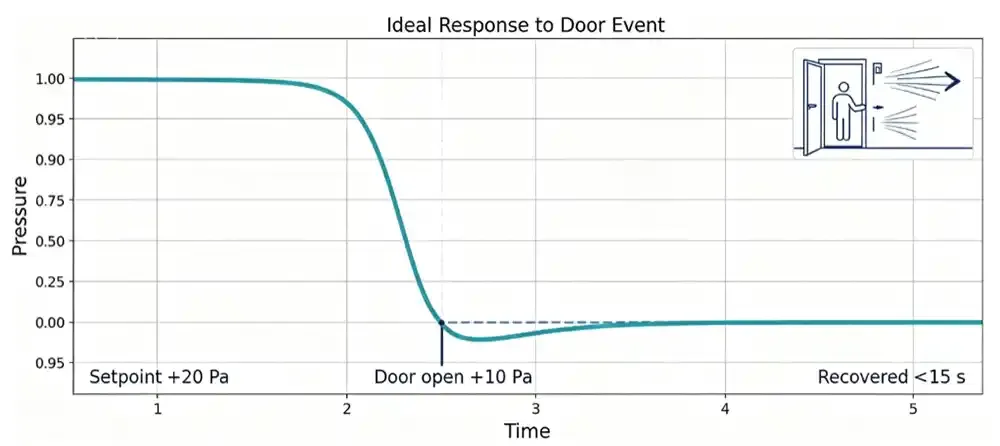
Visualization of a tuned recovery. Note the rapid return to setpoint without overshooting.
The Graph shows a trace from a real commissioned site. Notice the drop to +10 Pa when the engineer enters the room, and how the Active Control system hasn’t ‘had a heart attack’. It’s smoothly ramping up to bring the pressure back up to +20 Pa, within 15 seconds or so, with a ‘soft landing’ to prevent any nuisance alarms.
Maintain your Cleanroom Pressure Differential by checking damper linkages for slippage and verifying sensor calibration (annually).
Testing & Validation Protocols
Whether for routine maintenance activities or for preparation of a GMP audit, a reliable pressure differential system must be measurable, documentable and auditable. Validation of the following steps is necessary.
Verify cleanroom air cleanliness by performing pressure differential tests in accordance with ISO 14644-3:2019, Clause 6, test methods for pressure differential tests.
Perform the tests in static as well as in dynamic conditions, i.e. with equipment running without personnel as well as in normal production.
For tests between adjacent Cleanliness Classes the differential pressure should be at least 10 Pa.
A minimum differential pressure of 15 Pa between the clean core area and the surrounding area must be guaranteed for aseptic and high risk areas.
Test point to be located at approximately 1.2m above floor level and situated remote from perimeter supply / return outlets and doors and windows.
Record pressure readings when they are at a stable value and not immediately after the door has been opened or closed.
Re-validate after filter replacement, major change to HVAC, damper re-calibration, etc. Also re-validate after any changes to the room layout.
This evidence will be used for future GMP and ISO audits and must be recorded within the DQ / IQ / OQ / PQ documentation.
Recommended Frequency:
- Daily / Weekly: Monitor pressure gauge readings and alarm logs.
- Quarterly: Inspect door seals, damper linkages, and filter condition.
- Annually: Perform full pressure mapping, sensor calibration, and third-party validation.
- After any major change: Re-balance and re-validate pressure hierarchy.
Final Thoughts: Risk vs. Cost
The question for Cleanroom Pressure Differential control, whether to use passive or active systems, is always the same: What is the cost of failure? Low-risk areas can be run cost-effectively using passive systems of control. For critical processes, however, the cost of failure is too high to be risked by passive systems of control, and an investment in active systems is justified as an insurance policy.
Ultimately you want confidence in your Cleanroom and that will come from knowing that airflow is going in the correct direction for the specific application regardless of filter clogging or other room changes. A simple manual damper will satisfy the needs of some lower risk areas whilst for higher risk applications the more sophisticated Deiiang™ CCY11 sensor suite will ensure full control is always available.
Unsure About Your Pressure Strategy?
Navigating ISO standards, airflow calculations, and GMP requirements can be complex. Our engineering team specializes in optimizing pressure hierarchies for efficiency, safety, and compliance.
Consult Our EngineersFrequently Asked Questions (FAQs)
What defines active Cleanroom Pressure Differential control?
Active control systems utilize sensors, such as the CCY11, to continuously monitor the pressure in a room. Based on the readings from the sensor, the controller that operates the motorized damper in a room will adjust the position of the damper in order to keep the pressure at the setpoint even with clogged filters or open doors.
How does passive pressure control differ from active?
Passive control uses a fixed airflow setting (balancing) and does not include real-time feedback. It is less expensive, but does not have the capability to make changes (i.e. self-correct) for items such as filters that become loaded. Active control uses sensors and self-adjusts for increased stability and assurance of compliance.
When is a cascade pressure strategy used?
Cascade strategies are used in multi-room suites (e.g., Gowning -> AirLock -> Production). The cleanest room has the highest pressure, and pressure "cascades" down to the dirty corridor, ensuring contaminants are always pushed away from the core process.
What pressure differential should a cleanroom maintain?
For most cleanroom applications, adjacent cleanliness zones should maintain a minimum of 10 Pa. For sterile manufacturing and high-risk GMP areas, 15 Pa or higher is commonly required. The exact setpoint depends on room classification, industry standard, and local regulatory requirements.
Can I use passive control for iso 5 cleanrooms?
ISO 5 cleanrooms require extremely stable pressure control. Passive systems may be acceptable in very small, low-occupancy, non-GMP spaces with minimal door movement, but for most pharmaceutical, semiconductor, and aseptic applications, active closed-loop control is the recommended approach.