+86 13638632902
 Jason@cleanroomequips.com


 MENU
MENU
Indeed, it is feasible to convert an ISO 7 environment to iso 5 standards, but it usually requires more than just the installation of HEPA filters. In order to upgrade the space, experts need to analyze airflow patterns, filter distribution, room pressure, HVAC capacity, heat loads, enclosure integrity, and contamination control protocols. The upgraded space must afterwards be examined in its designated state of occupancy with respect to iso 14644 standards.
Can an ISO 7 Cleanroom Be Upgraded to ISO 5?
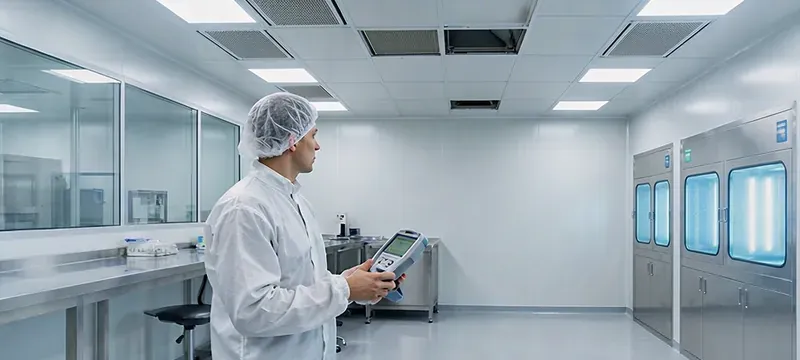
Upgrading is certainly possible, but a localized iso 5 cleanroom is likely more cost-effective and more practical than an entire cleanroom upgrade. Deiiang™ ffu systems can ease the burden on the central HVAC system, but ultimately, on-site particle counting tests should be performed to validate compliance.
Comparison of Retrofitting vs. Rebuilding
| Cost/Impact Factor | Partial Retrofits | Complete Rebuilds |
|---|---|---|
| Capital expenditure (CAPEX) | 40% – 60% lower | 100% new construction |
| Production downtime | 5 – 12 days | 1 – 3 months |
| Utilization of existing HVAC systems | 70% – 90% | 0% |
| Structural modification costs | Low | High |
| Operational risk | Moderate | High |
| Factor | Retrofit | Rebuild |
|---|---|---|
| CAPEX | 40‑60% lower | 100% |
| Downtime | 5‑12 days | 1‑3 months |
| HVAC reuse | 70‑90% | 0% |
| Struct. cost | Low | High |
| Operational risk | Moderate | High |
A well-planned retrofit typically delivers the required ISO 5 performance at a fraction of the cost and time of a complete rebuild.
Key Quantitative Disparities: ISO 7 and ISO 5
| Metric | ISO 7 | ISO 5 |
|---|---|---|
| Cleanliness | ≤ 352,000 particles/m³ | ≤ 3,520 particles/m³ |
| Airflow type | Mixed / non‑unidirectional | Unidirectional |
| Ceiling FFU Coverage | 15% – 25% | 60% – 80% |
| air changes per hour | 30 – 60 | 240 – 480 |
| Terminal filtration | HEPA (H13) | HEPA/ULPA (H14/U15) |
| Validation complexity | Moderate | High |
| Metric | ISO 7 | ISO 5 |
|---|---|---|
| Cleanliness | ≤352k | ≤3,520 |
| Airflow | Mixed | Unidirectional |
| FFU coverage | 15‑25% | 60‑80% |
| ACH | 30‑60 | 240‑480 |
| Filtration | H13 | H14/U15 |
| Validation | Moderate | High |
Preconditions for ISO 7 to ISO 5 Transition?
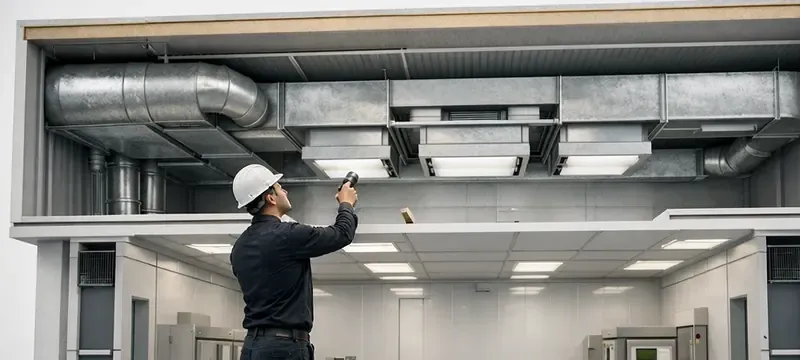
Data collection phase – analysis of current state and identification of gaps
Existing HVAC Capacity – Measurable Parameters
- Supply airflow (m³/h) and external static pressure (Pa) at the AHU.
- Defined cooling coil (kW) and heating coil (kW) design capacities.
- Verified fresh air ratio and return air volume in the HVAC return path.
- Measured filter pressure drops (initial and current) and fan VFD position.
- Measured temperature and humidity of rooms during production.
- Existing electrical capacity to supply new FFUs in the HVAC return path.
Ceiling, FFU & H Unit Compatibility
- Ceiling grid and module type (600×600, 1200×600, etc.) have to be matched with FFU footprint.
- Ceiling structural load capacity must be acknowledged; each FFU weighs 25‑35 kg.
- Obstructed access must be verified for filter replacement.
- Design clearance for replacement around ceiling fixtures and devices.
Airflow Pattern and Return Air Path
- Current airflow is assessed along with dead zones and recirculation areas.
- Disruptions from beams, equipment, and columns.
Room Leakage and Pressure Cascade
- Enclosure leakage survey: wall/ceiling joints, doors, pass-throughs, utility penetrations.
- Pressure differential relative to adjacent areas — must be positive for ISO 5 zone.
- Cracks and gaps, indicating directional airflow (telltale or smoke pencil).
Moving to ISO 5 in core zones means upgrading Personnel/Material Airlocks. air showers must be installed with a minimum air shower velocity of 20–25 m/s and pass-through boxes must contain HEPA recirculation with an internal UV/HEPA purge cycling to prevent cross-contamination. Personnel movement disrupts unidirectional flow and the ISO 5 compliant environment.
Process Heat Load and Environmental Control
- The dissipation of process equipment heat (kW) and its influence on cooling load.
- The number of personnel and their activities level — influence on particle generation and heat load.
- The fresh air requirements and the AHU capability in extreme outdoor conditions.
The Major Challenges of Retrofitting ISO 7 to ISO 5
The purpose of this chapter is to address concerns regarding the challenges of construction.
Challenge 1 — Inadequate HVAC Capacity
A common problem after the addition of FFUs is a significant drop in air flow, as the AHU does not have sufficient fan static pressure to overcome the greater filter resistance.
Solution: Use Deiiang™ FFUs with a low pressure drop filter coupled with variable speed control. If possible, strengthen the AHU fan or add a booster fan to the return air.
Challenge 2 — Airflow Distribution is Insufficiently Uniform
Even with a sufficient number of FFUs, poor layout results in turbulence. Airflow collision from adjacent FFUs can cause particle recirculation.
Countermeasure: Implement CFD simulations or deploy balancing dampers for every FFU. Adjust return grille locations to match airflow trajectories. Smoke tests will confirm their effectiveness.
Challenge 3 — Installation Constraints
A technological barrier exists whereby the existing ceiling is unable to bear the additional load of the FFUs. Outdated ducting and the electrical system may also impede installation.
Countermeasure: Use suspension rods independently threaded from the structure (not the ceiling grid). Sponsor the phased installation to happen during the weekends/off hours.
Challenge 4 — Filter Pressure Drop and Maintenance
HEPA filters get clogged with dirt and dust which diminishes airflow and reduces energy efficiency. Changes to filters at regular intervals are also an overhead cost.
Countermeasure: Use differential pressure sensors to monitor HEPA filter loading. Changes will be dictated by actual pressure drops and not by a set time. Use filters with high capacity dust holding to increase the time between maintenance.
Challenge 5 — Validation and Compliance
ISO 5 requires extensive pre-production tests, and the failure of the smallest test may also delay the restart of operations.
Countermeasure: Hire a validation consultant at the first available opportunity. Pre-test FFUs for integrity before installation. Ensure sufficient time is allocated for airflow balancing and particle count tests.
Minimizing Production Downtime During a Phased Retrofit
For many facilities, a complete shut down is not possible. With soft-wall containment, a phased retrofit can occur while the ISO 7 surrounding area remains operational.
What this looks like: Setting up soft-wall barriers around the containment area with a portable unit with HEPA filtration as a negative pressure unit to contain dust. The personnel remain in the area in cleanroom protective suiting, and the FFU is installed along with the ceiling, which is done in a phased manner of 20-30 m² at a time. Each phase is validated before proceeding to the next. This phased approach can reduce the downtime for a 100 m² area from 3-4 weeks to 5-8 days.
Jason's Field Pro-Tips
When placing FFUs above ovens or hot presses, the thermal plumes which rise conflict with the downward unidirectional airflow. To avoid this, install vinyl curtains or side panels to separate the FFU airflow and the thermal plume.
Many ISO 7 compliant T-Grid ceilings have a rating of 0.5-1.0 kN/m², and 60-80% coverage of FFUs may lead to exceeding the rating. Always use threaded rods with a vertical hold to the top of the ceiling for support.
When FFUs boost supply airflow, the return air system might not draw an equivalent volume. This can create a negative pressure compared to surrounding areas. Check the capacity of the return ducts and, if required, add a varying capacity return fan for pressure balancing.
How Deiiang™ FFU Systems Facilitate ISO 7 to ISO 5 Retrofits
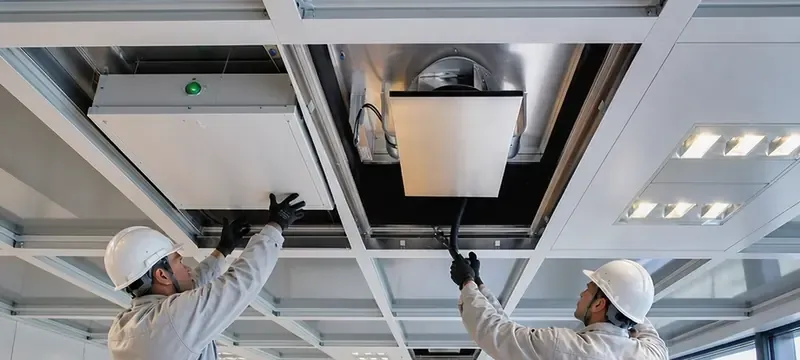
Deiiang™ FFU systems designed by Jason.peng are purposefully designed for retrofit projects. Notable attributes are as follows:
- Modular sizes of 1175x575mm and 575x575mm fit standard ceiling grids.
- EC/DC motors with variable frequency drive (VFD) ensure better speed regulation and energy efficiency.
- Filters with a low initial pressure drop (120-150 Pa) and a high dust-holding capacity (H13/H14).
- Differential pressure is measured internally with alerts for filter changes.
- Control can be centralized using Modbus or BACnet and can be done at the zone level.
- Sound levels are low, rated speed ≤55 dB(A), and suitable for occupied areas.
Saving Energy – EC Motor vs. AC Motor OPEX
Deiiang™ EC FFUs consume 30% - 45% less energy than AC FFUs at comparable operating levels. For a 100 m² ISO 5 zone (with 80% zone coverage equating to ~120 FFUs), there would be a total savings of ~85,000 kWh each year. The investment in the EC technology typically has a payback period of less than 2 years.
Local Assistance for Maintenance and Filter Change
- Replacement Pre-filters (G4/F8): low cost and change every 3-6 months, lasting as a protective layer for the main HEPA filter.
- HEPA (H14): The life of the HEPA filter is usually 3-5 years under stable EC FFU use.
- Emergency stock: Deiiang™ provides emergency stock in East and South China with a supply of filter and FFU changes available within 48 hours.
Case Study: Upgrading an ISO 7 Area to an ISO 5 Production Zone
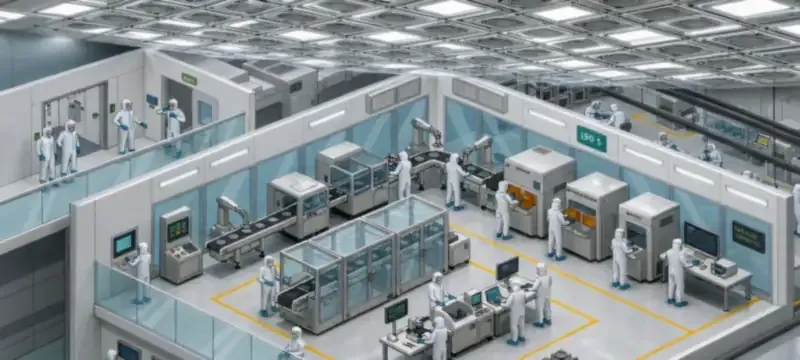
Project Overview – Suzhou Microelectronics Assembly Line
- Location: Suzhou, China
- Industry: Microelectronics (sensor assembly)
- Original classification: ISO 7 (at-rest), iso 8 (operational)
- Goal: ISO 5 (operational) over a 25 m² critical assembly zone
- Total room area: 120 m², ceiling height 3.2 m
- Project duration: 9 days (phased, 2 weekend shutdowns)
- FFUs deployed: 18 units of Deiiang™ Smart EC FFU (1175×575 mm, H14 filters)
Measured Performance
| Parameter | Before (ISO 7) | After (ISO 5 zone) | Test condition |
|---|---|---|---|
| Particle count (≥0.5 µm) | 285,000 / m³ | 2,800 / m³ | Operational |
| Particle count (≥5.0 µm) | 1,200 / m³ | 25 / m³ | Operational |
| Room pressure differential | +12 Pa | +25 Pa (relative to adjacent) | At‑rest |
| Average face velocity | 0.2 m/s (mixed flow) | 0.48 m/s | Operational |
| Total supply airflow (zone) | 2,400 m³/h | 12,800 m³/h | Operational |
| Temperature stability | ±1.2 °C | ±0.4 °C | Operational |
| Parameter | Before | After |
|---|---|---|
| Particles ≥0.5 µm | 285k | 2,800 |
| Particles ≥5.0 µm | 1,200 | 25 |
| Pressure diff. | +12 Pa | +25 Pa |
| Face velocity | 0.2 m/s | 0.48 m/s |
| Zone airflow | 2,400 m³/h | 12,800 m³/h |
| Temp. stability | ±1.2 °C | ±0.4 °C |
Key success factors: Detailed pre‑audit, precise FFU layout (CFD‑optimised), and use of independent ceiling suspension. The phased approach allowed the main production line to continue operating during weekdays.
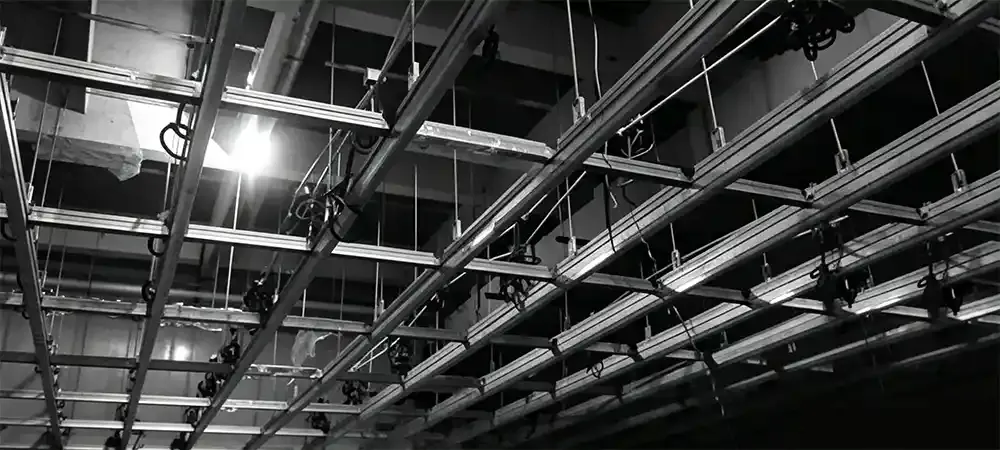
FFU Quantity & Energy Estimator
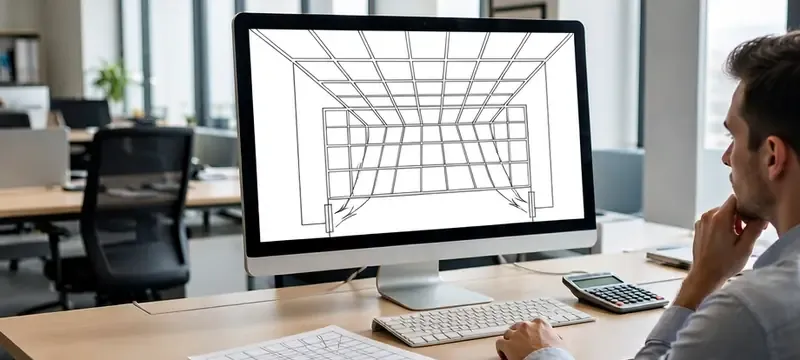
Get a rough estimate of FFU count and daily energy consumption for your target ISO 5 zone.
ISO 7 to ISO 5 Retrofit Checklist – Actionable Items
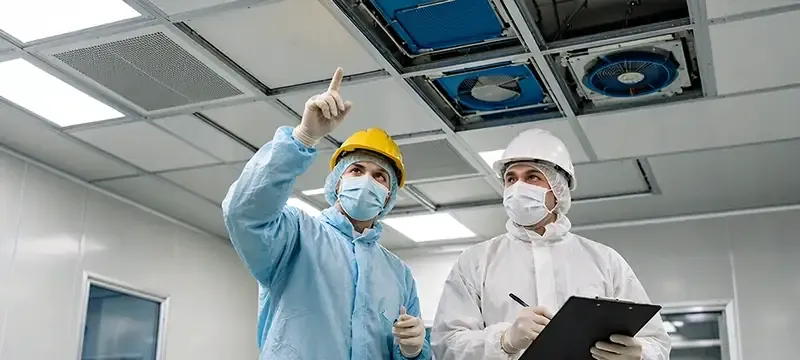
Pre-Retrofit Site Assessment
Design & Engineering
Installation & Construction
Validation & Handover
Common Misconceptions About ISO 7 to ISO 5 Upgrades
Changing to a new HEPA filter is enough
This is only a small partial component. An equal portion of the upgrade is achieving the correct air flow, sealing, and pressure. If the velocity is neither sufficient, nor is the pressure properly cascaded, the particle counts will remain elevated.
More FFUs mean better cleanliness
For an optimal cleanroom environment, the number of FFUs must be balanced with room layout. Faulty placement of FFUs can lead to turbulence and dead zones. A well-designed localized clean zone can be more effective than a densely packed cleanroom.
A complete new HVAC system is needed
FFUs can provide a load relief to the central AHU, but this must be verified. If the AHU has sufficient static pressure and cooling, it may be retained.
One particle test means the job is done
Validation is more than just testing the at rest and operational states, integrity of filters, pressure, and recovery. Continuous monitoring is best for achieving and maintaining compliance.
Key Factors
Available margin compared to the required ISO 5 load.
Load capacity, grid size, and access.
Integrity of joints, sealing of doors, tightness of penetrations.
Duct sizing, grille placement, fan capacity.
Particle generation from equipment, materials, personnel.
Test protocols and documentation.
Frequently Asked Questions
What is required to calculate how many FFUs are needed for an ISO 5 area?
The number calculation would depend on multiple factors including the target face velocity, room dimensions, placement of equipment, and the design of the return air. Estimators can help you get an idea, but you should always perform the detailed engineering calculations.
Is it possible to create an ISO 5 zone within an ISO 7 room?
That is possible, and it is common practice to use FFUs, laminar flow hoods, or soft-wall enclosures to achieve this.
What tests are typically required following the retrofit?
Tests such as the measurement of airflow volumes and velocities, the measurement of pressure differentials, integrity of HEPA filters (by performing a PAO integrity scan), measurement of particle concentrations at restful conditions and during regular operations, the measurement of airflow, visualizations and the measurement of recovery time.
What is the standard schedule for replacement of filters?
G4/F8 Pre-filters should be replaced every three to six months. H14 HEPA filters should be replaced every three to five years for filters that are operated under stable environmental conditions. Deiiang offers a 48-hour emergency replacement service for filters from the closest location.
How can I calculate the cost of a retrofitting project?
The cost is dependent on the number of FFUs, the grade of filters being used, the required modifications to the HVAC system, the required reinforcements to the ceiling, the required electrical work and validations, and the cost of project management. A site survey and a design study are required to create an accurate budget for the project.
Is it only possible to improve the clean room infrastructure from ISO 7 to ISO 5, or is it possible to achieve that clean room class through retrofitting and without major structural alterations?
The class of clean rooms can be upgraded from ISO 7 to ISO 5 through a carefully devised plan and the use of appropriate technology relying on retrofitting only. When a good retrofit is achieve, you can achieve the required clean room class of ISO 5 within 40 to 60% of the capital expenditure as compared to a complete structural alteration. Downtimes is also severly reduced when retrofitting is done compared to a complete structural alteration.
Conclusion
Excited for a cleanroom upgrade? Reach out to Deiiang™ with the dimensions of your room, specifics regarding your existing HVAC system, and the target iso classification. You can expect a dedicated, customized, and feasible FFU layout from our engineering team under the direct supervision of Jason.peng.
Request a Cleanroom Retrofit Assessment
Recommended information to include:
- Room dimensions (L×W×H) and current ISO class
- Target ISO class and operational state (at‑rest/operational)
- Industry and process description
- Existing AHU model, airflow, and static pressure
- Current filter configuration and any existing FFUs
- Project location and site constraints (downtime limits, etc.)
References
- ISO 14644‑1:2015 – Classification of air cleanliness by particle concentration
- ISO 14644‑3:2019 – Test methods (including PAO leak testing)
- IEST‑RP‑CC006 – Testing of Cleanroom Garments
- ISO 14644‑4:2022 – Design, construction and start‑up
© 2026 Deiiang™ — Cleanroom Solutions. Product design by Jason.peng.