+86 13638632902
 Jason@cleanroomequips.com


 MENU
MENU
A. Core Question Answer
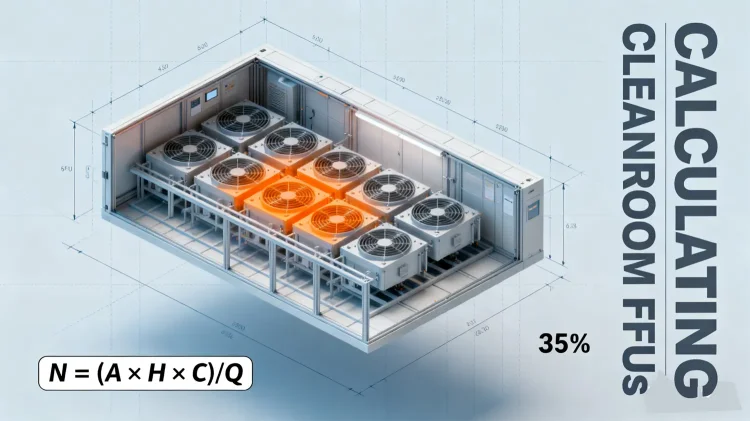
The number of ffus (fan filter units) required for a modular cleanroom is not a fixed value but depends on multiple critical factors working together. The most important factors include the target cleanliness level (iso class), room volume, FFU performance specifications, and the specific application requirements.
Calculating the correct number of FFU units is essential for creating an effective modular cleanroom environment. A properly designed modular cleanroom with the right FFU configuration ensures optimal performance and efficiency.
B. Importance of FFUs & Correct Calculation
FFUs play a crucial role in cleanroom operations by providing filtered air and controlling airflow patterns. They are essential components in any modular cleanroom setup, ensuring consistent air quality throughout the space.
Incorrect FFU calculations can lead to serious consequences including failure to meet cleanliness standards, energy waste from over-specification, increased operational costs, and compromised product quality. For any modular cleanroom project, proper FFU planning is critical.
Understanding FFU & Modular Cleanroom Basics
A. what is an ffu?
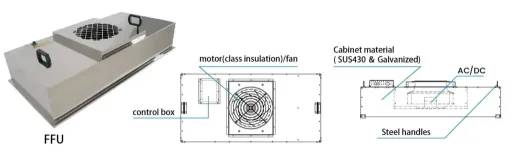
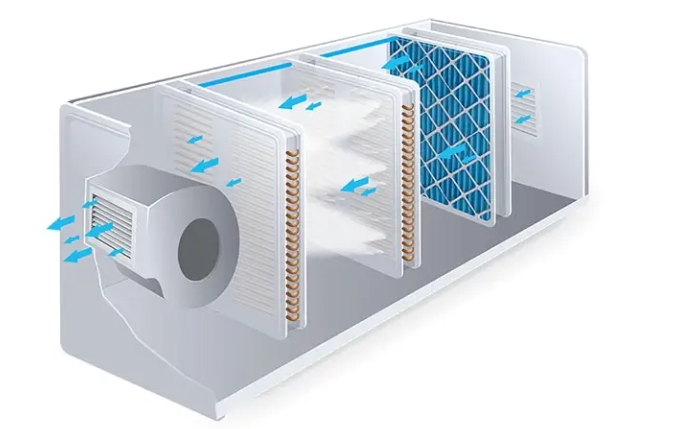
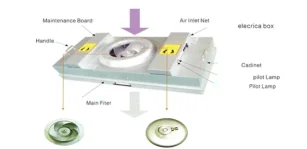
An FFU (Fan Filter Unit) is a self-contained air purification device that combines a fan motor and high-efficiency filter (HEPA or ULPA) in a single housing. These units are fundamental components in modern modular cleanroom designs, providing the necessary air filtration and circulation.
EACH FFU typically includes a centrifugal fan, HEPA/ULPA filter, and control system, working together to draw in ambient air, filter out contaminants, and deliver clean air downward in a uniform pattern. The efficiency of these FFU units directly impacts the overall performance of the modular cleanroom.
B. What is a Modular Cleanroom?
A modular cleanroom is a prefabricated controlled environment constructed from standardized panels and components. Unlike traditional built-in-place cleanrooms, these systems offer significant advantages including flexibility, rapid installation, scalability, and cost-effectiveness.
| Feature | Modular Cleanroom | Traditional Cleanroom |
|---|---|---|
| Installation Time | Weeks | Months |
| Flexibility | High (easily reconfigured) | Low (permanent structure) |
| Cost | Lower initial investment | Higher initial investment |
| FFU Integration | Pre-designed for optimal FFU placement | Custom engineering required |
Key Factors Affecting FFU Quantity
A. cleanliness class - iso 14644-1 Standards
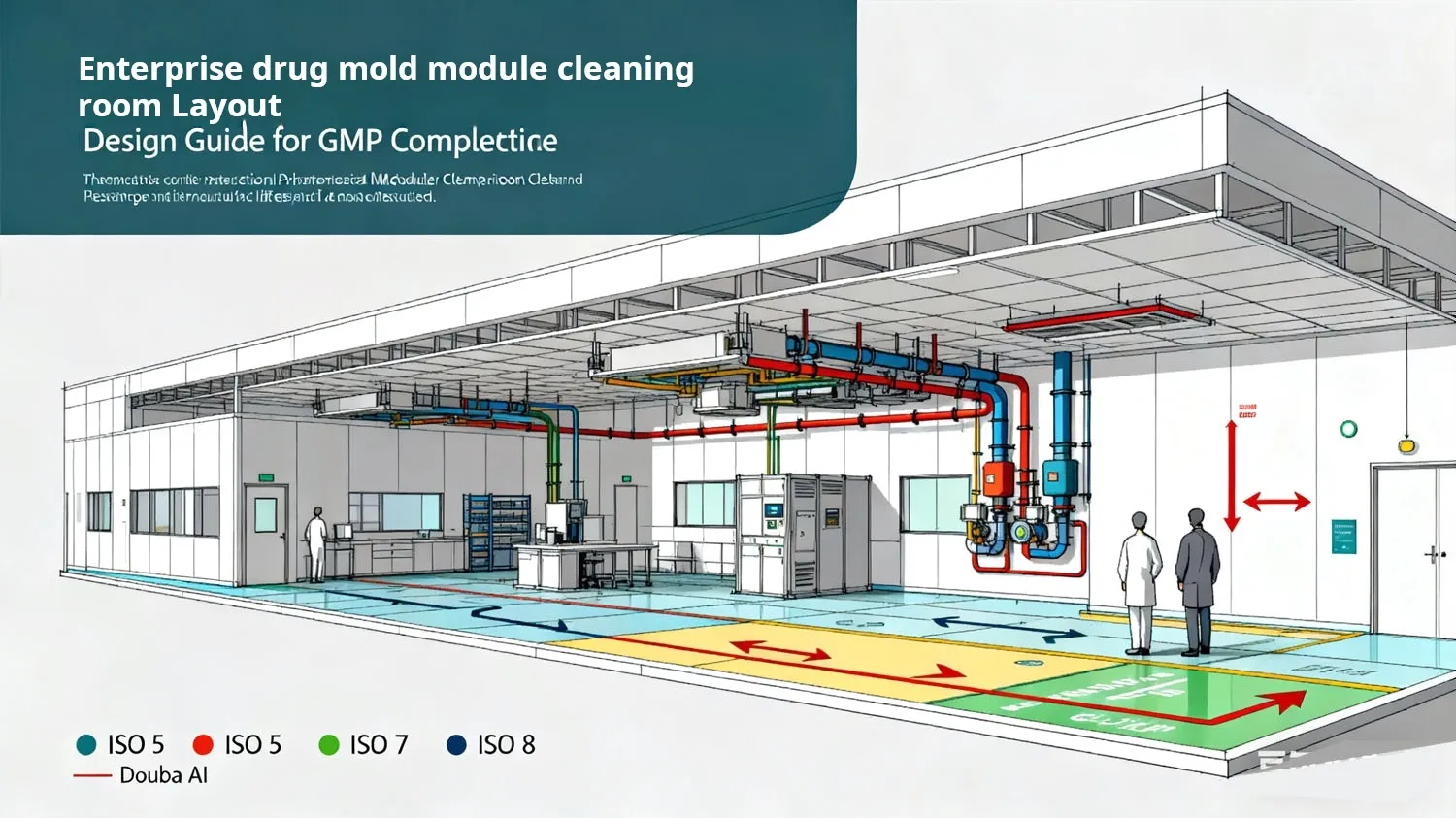
The ISO cleanliness classification is the primary determinant for FFU requirements in a modular cleanroom. Higher cleanliness classes require more air changes per hour (ACH), directly impacting the number of FFU units needed.
| ISO Class | Maximum Particles/m³ (≥0.5μm) | Recommended ACH Range | Typical FFU Coverage |
|---|---|---|---|
| iso 5 (class 100) | 3,520 | 240-600+ | 80-100% ceiling |
| ISO 6 (class 1000) | 35,200 | 90-180 | 25-40% ceiling |
| ISO 7 (Class 10,000) | 352,000 | 30-70 | 15-25% ceiling |
| iso 8 (class 100,000) | 3,520,000 | 10-25 | 5-15% ceiling |
B. Cleanroom Dimensions
The physical size of your modular cleanroom directly impacts FFU requirements. A room measuring 10m × 8m × 3m has a volume of 240m³, while a larger 15m × 10m × 3m room has 450m³ volume - nearly double the air volume to filter.
C. Application & Internal Activities
Different industries have varying contamination control needs. Electronics manufacturing might require ISO 6 with specific humidity control, while pharmaceutical applications often need ISO 5 with strict temperature and monitoring. Each application affects the FFU configuration in your modular cleanroom.
D. FFU Performance Parameters
Individual FFU specifications vary significantly. A standard 2x4 ft FFU might deliver 900-1200 CFM, while high-performance models can reach 1500+ CFM. Deiiang™ offers various FFU models with different specifications to match your modular cleanroom requirements.
E. Airflow Pattern
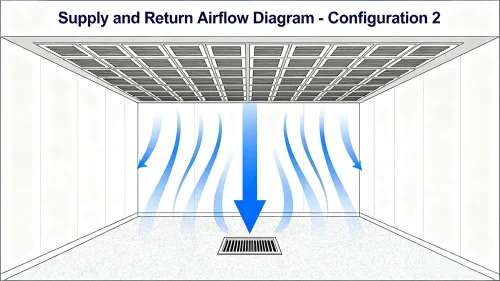
Unidirectional Flow: In iso 5 environments, FFUs typically cover 80-100% of the ceiling area, creating uniform downward airflow. This requires more FFUs but provides superior contamination control.
Non-unidirectional Flow: For ISO 6-8 applications, FFUs are arranged in arrays covering 15-40% of the ceiling, relying on air dilution rather than piston-like flow.
F. Room Pressure Requirements
Maintaining positive pressure (typically +10 to +25 Pa) prevents unfiltered air from entering the modular cleanroom. This pressure differential requires additional airflow, potentially increasing FFU requirements by 5-15% depending on room sealing and air leakage rates.
FFU Quantity Calculation Method & Examples
A. Basic Calculation Formula
Step 1: Calculate Room Volume
Volume (m³) = Length (m) × Width (m) × Height (m)
Step 2: Calculate Total Required Airflow
Total Airflow (m³/h) = Room Volume (m³) × Target ACH
Step 3: Calculate Number of FFUs
Number of FFUs = Total Airflow (m³/h) ÷ Single FFU Airflow (m³/h)
Note: Always include a safety factor of 10-20% for leakage and future requirements.
B. Step-by-Step Calculation Examples
Example 1: ISO 7 Modular Cleanroom
Parameters:
- Room dimensions: 8m (L) × 6m (W) × 2.8m (H)
- ISO Class: 7 (Target ACH: 50)
- FFU type: Deiiang™ 2x4 ft FFU (1200 m³/h capacity)
- Safety factor: 15%
Calculation:
- Volume = 8 × 6 × 2.8 = 134.4 m³
- Total Airflow = 134.4 × 50 = 6,720 m³/h
- With safety factor: 6,720 × 1.15 = 7,728 m³/h
- Number of FFUs = 7,728 ÷ 1,200 = 6.44 → 7 FFUs
Example 2: ISO 5 Modular Cleanroom
Parameters:
- Room dimensions: 5m (L) × 4m (W) × 2.6m (H)
- ISO Class: 5 (Target ACH: 300)
- FFU type: Deiiang™ 2x2 ft FFU (600 m³/h capacity)
- Safety factor: 10%
Calculation:
- Volume = 5 × 4 × 2.6 = 52 m³
- Total Airflow = 52 × 300 = 15,600 m³/h
- With safety factor: 15,600 × 1.10 = 17,160 m³/h
- Number of FFUs = 17,160 ÷ 600 = 28.6 → 29 FFUs
| Parameter | Example 1 (ISO 7) | Example 2 (ISO 5) |
|---|---|---|
| Room Volume | 134.4 m³ | 52 m³ |
| Target ACH | 50 | 300 |
| FFU Type | 2x4 ft (1200 m³/h) | 2x2 ft (600 m³/h) |
| FFUs Required | 7 | 29 |
| Ceiling Coverage | ~20% | ~90% |
C. Online FFU Quantity Calculator
Try Our Interactive FFU Calculator
Calculate Your FFU Requirements
Get instant calculations based on your specific modular cleanroom parameters
FFU Layout & Installation Considerations
A. Airflow Uniformity & Dead Zones
Proper FFU placement is crucial to avoid dead zones where contaminants can accumulate. In a typical modular cleanroom, FFUs should be evenly distributed across the ceiling with special attention to corners and equipment areas.
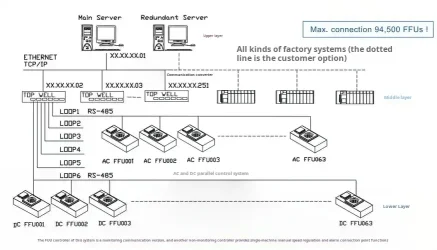
For ISO 5 applications, FFUs are typically arranged in a grid pattern covering most of the ceiling. For lower classes, strategic placement around critical processes may be sufficient.
Deiiang™ engineers use computational fluid dynamics (CFD) analysis to optimize FFU placement in your modular cleanroom, ensuring uniform airflow distribution.
B. Maintenance & Replacement
FFU placement should allow easy access for filter replacement and maintenance. Most HEPA filters in FFU units need replacement every 3-5 years, depending on operating hours and environmental conditions.
C. Noise & Energy Consumption
Modern FFU designs from Deiiang™ feature energy-efficient EC motors that reduce power consumption by 30-50% compared to traditional AC motors. Noise levels typically range from 45-65 dB, important for operator comfort in the modular cleanroom.
Frequently Asked Questions
Q1: What are the common FFU sizes?
The most common FFU sizes are 2x2 ft (600x600mm), 2x4 ft (600x1200mm), and 4x4 ft (1200x1200mm). Deiiang™ offers all standard sizes plus custom dimensions for specialized modular cleanroom applications.
Q2: HEPA vs. ULPA filters - which should I choose?
HEPA filters are 99.97% efficient at 0.3μm, suitable for ISO 5-8. ULPA filters are 99.999% efficient at 0.12μm, used for ISO 3-5 applications. Most modular cleanroom installations use HEPA filters in their FFU units.
Q3: How often do FFU filters need replacement?
Typically every 3-5 years, but this depends on operating hours, particle load, and pressure drop monitoring. Regular maintenance of your FFU system extends filter life in the modular cleanroom.
Q4: Can I upgrade my FFU system later?
Yes, one advantage of a modular cleanroom is the ability to upgrade or reconfigure FFU systems as requirements change. Deiiang™ designs allow for future expansion and technology upgrades.
Q5: How do I know if my FFU count is sufficient?
Regular particle counting and airflow velocity measurements will verify performance. Deiiang™ provides certification services to ensure your modular cleanroom with the installed FFU system meets specified standards.
Conclusion & Professional Recommendation
A. Summary of Key Points
Determining the correct number of FFUs for your modular cleanroom requires careful consideration of multiple factors including ISO classification, room dimensions, application requirements, and FFU specifications. The examples and calculations provided serve as guidelines, but professional assessment is recommended for optimal results.
B. Call to Action
Need Professional Assistance with Your Modular Cleanroom Project?
Contact Deiiang™ experts for a customized cleanroom design, FFU selection consultation, or free quotation.