+86 18186671616
 Jason@cleanroomequips.com


 MENU

The fume hood may look simple, yet its ventilation can dominate a laboratory's energy use. In a Pharma suite or an IC fab, hoods are usually the largest single air load and they set the room air change rate (ACH). If a laboratory has multiple Fume Hoods, controlling airflow matters as much as the layout of the hoods themselves.
The VAV vs CAV dilemma is about controlling ventilation. CAV has a set ventilation capacity meaning that airflow is variable depending on the position of the sash. However, VAV constantly adjusts airflow to set the face velocities of the fume hood while maintaining a minimum limit on the amount of air ventilated. The option chosen will influence the amount of energy used, response to changing requirements, and containment of hazardous substances, but not the cost.

Working of a CAV Fume Hood
A CAV fume hood works on one fixed value: the flow assigned to it at commissioning. A damper in the hood exhaust collar is calibrated to meet the designed flow parameters during installation, and further adjustments of the damper are not possible. The face velocity can only be determined by the working chamber size — the equation for calculating face velocity is as follows:
face velocity = exhaust flow rate ÷ the area of the opened face
This equation is universal for all required calculations. For example, the calculations show that a 1,500 mm hood with 1,105 m³/h exhaust airflow delivers 0.41 m/s face velocity at 500 mm hood opening, however, when increasing the opening of the hood to 800 mm, the face velocity will drop to 0.26 m/s, which is below the 0.30 m/s minimum and far under the 0.41–0.51 m/s design band.[2] The worst flow conditions occur when the operator uses the fume hood.
The 0.41–0.51 m/s band is the design target. For low-toxicity work some EHS departments accept 0.35–0.40 m/s on a hood verified by the ASHRAE 110 tracer-gas test; carcinogenic duty pushes the requirement to 0.50–0.60 m/s.
Why Bypass Grilles Should Be Used
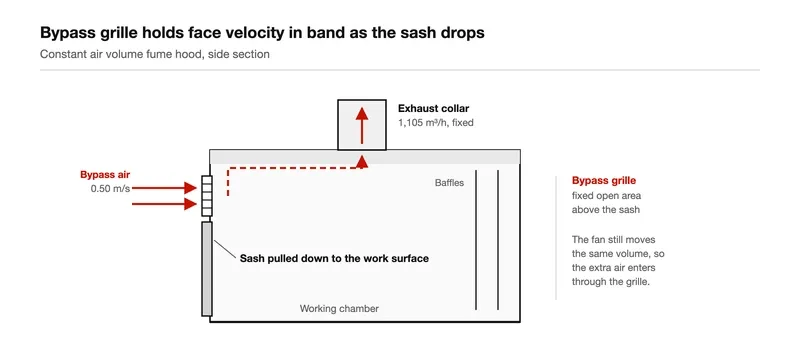
If a hood sash is down completely, the face velocity will increase significantly, climbing over 5 m/s (roughly 1,000 fpm), which is unacceptable. The bypass system opens once the sash descends, allowing the air to be pulled into the hood plenum. Nevertheless, this system works on a passive principle and is not able to compensate for much dust in filters or a decrease of the power of a fan during more than 70% of the working cycle of a fume hood.
In the real-world scenario, the most common blunder related to CAV is a bypass that is installed on 1.5 m cabinets but sized for a hood of 1.2 m. At first, everything seems alright with the equipment; but as time goes by and after around three years, filters become clogged and the fan loses the capacity, which results in reduced flow to 70% and face velocity to below 0.30 m/s without anyone noticing it. It is necessary to require the balancing contractor to make measurements of fan speed at 80% level, not only at the level of design speed. The entire process takes 15 minutes and deters any EHS violations.
How a VAV Fume Hood Works
A VAV fume hood works the opposite way. The hood performs a complete sequence of operations by measuring the opening, calculating the flow required for obtaining the desired face velocity, and moving the valve accordingly. Three signals are used here and one actuator performs the operations:
- Signal from the sash position — a cable potentiometer, encoder, or infrared array reports the size of the opening (and also it is required for combination sashes).
- Signal for flow measurement — from a venturi or DP fixed orifice, which records the flow at the valve instead of calculating it based on fan speed.
- Pressure reference — the valve holds the flow it was given as duct pressure moves with the other hoods on the same riser (pressure independence), typically ±3% between 150 and 750 Pa.
Difference Between Venturi and Butterfly Valves
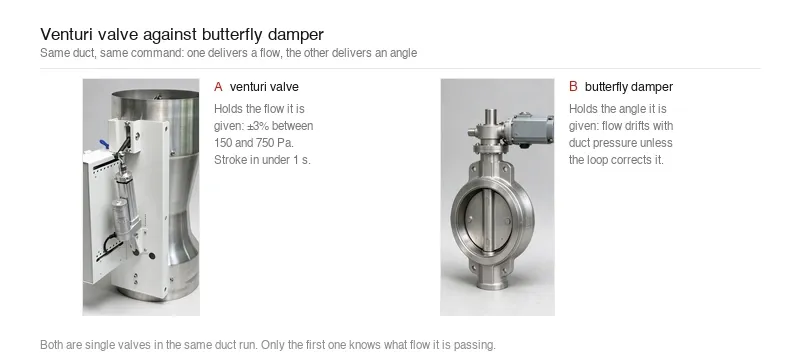
The difference in design of valves is outlined in the table below. The valve is what makes the loop work in a shared duct; a butterfly damper with a positioner delivers the commanded angle whatever the duct pressure is doing, while a venturi valve delivers the commanded flow. The difference appears the moment the hood two floors down opens its sash.
| Valve type | Pressure independence | Response | Cost per hood (2026 FOB) |
|---|---|---|---|
| True venturi (Phoenix Controls, Price, etc.) | By design; holds ±3% flow over 150–750 Pa | <1 s | $1,800–$2,800 |
| Modulating butterfly + external flow sensor | Depends on feedback loop; drifts without calibration | 2–4 s | $600–$1,000 |
| Cheap “venturi” clone | Marketed as pressure-independent; drifts to ±10% after 12 months | 1–2 s | $400–$700 |
The $1,500 per-hood difference pays for itself the first time a neighbouring hood opens its sash and your containment does not spike.
Response Time Is What Counts
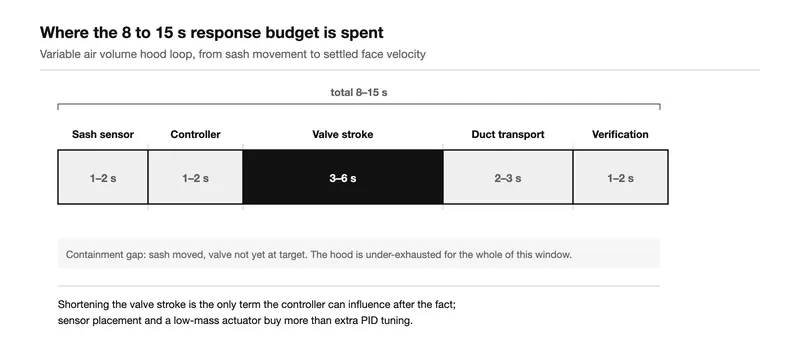
Suppliers indicate actuator stroke, but what is important is the end time of sash movement until face velocity is restored again (sensor lag + scan time + valve stroke). ASHRAE 110 cycles the sash three times while logging tracer gas at the breathing zone, reported as a peak and 45-second rolling average.[1] For instance, if the terminal takes 3 s while the loop needs 1 s, it results in a spike that cannot be removed by baffle geometry. In testing on the Deiiang T3 platform, we recorded RA-Max below the analyser’s detection limit of 0.05 ppm with the hood resistance of 41 Pa.
Installation Issues Are Not in the Datasheet
- ~30% of retrofits forget the 24 V wiring. Budget ~92 runs of 18/2 cables for a 92-hood station before signing the contract, but not afterwards.
- BACnet/Modbus addresses may clash. Every valve needs its own ID, and nothing is more annoying than chasing two linked hoods during commissioning.
- Local displays matter. A green light tells the operator nothing; specify a display showing live face velocity, setpoint and alarm threshold.
- Venturi valves whistle at low flow. A poppet with silicone seating stays below 55 dBA at the sash; a cheap one hisses loudly enough that operators prop the sash open to stop the noise.
- Sash cable stretches over time. The potentiometer cable stretches 2–3% after 2–3 years — enough for the controller to think the sash is at 600 mm when it is really at 580. Re-tension and recalibrate at annual service, not just the valve.
- Occupancy sensors get bypassed. Researchers will tape over the sensor so the hood does not step down when they step out for coffee. Spec the sensor as a setback to 80% minimum flow, not a shutdown, or it will be defeated within a month.
VAV and CAV: Side-to-Side Comparison
| Parameters | CAV | VAV |
|---|---|---|
| Face velocity vs. sash height | Falls: 0.41 m/s at 500 mm, 0.26 m/s full open | Controlled according to its settings over the entire range |
| Exhaust flow | Kept intact at design levels | 25%–100% of design |
| Hardware | Flow regulating valve and bypass grille | Sash and flow sensor, PI valve, controller |
| Response to sash movement | Moving is not necessary; flow is constant | ≤1 s, or a measurable concentration spike |
| Pressure independence | None; flow follows duct pressure | ±3% from 150–750 Pa |
| Cabinet price, 1.5 m bench, FOB Shenzhen | $1,200–$2,200 | $3,800–$5,500 (valve + sensor + controller) |
| Additional installed cost per hood | Very little — only balancing | $2,500–$4,000 (VSD + controls + balancing) |
| Maintenance process | Damper/belt check | Annual sensor calibration and valve verification |
| Best match | Teaching labs, low hood count, single shift | Multi-shift operations, high hood count, high utility rate |
All cabinet prices are FOB Shenzhen, ex-works, 2026. Add 18–25% for ocean freight to the US West Coast, plus import duty. Installed cost depends heavily on local labour and whether your exhaust fan already has a VSD.
The Term Turndown and Payback
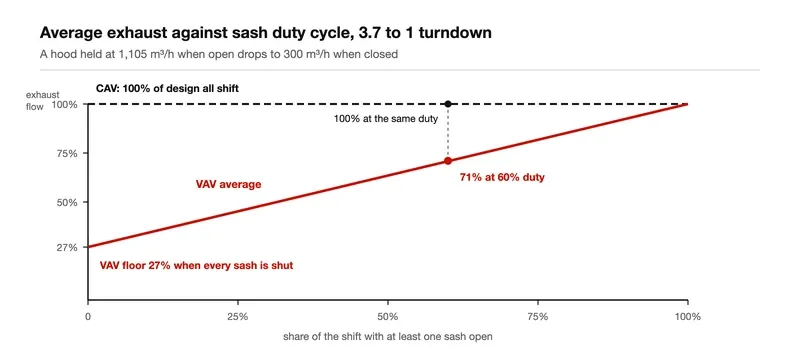
A CAV hood runs at its design flow all the time. A VAV hood’s average flow depends on how much of the shift the sash is actually open:
Q average = u × Q full + (1 − u) × Q minimum
For example, if its design value is 1,105 m³/h and its minimum is 300 m³/h (3.7:1 turndown):
| Duty cycle (when sash is open) | Avg. exhaust, m³/h | % of CAV |
|---|---|---|
| 20% | 461 | 42% |
| 30% | 542 | 49% |
| 50% | 703 | 64% |
| 70% | 864 | 78% |
| 90% | 1,025 | 93% |
So when does VAV’s $3,000 premium return anything? At a 30% duty cycle, 560 m³/h of conditioned air is saved. The average cost of conditioned air in southern China / Southeast Asia is about ¥1.20 per m³/h-year, which generates savings of about ¥670 (or $100). The payback time for a single teaching-lab hood is over 25 years, which makes it useless for a 3-hood lab. Payback depends on the number of hoods and the utility cost, which is why the 92-hood NRC project mentioned below resulted in savings of $480k/year.[6]
Humid climate correction: unlike in a cold climate where the coil load varies with airflow, in a humid climate such as Singapore, Guangzhou or Miami, the airflow savings will be affected by the room humidity which must be maintained. The analysis in Nairobi shows that while the airflow saving is 53%, the actual results point to a coil savings of only 31%. The business case should be built on the coil data and not based on the airflow.
Safety and Containment

ASHRAE 110 outlines the apparatus, release rate and sampling arithmetic but deliberately sets no pass threshold — acceptable leakage depends on what is handled inside and on the EHS judgement.[1] The numbers 0.05 ppm and 0.10 ppm in tenders come from Z9.5 §3.4:[2] the 0.05 ppm figure is as-manufactured (brand new out of the crate); the 0.10 ppm figure is as-installed, as-used. If your tender writes 0.05 ppm on a commissioned lab, you will reject hoods that are performing correctly — always name which state you are testing. An “ASHRAE 110: pass” report without naming the test state and control level has not recorded a result. Face velocity alone also says very little: in a NEBB retrospective, over 80% of hoods that failed tracer-gas testing had a compliant face velocity.
What Happens on Power Loss?
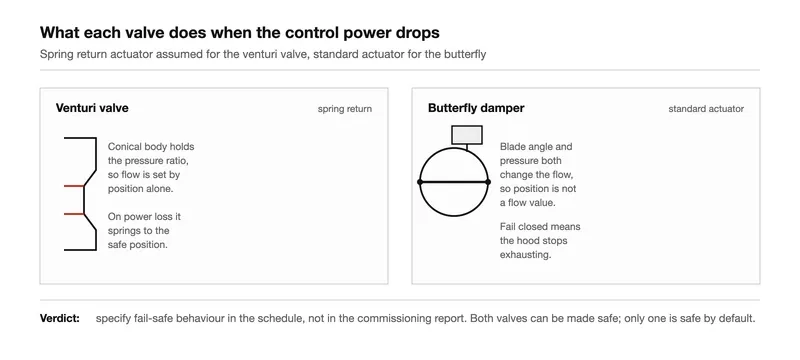
This is the question sales reps never seem to have an answer to. On a CAV hood, power loss stops the fan — evacuate. On a VAV hood, the failure mode depends entirely on the valve:
- A spring-return venturi fails open to a safe fixed position (typically 60–70% of design flow) — enough flow to keep containment until the fan comes back.
- A modulating butterfly without spring return fails to wherever it last was, possibly at minimum flow — unsafe if the sash is wide open when power drops.
Write “spring-return to ≥70% design flow on loss of power or control signal” into the datasheet. If the supplier blinks, keep looking.
Alarm Thresholds We Specify
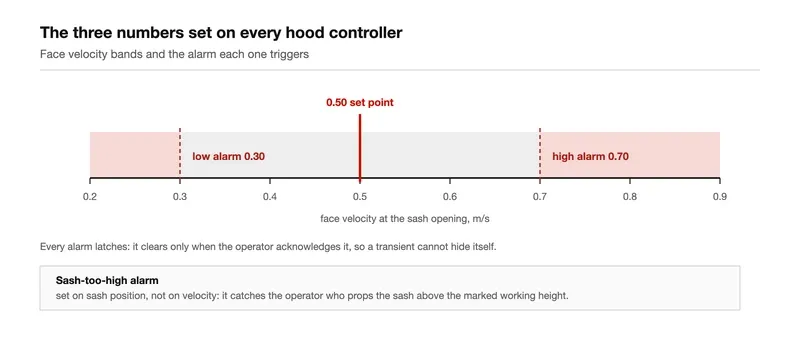
- Low alarm: face velocity drops below 0.30 m/s (or 80% of setpoint) — visual + audible.
- High alarm: above 0.70 m/s — uncomfortable for the operator, and strong enough to cause turbulence.
- Sash-too-high alarm: sash above the marked working height — the one most labs forget, and the one that catches operators propping the sash above the safe line.
- Alarms latch: they do not clear until the operator presses acknowledge. A transient spike should not vanish on its own.
A VAV fume hood is more dangerous than CAV because it has varying air supply.
Fact: The sash-movement analysis shows that RA-Max stays below 0.05 ppm, as a VAV system is specifically engineered to hold face velocity constant through the transient. The only underperforming VAV hoods are due to bad calibration or a slow loop — which are maintenance failures, not properties of variable flow.
The Retrofit Evidence
There are hardly any public accounts of successful CAV-to-VAV retrofits at scale. The NRC Canada Building M-12 project in Ottawa is one of the few fully documented cases.[6] Energy expenses came in 33% below projection ($480,000 actual against $720,000 modelled). Sixteen hoods were excluded after chemical review because their chemistry could not be safely manifolded. The takeaway: scope is set by chemistry, not by the HVAC schedule — do the chemical inventory before the MEP’s first design meeting. We have walked off two sites in the last three years where VAV design was 60% done before anyone noticed one hood handled perchloric acid and another handled cyanide.
Field tip: when you commission a VAV hood, ask the balancing contractor to cycle the sash through three full strokes while you watch the BMS trend. If face velocity overshoots more than ±10% on the way up, the loop gain is too high and the valve will chatter after two years. It takes 5 minutes to fix on site and saves a warranty call-back. We see this on roughly one in five new installs.
Our Own Project: 14-Hood Retrofit in Nairobi
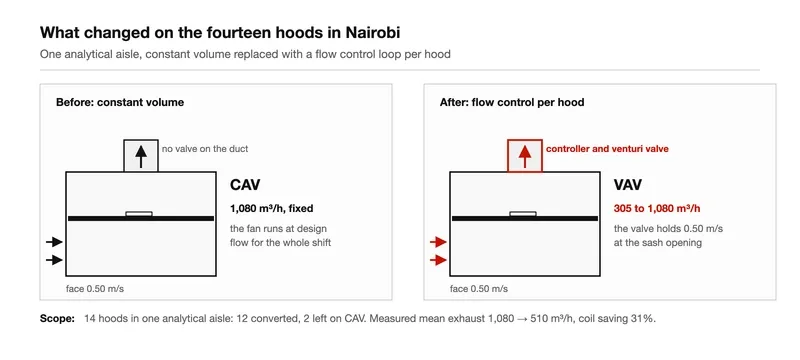
Picture this: you walk into an analytical chemistry building left over from the 1980s in Nairobi, and the first thing you hear is fourteen CAV hoods roaring at full tilt with sashes propped open on bricks — face velocity had dropped to 0.28 m/s and operators were compensating by leaving the sash half-closed. The client, a top-three East African contract research organisation running current GMP (cGMP) analytical labs (name withheld under NDA), came to us after an EHS audit flagged three of the hoods.
Pain points: fourteen CAV hoods tied to a 30-year-old fan with no provision for VSDs; passive losses in draft pressure when the sash was operated (swinging at ±15 Pa); need for fresh ASHRAE 110 data from the medicines regulator; and exposure to 70–80% RH for most of the year, which was already the dominant cooling-coil load.
What we did: retrofitted 12 of the 14 hoods with T3 venturi valves, sash sensors and local displays; retrofitted the exhaust fans to include VSDs; tied the exhaust AHU into the BMS; kept 2 hoods on CAV where acids and strong oxidisers could not be safely combined; and conducted ASHRAE 110 sash-movement testing on every modified hood.
Measured results: average exhaust per hood fell from 1,080 to 510 m³/h (a 53% airflow reduction); chilled-water coil saving came in at 31%, not the 53% the airflow ratio suggested, because the humidity setpoint had to be held independently; at ¥1.20 per m³/h-year of conditioned air the saving is about ¥680 ($95) per hood, which closes nothing on its own — the fan downsizing is what paid for the project, and we also caught a leaking reheat coil during balancing that the original survey had missed.
Our take: if you are retrofitting in a humid climate, the contractor who promises you a 50% airflow saving without showing you a coil-side model is going to disappoint you. Insist on the coil number before you sign.
Choosing Between VAV or CAV
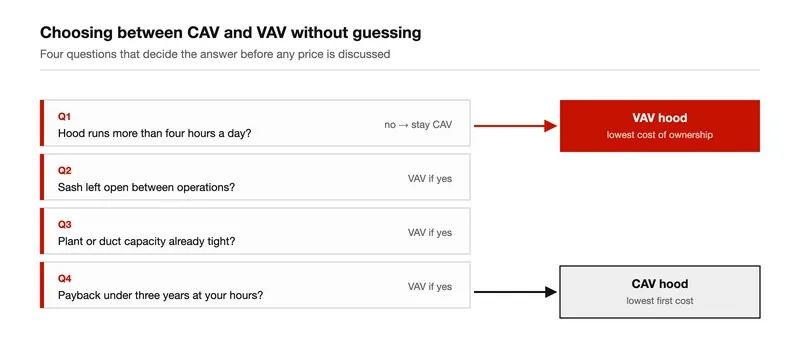
Answer these questions in order before specifying any Laboratory Fume Hood:
- Hours of operation per week for the hoods? Below ~20 h/week, the turndown never happens and payback is only a spreadsheet number.
- Can the make-up air follow? VAV on a constant-volume supply turns an airflow saving into a corridor pressure problem.
- Who calibrates it? If there is no answer on staff, specify CAV. An uncalibrated VAV is a CAV with extra failure modes.
- Local regulations: JGJ 91-2019 sets face velocity in three tiers by toxicity (0.35–0.75 m/s).[4] ASHRAE Z9.5 (US), EN 14175 (EU), AS 2252 (Australia) and SS 345 (Singapore) each set different bands and type-test requirements. We stock T3 cabinets pre-certified to EN 14175-3 and AS 2252; in Europe the same unit is sold and type-tested as a fume cupboard.
Summary: <6 hoods, single-shift, sash open 0–20 h/week, utility <$0.10/kWh → CAV. >20 hoods, multi-shift, sash open >30 h/week, utility >$0.15/kWh → VAV. Call us for the cases in between — that is where the answer depends on your room pressure cascade and your chemical inventory.
Deiiang™ builds both: the T3 high-performance VAV platform (0.50 m/s mean face velocity, 6.0% uniformity, 41 Pa resistance, ASHRAE 110-2016 tested); the X1 all-steel CAV / two-position line; and the PP range for corrosive duty.
Frequently Asked Questions
Can an existing CAV hood be converted to VAV?
Often, but the cabinet is the easy part. The conversion needs a modulating valve, a sash sensor and a controller at the hood, plus a fan that can follow reduced flow (a VSD or bypass damper). Budget the controls and the fan before the cabinet — the cabinet is where the money goes last, not first.
Lead time: VAV vs. CAV?
CAV: 2–3 weeks ex-works. VAV: 5–7 weeks, because the venturi valve is always the long-lead item — not the cabinet. Place the valve order first, even before the PO for the cabinet is signed.
Does a VAV hood need dedicated power?
Yes: 24 V Class 2 daisy-chained supply, plus a BACnet/Modbus drop if you want central monitoring. Budget one electrician-day per 8 hoods. This is the line item that vanishes from low-bid proposals and reappears as a change order.
What does annual VAV maintenance actually involve?
One service visit per hood per year: (1) verify valve stroke against the commanded signal; (2) calibrate the flow sensor against a reference anemometer; (3) check sash potentiometer cable tension; (4) confirm alarm setpoints. Budget roughly $150–$250 per hood-year in-house, or $400–$600 if outsourced to a balancing contractor.
How do I check my hood is working today?
Measure face velocity at the working opening with a calibrated anemometer, at the sash position shown on the test label. It is a screening test, not a containment test, but it catches the failures that dominate field data: clogged filters, slipping belts, jammed dampers. Pair it with an annual ASHRAE 110 tracer-gas test on any hood above Control Level 2.
This article is general engineering guidance, not a substitute for project-specific design by a licensed MEP engineer and EHS reviewer. Always confirm face-velocity setpoints against the chemicals handled and local code. Last reviewed against ASHRAE Z9.5-2022, EN 14175-3:2019, JGJ 91-2019, and AS 2252.2:2023, October 2026.
References
- ANSI/ASHRAE 110-2016, Method of Testing Performance of Laboratory Fume Hoods. ASHRAE.
- ANSI/ASHRAE/ASSP Z9.5-2022, Laboratory Ventilation, §3.4 control levels. ASHRAE.
- Smith & Hitchings, Reducing Minimum Exhaust Flow for Fume Hoods at UC Irvine, 2012. UCI EH&S.
- JGJ 91-2019, Standard for Design of Scientific Research Building. MOHURD.
- Natural Resources Canada, Fume Hood Retrofits at NRC Building M-12, Cat. No. M144-252/2013E-PDF, 2014.
- NFPA 45, Standard on Fire Protection for Laboratories Using Chemicals. NFPA.
- GB/T 29472-2012, Safety and Functional Requirements for Laboratory Fume Hoods. SAMR.
- EN 14175-3, Fume Cupboards — Type test methods. CEN.
- AS 2252.2:2023, Fume cupboards — Part 2: Performance requirements. Standards Australia.
- SEFA 1, Laboratory Fume Hoods Recommended Practices.
About the Author: Jason Peng is cleanroom engineering Technology Manager at Deiiang and Product R&D Manager at GDC Inc. He has commissioned or retrofitted fume hoods in China, Kenya, Mongolia, Australia and Slovenia. Recent projects include a 14-hood cGMP analytical retrofit in Nairobi, Mongolia’s first GMP cell-therapy lab in Ulaanbaatar, and an iso 5 pharmacy cleanroom in Sydney. If your project sits between the CAV and VAV rule-of-thumb lines, he reviews the sash-duty logs personally.