+86 13638632902
 Jason@cleanroomequips.com


 MENU
MENU
In this article, we will classify HEPA filter types into flat-panel/box, mini-pleat, V-bank/high-capacity box, cylindrical/cartridge, bag/pocket and separator-style or separator-less framed filters based on their construction and physical configuration. The term H13/H14 and other similar terms refer to the efficiency classes of filters, rather than the shape of the filters themselves. EACH HEPA filter has a particular physical configuration (type) as well as a certain efficiency classification (class). Thus, their two axes of classification are independent.
These six types of HEPA filters imply different product designs, but they may also overlap in some cases. Thus, for example, a mini-pleat filter may be identified as a box filter, while it is possible for any box filter to be classified as a separator-less pack filter. A reader who tries to assign each HEPA filter an exact category will face the challenge that there will often be more than one valid label for a particular filter design. This is expected and serves the purpose of providing these six types of HEPA filters as a practical classification of products according to their design and physical configurations as opposed to mutually exclusive product types.
The other axis refers to the efficiency class of the filter according to EN1822 or ISO 29463 standards such as the E-class (EPA), H-class (HEPA), and U-class (ULPA) product families. This guide will turn to both axes, provide a comparison table for the six product types, offer product data from our Deiiang™ catalogue and provide a project example featuring a selection framework for the use of those products.
Quick reference — the six types of HEPA filters:
- Flat-panel/box-type
- Mini-pleat
- V-bank/high-capacity box
- Cylindrical/cartridge design
- Bag/pocket style
- Separator-style and separator-less framed products
How We Define the Six HEPA Filter Types
It is important to note that this classification of the types of HEPA filters is based on purchasing practicality rather than on a standard-defined classification. Certain labels indicate the overall configuration of the product while some other labels refer to key product design aspects such as pleat geometry or separator design. Due to the fact that these designations correlate to different characteristics of the same filter, the classifications may overlap. This does not imply that the list is incorrect; rather, it should be taken to represent a combination of attributes of filters, not necessarily a means of categorizing every filter into one of six groups.
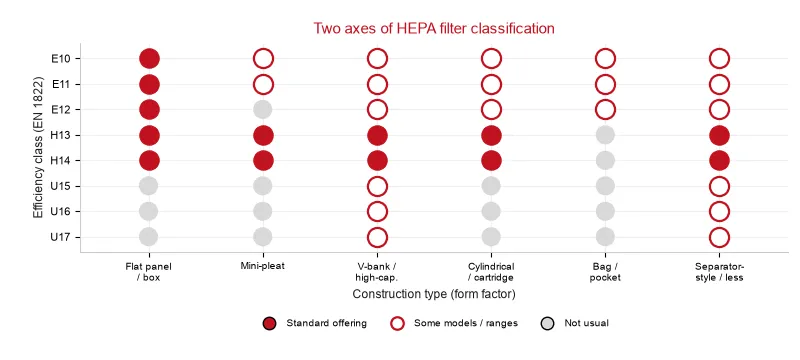
Figure 1: The Two-axis Matrix of Filter Type and Performance Class. The horizontal axis of the matrix has the six filter types and the vertical axis shows the performance classes from E10 to U17. Each filter is represented on the matrix as a dot on the corresponding axes.
Construction and Form Factor Are One Classification Axis
The frame configuration and pleats in the filter media pack and air passageways are the factors that determine the physical type of a cleanroom HEPA filter and how it fits into a unit. For example, although having the same efficiency class, a flat-panel cleanroom HEPA filter with an ABS frame and polyurethane sealant is distinct from the V-bank type consisting of multiple filter media. Different forms can have the same efficiency level; likewise, different efficiency levels can belong to the same form.
Efficiency Class Is a Separate Classification Axis
Performance class, which is one of the HEPA filter classes, is a category defined according to standards (for instance, EN 1822 and ISO 29463) [3][5]. Such HEPA filter classes must always be considered along with the standard, test method, and other parameters used for establishing it. Having a specific form factor does not demonstrate efficiency in filters. The flat-panel filter and the mini-pleat filter can be of the same grade (H13) and at the same time be at grades of E11 or H14. One should not make a HEPA filter classification based on form, and should confirm if one is transferring an E, H or U class from one measurement standard to another, ensuring they understand the current applicable edition of the test method and basis.
The 6 Types of HEPA Filters
The 6 types of HEPA filters have been categorized according to their construction and configuration as follows:
- Flat-panel / box-type (framed / pleated media packs)
- Mini pleat (pleated)
- V-bank / high-capacity box
- Cylindrical / cartridge
- Bag / pocket
- Separator style and separator-less framed (not pleated)
Which of the six types of HEPA filters to use for each system depends on the construction, airflow, pressure drop, size, and application. The numbers reported for the data used from here on will either be from the Deiiang catalogue data or project data labeled clearly, not universal values for all models. The facets of each of the 6 categories mean that the characteristics for some will apply to more than one category.
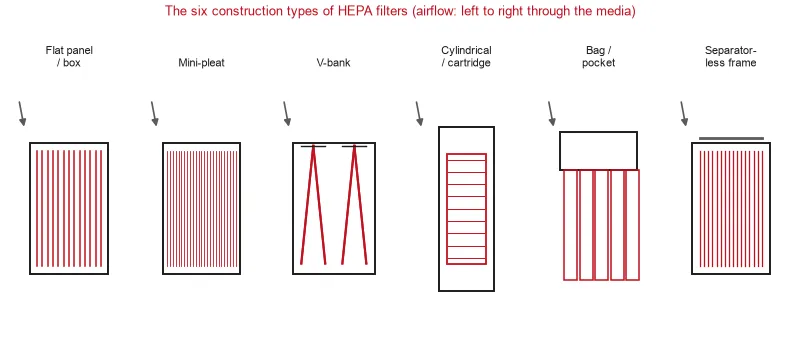
Figure 2: Diagram of the construction principles in the 6 categories of HEPA filters that shows the direction of airflow through them as indicated by arrows.
1. Flat-Panel or Box-Type HEPA Filters
A flat-panel or box-type cleanroom HEPA filter operates through the use of framed pleated media packs in a box form. This kind of filter is often applied in air-handling and terminal applications due to its rectangular shape, which is consistent with standard ceiling grid and terminal housing shapes. The two most important performance factors for this type of HEPA filter are the seal integrity and the face velocity.
One example of Deiiang catalog under this category is the H13/H14 high efficiency filter that is constructed of the ABS frame, ultrafine glass-fiber media, a design with no separator which uses thermoplastic EVA hot melt as a spacer, and PU two-component polyurethane as a sealant. This example also shows that it is difficult to distinguish between categories, as the construction of this filter consists of a box form, mini pleat media pack and separator free. Yet, this does not mean that the flat panel and mini-pleat are distinct product lines.
2. Mini-Pleat HEPA Filters
The operation of mini-pleat types of HEPA filters consists of closely spaced pleats and spacer designs that increases the media area while preserving a compact depth. This additional media area enables the filter to furnish the required airflow while keeping the air velocity at acceptable condition. In fact, the corresponding resistance depends on the media, pleat geometry and operation condition as opposed to the number of pleats in the filter. In other words, two different filters with the same number of pleats might possess extremely different pressure drops depending on permeability of the respective media.
The Deiiang combined filter maintains the correct spacing of the pleats by utilizing a thermoplastic EVA hot-melt spacer. The uniform spacing of the pleats is very important, as the uneven spacing can cause localized speed zones and thereby makes the effective media area smaller although the nominal filter area stays the same.
3. V-Bank or High-Capacity Box HEPA Filters
The V-bank or high-capacity box cleanroom HEPA filter may include several trays of media being arranged in a V configuration. Such construction is able to provide at the same time both high media area and required airflow with an appropriate face area. The exact pressure drop performance depends on the particular model and operating conditions of the system.
This is under the general category of construction. There is no reference to a specific Deiiang catalogue model in this article, and therefore, no set numbers are available here regarding the performance. Clients needing V-bank data must request the model-specific catalogue sheet.
4. Cylindrical or Cartridge HEPA Filters
Cylindrical or cartridge HEPA filters use a cylindrical or a cartridge shaped media pack. This cleanroom HEPA filter is usually utilized where equipment is inherently designed for that configuration including selected industrial filtration systems. Aspects of importance in this case are compatibility with the housing, sealing, cleaning or replacement requirements, and monitoring of the pressure drop. Not all cartridges are applicable in cleanroom terminal filtration, hence specific application ought to be rated on its standards.
5. Bag or Pocket HEPA Filters
Bag or pocket filters are of a different construction type than flat-panel cleanroom HEPA filter designs, and they are mostly found at the upstream end of the air-handling apparatus. Having a bag construction does not qualify a filter as being HEPA rated. In order for a bag or pocket filter to be rated as HEPA, it must be subjected to the tests and then classified as HEPA under the given standard, as well as implement the same model in line with the specification. Usage of bag or pocket filters in typical air handling applications makes them pre-filters instead of HEPA filters.
Deiiang catalogue indicates the kinds of F5 to F9 glass or synthetic fiber bag filters to be used in pre-filtration application. The given equipment does not carry HEPA ratings hence their role is to protect the final HEPA filter stage against coarse contamination loading. When a buyer requests a HEPA-rated bag filter or pocket filter, it should specify the model and test report needed, as opposed to relying on the term described above.
6. Separator-Style and Separator-Less Framed HEPA Filters
Some framed HEPA filters use separators to separate adjacent pleats. Some use an adhesive bead or thermoplastic to maintain pleat space in a separator-free design. Switching between different separator choices affect construction and packing but does not determine filter class ratings.
Engineered design differences in these two approaches may include media area per square foot of filter face, consistency of pleat spacing, design/construction difficulty, and weight. The specifications of the filter must support airflow and pressure drop requirements. Separatorless designs reduce both weight and difficulty of construction; one design is not necessarily superior over the other.
Among the six types of HEPA filters, Deiiang provides an H13/H14 separator-less filter constructed with EVA hot melt spacers. Deiiang also carries the U15/U16/U17 baffleless filter.
Compare the Six HEPA Filter Types
The following table provides a comparison of the six types of HEPA filters on the basis of:
- Construction
- Media area
- Air flow
- Pressure drop
- Use
- Replacement or retest interval
Where there is no match with catalogue information, the field will state "not reported from the catalogue."
| Item Type | Type of Construction | Media Area | Rated Airflow | Initial Resistance | Common Applications | Period for Replacement or Retesting |
|---|---|---|---|---|---|---|
| Flat Panel / Box | Framed pleat pack - using ABS or metal with PU sealing | Deiiang Inst. = 4.63 - 20.04 m² | Deiiang Inst. = 550 - 2,500 m³/h | Deiiang H13 = ≤200 Pa, H14 = ≤220 Pa @ catalogue conditions; final = 400 - 600 Pa | Terminal filtering in AHU, large scale sanitation | Condition dependant. Integrity retesting and changing are separate matters. |
| Mini-Pleat | Spacing created by pleats using spacers | Deiiang Inst. = 20.04 m² | Deiiang Inst. = 2,500 m³/h | Deiiang H13 = ≤200 Pa, H14 = ≤220; meets catalogue conditions | Compact H.A. terminal filtration | Condition dependant. |
| V Bank / High-Capacity Box | Media packs in a 'V' shape | Not indicated from catalogue | Not indicated from catalogue | Not indicated from catalogue | Systems with large requirements | Condition dependant. |
| Cylindrical / Cartridge | Cylindrical media packs | Not indicated from catalogue | Not indicated from catalogue | Not indicated from catalogue | Equipment for cartridge design | Condition dependant. |
| Bag / Pocket | Media made of bag or pocket | Deiiang pre filter Inst. = 3.18 m² | Deiiang F5 - F8 = 2,050 m³/h | F5 = <50 Pa, F8 = <100 Pa. Final resistance = 250 Pa - 400 Pa | Upstream pre-filtration before HEPA filter stage; not a HEPA filter itself | Based on loading of the particular filter and the pre-filter schedule defined by the client. |
| Separator / Separator-Less Framed | Pleats held by separators or spacers | Deiiang separator-less example = 20.04 m² | Deiiang example = 2,500 m³/h | Deiiang H13 = ≤200 Pa, H14 = ≤220 Pa at catalogue conditions | Cleanroom or high-volume terminal application | Condition dependant; include integrity test results. |
| Item Type | Media Area / Airflow | Initial Resistance |
|---|---|---|
| Flat Panel / Box | 4.63 - 20.04 m² / 550 - 2,500 m³/h | H13 ≤200 Pa, H14 ≤220 Pa |
| Mini-Pleat | 20.04 m² / 2,500 m³/h | H13 ≤200 Pa, H14 ≤220 Pa |
| V Bank / High-Capacity Box | Not indicated from catalogue | Not indicated from catalogue |
| Cylindrical / Cartridge | Not indicated from catalogue | Not indicated from catalogue |
| Bag / Pocket | 3.18 m² / 2,050 m³/h | F5 <50 Pa to F8 <100 Pa |
| Separator / Separator-Less Framed | 20.04 m² / 2,500 m³/h | H13 ≤200 Pa, H14 ≤220 Pa |
Table 1: Comparison of the six HEPA filter types.
Note: This example is drawn from the Deiiang catalogue and must not be read as a general performance range; actual performance depends on dimensions, airflow, HEPA filter classification and rated pressure.
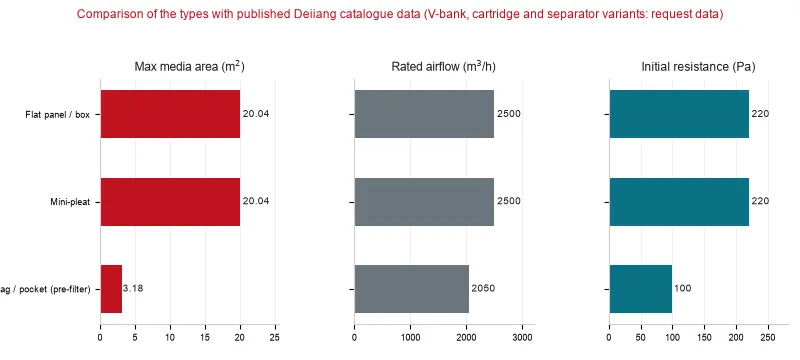
Figure 3: Six-type comparison chart showing media area, rated airflow, and pressure drop for the categories where Deiiang catalogue data are available.
How to Read the Comparison
The media area alone cannot be used as a HEPA filter classification criterion. Two filters, which have the same media area, may have high differences in pressure performance with same airflow since various filtration media as well as pleat design affect those differences. Only the design airflow, housing used and the testing method chosen must be used to compare the filters.
Across the HEPA filter classes, the final and initial resistance, as mentioned, do not guarantee energy consumption and product lifecycle. Lower pressure may reduce the fan pressure needed at the installation of the filter but the result will depend on the entire system functioning. The pressure replacement time cannot be determined based only on the type of filter installed. The choice should consider the differential-pressure readings, integrity test results, and maintenance methods employed on the site.
HEPA Filter Classes and Efficiency Classification
HEPA filter classes are not connected to physical types as discussed in previous sections and are about filter efficiency and are classified under EN 1822 into three classes: EPA (E), HEPA (H), and ULPA (U) [3]. ISO 29463 is another international classification standard for the same topic [5]. The details of each class are based on which standard is used and which test procedure was utilized. One should only transfer a HEPA filter classification label from one standard to the next after confirming which edition and which basis of test is applicable for that label.
Comparison table of the various standards:
| Standard | Classifications by or testing done | Verify the report from the supplier |
|---|---|---|
| EN 1822 | EPA, HEPA, ULPA filter classifications and performance testing | Applicable portion and edition; the MPPS test basis; local and integral efficiency; individual scan test results |
| ISO 29463 | International classification and testing for HEPA filters | Applicable portion and edition and test method; should correspond to EN 1822 when the supplier claims |
| iso 14644-1 | Classification of cleanroom air cleanliness by particle counts [1] | Should obtain a copy of the classification report as this is not about filter classification |
| iso 14644-3 | Testing procedures for cleanrooms including installed filter leakage testing [2] | Installed leak test methods and requirements |
| IEST-RP-CC001 | HEPA and ULPA filter guidance | Current version and title; which statements or sections in the report correspond to which clause |
| EN 779 | Older particulate filter classification for general ventilation [7] | Whether the site is using current class (ISO 16890) as therein for new specifications |
| Standard | What it covers | What to verify |
|---|---|---|
| EN 1822 | EPA / HEPA / ULPA classification and testing | Edition, MPPS basis, scan results |
| ISO 29463 | International HEPA classification and testing | Edition, method, EN 1822 correspondence |
| ISO 14644-1 | Cleanroom air cleanliness classification | Classification report (not filter class) |
| ISO 14644-3 | cleanroom test methods including filter leak | Installed leak test method and criteria |
| IEST-RP-CC001 | HEPA / ULPA filter guidance | Current edition and matching clauses |
| EN 779 | Legacy general ventilation filter class | Whether ISO 16890 is now required |
Table 2: Standards to check and what to verify in the supplier report.
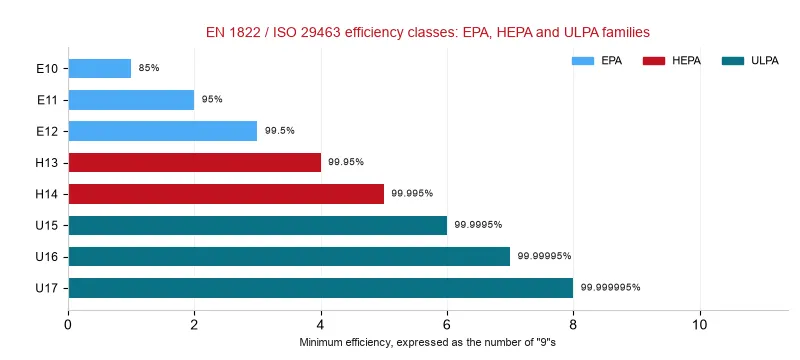
Figure 4: EN 1822 / ISO 29463 efficiency classifier ladder that includes ULPA. The ladder presents E-class family, H-class family, and U-class family with the corresponding test basis.
What H13 and H14 Mean
According to Deiiang catalog data, the efficiency of category H13 is 99.97 – 99.99% and of H14 is 99.995 – 99.999% at 0.3 µm. However, these data cannot be accepted as an EN 1822 HEPA filter classification report. The EN 1822 HEPA filter classification is dependent on the MPPS basis and applicable standard test methods; therefore, the efficiency at 0.3 µm must not be quoted as a proof of EN 1822 classification.
Buyers across all HEPA filter classes must confirm the applicable edition test for the MPPS, localized integral efficiency requirements, and verify the test report applicable to specific products. The technical team at Deiiang clarifies if each catalog number represents EN 1822 results, 0.3 µm results, or just catalog claim and provides matching test results.
What U15, U16, and U17 Mean—and How ULPA Relates
U15, U16, and U17 are ULPA HEPA filter classes, not H13/H14, in the family of EN 1822. The catalog claims by Deiiang identifies U15 to denote 99.999 – 99.9995%, U16 to denote 99.9999 – 99.99995%, and U17 to denote 99.99991 – 99.999995%; and indicated at particle size of 0.12 µm. The wording used for applications is derived from the technical documentation and that a size such as 0.12 µm is only one of many possible cut points. Selection of ULPA filter media should always be based on the assessment of the entire system rather than the designation of a filter class.
"True HEPA" Versus "HEPA-Type" or "HEPA-like"
The phrase "true HEPA," "HEPA-type," and "HEPA-like" is often seen in advertisements, yet none of them is a HEPA filter classification. These terms are not a substitute for a standard or test result. In the event that a supplier uses these terms, obtain a copy of the test certification for the precise model being offered, the standard utilized, relevant test specifications along with data on efficiency versus particle size or MPPS, information regarding leakage and integrity testing, and the name of the filter as it would appear on the confirmation of the order.
HEPA Filter Efficiency, Pressure Drop, and Service Life
Efficiency, airflow, pressure drop, dust loading, sealing, and pre-filtration must always be evaluated together as a cleanroom HEPA filter system. A HEPA filter may have the highest efficiency rating, but not necessarily perform the best in any particular application. There may be greater pressure drop leading to inefficiency since the filter may load up more quickly.
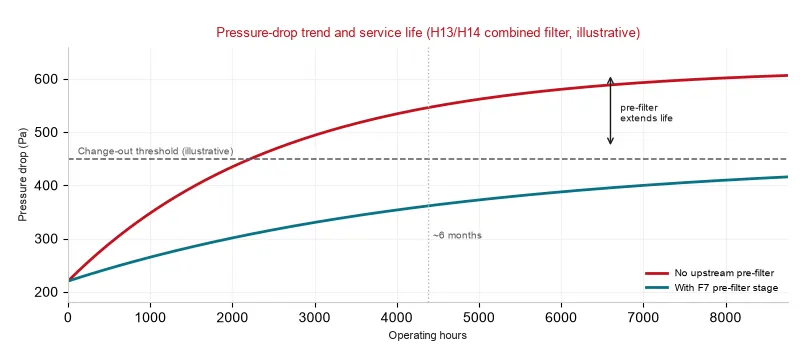
Figure 5: Representation of initial resistance and gradual loading as well as final resistance literature for a particular Deiiang model listed in its catalog. This chart is valid only for the referenced operating model and application.
Initial and Final Resistance
The initial resistance of a HEPA filter is defined as the pressure drop at the test or operational condition, while the final resistance is defined as the terminal or change-out criteria. According to Deiiang's catalog for combined filters, initial resistance levels are ≤ 200 Pa for H13 and ≤ 220 Pa for H14, with finishing resistance levels being at 400-600 Pa for specified models. The catalog presents these values under rating airflow for each model.
For any resistance level noted on the chart or table, the correct measurements associated with the filter dimensions, category, rated airflow, testing procedure or catalog condition as well as whether it is measured per filter must be included. The final resistance level of 400-600 Pa is valid for catalogs only and not applicable universally to any other purposes. If there is no matching airflow from the catalog for a specific resistance level, the data are not acceptable for graphing.
Why Pre-Filters Can Extend HEPA Service Life
Pre-filtering upstream reduces the pressure-drop increase on the final cleanroom HEPA filter stage due to the reduced particle loading on them. Deiiang catalog data defines moderate efficiency F5-F9 filters in terms of the EN 779 standards. Their catalog data at 0.5 µm are F5 = 45% efficient, F6 = 65% effective, F7 = 85% efficient, F8 = 90%, and F9 = 95%. The above-mentioned Deiiang data are for the catalog products only and do not define a general equivalence between all standards. Deiiang needs to know if the given values were derived from catalog testing or simply correspond to the EN 779 classification.
EN 779 was a legacy classification system, and the HEPA filter classes defined by EN 1822 rest on a different test basis. Modern applications should therefore define a HEPA filter classification against ISO 16890 where the project requires it. Do not convert the rating of F5-F9 into the ratings directly.
A sample from the catalog — for example, the model with six bags of 592 × 592 × 381 mm having an airflow of 2050 m³/h and a filter area of 3.18 m². The initial resistance is lower than 50 Pa for F5 and lower than 100 Pa for F8, while the final resistance range is between 250-400 Pa. The fiber glass filters can resist higher temperatures (up to 150°C), whereas the synthetic ones can withstand up to 80 degrees C. Please note that these models are pre-filters, and do not act as cleanroom HEPA filter units.
When to replace or Retest a HEPA Filter
The decision to replace or retest a cleanroom HEPA filter should be based on the pressure-differential trends, visible damage, collar proof and results of integrity tests. There are two separate decisions — one is replacement of the filter, and another is retrial of the filter, which states that it should be retrialed in case there is a need to confirm the collared condition. A pre-determined period of time for replacement should not be mentioned unless it is supported by any standards prepared by the manufacturers or under any legal provisions.
Deiiang Cleanroom and HVAC HEPA Filter Product Data
Deiiang is a manufacturer of cleanrooms and air filters. The information mentioned in this section includes specifications stated in the company catalog. Customers are requested to check all configuration details including test reports and project specifications prior to placing orders.
Understanding of the catalog data: The data in the catalog mention the details of the product as per the stated conditions in the catalog and do not provide any site specific information guarantee. Therefore, it is really important for any system usage to ensure that all of the standards, MPPS mentioned, rated airflow rating, test methods and other specifications are clearly mentioned in order to avoid confusion. Avoid making comparisons between resistance numbers across various rates of air flow.
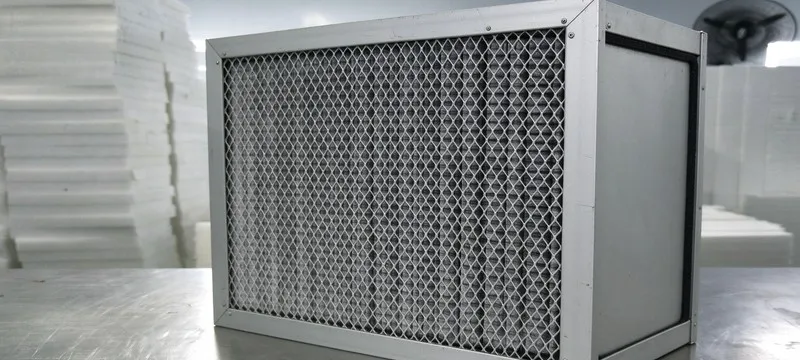
Figure 6: Deiiang H13/H14 combined high-efficiency filter, showing the gasket, frame and pleat pack on the photo.
Combined High-Efficiency Filter: H13/H14
The combined high-efficiency HEPA filter is designed for terminal filtration in air conditioning systems and high air-purifying devices. The materials described in the combined high-efficiency filter catalog include ultra-fine fiberglass filter material, a separator-free service with an EVA hot melt thermoplastic spacer, uniform pleat spacing over the media, a two component PU polyurethane sealant, an ABS frame, diamond mesh preventive coating and an EVA or neoprene gasket. It can operate at the highest temperature of 70 degrees Celsius and 80% relative humidity.
Examples of catalog sizes and performance:
- 287 mm x 287 mm x 292 mm = 550 m³/h, 4.63 m².
- 592 mm x 592 mm x 292 mm = 1900 m³/h, 15.03 m².
- 592 mm x 592 mm x 292 mm, 4-pleats model = 2500 m³/h, 20.04 m².
- 592 mm x 490 mm x 292 mm = 2050 m³/h, 16.44 m².
- 592 mm x 287 mm x 292 mm = 1150 m³/h, 9.26 m².
For this specific filter family, initial resistance values in the catalog are ≤ 200 Pa for H13, and ≤ 220 Pa for H14, while final resistance values are 400-600 Pa. Dust-holding capacity for edition 2500 m³/h is approximately 1200 grams.
Filters in this product line pass strict quality control tests before shipping. Specific laboratory test reports for the purchased filter should be verified with Deiiang.
Deiiang engineering note — uniform spacing of pleats is important because without it, high local air flow zones may occur within the filter, which in turn reduces usable filter media area. When making sure the specification of gaskets does not contain silicone material, please ensure the compatibility of the cleaning procedures and various decontamination agents that will be retrieved from the facility in order to help with the cleaning process. Because the integrated filter has a testing port that has been integrated into the filter to assist it with the filtering process, be sure to check where the port will be located and if it is accessible on the exact model you are using. Please note that the above-mentioned information serves only as engineering guidance and is not required in the standards.
DOP Integrated Filter for Limited Plenum Height
The DOP integrated cleanroom HEPA filter is meant to be installed in cleanrooms that do not have a considerable construction height. The construction of the catalogue contains a box-shaped structure that comes with a built-in air inlet pipe having a diameter of either 250, 300, or 350 mm, an airflow adjustable valve, DOP test port that is sealed using a rubber plug at its outlet end, and the external foam insulation made using PEF. The media and the construction contain a filter made from ultrafine glass-fiber paper, two-component PU sealant, aluminum foil folded or galvanized frame, and EVA hot-melt separator. The temperature limit is 70°C and the maximum humidity is 80%.
Examples from the catalogue are listed below:
- 610 × 610 × 120 mm: 1,000 m³/h, 11.32 square meters; initial resistance <= 200-220 Pa; final 400-600 Pa; dust holding capacity about 680 g.
- 1,220 × 610 × 120 mm: 1,800 m³/h, 19.79 square meters; dust holding capacity about 1200 g.
- 610 × 610 × 150 mm: 2,500 m³/h; 22.14 square meters; dust holding capacity about 1350 g.
- 1,170 × 570 × 150 mm: 2,200 m³/h, 24.74 square meters; dust holding capacity about 1,500 g.
H13/H14 catalogue depicts efficiency figures for H13 and H14 using the same qualification basis and 0.3 µm particle size.
Super-High-Efficiency Baffle-Free Filter: U15/U16/U17
The super-high-efficiency baffle-free HEPA filter is described in the catalogue as a filter for semiconductor, super LSI, and ultra-clean laboratory applications.
Catalog classification of cleanroom products for 0.12 µm:
- U15 = 99.999-99.9995%
- U16 = 99.9999-99.99995%
- U17 = 99.9999-99.999995%
Catalog item sizes and ratings:
- 610 mm x 610 mm x 50 mm: 450 m³/h; 7.13 m²; initial Dp < 150-170 Pa; final Dp = 400-600 Pa.
- 915 mm x 610 mm x 50 mm: 650 m³/h; 10.58 m².
- 484 mm x 484 mm x 50 mm: 300 m³/h; 4.51 m².
- 320 mm x 320 mm x 50 mm: 150 m³/h; 1.99 m².
This data covers U-class ULPA products only; across the six types of HEPA filters above it is not H13/H14 HEPA data, not H13/H14 HEPA products. Verify the standard and test basis with the manufacturer.
Deiiang Case Study: Pharmaceutical Packaging Cleanroom
This is a report on the project as an example, not a detailed case study. There are no dates, client identification, location details, sample sizes, particle counting results, operational specifics regarding instruments, or reduction percentages.
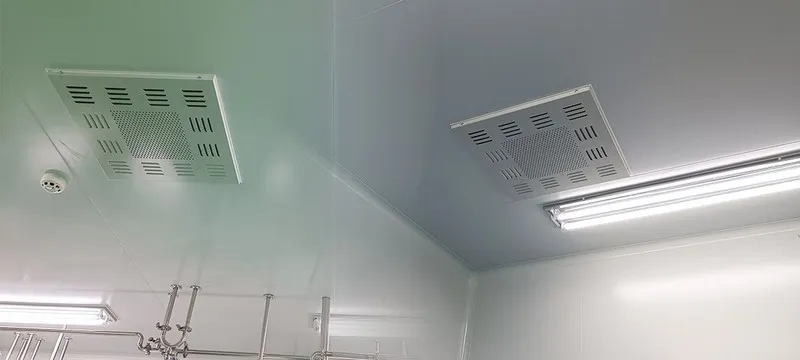
Figure 7: An on-site cleanroom ceiling installation photo taken during the project to show the installation environment and context.
Project Introduction and Site Conditions
The project was for a pharmaceutical cleanroom to meet class 1000/iso 6 criteria. The project site consortium consisted of a high ambient particle load, limited plenum height requirements, and strict pressure drops. class 1000 can be either a legacy classification for the project or an individual measurement and should be verified prior to publication. Class 1000 and ISO 6 should not be confused with each other, since they do not automatically mean the same measurement without specifying certain aspects prior to publication. The airflow condition of the project should state "designed airflow" unless it was specified by the project documents that a unidirectional airflow or other type of airflow is required.
Project Difficulties
There were three conflicting requirements faced by the project. The first requirement is to achieve the cleanliness level in spite of a high level of ambient particles being present. The second requirement is to install the system in a plenum of limited height. Thirdly, a sufficiently low pressure drop should have to be present in order to achieve the designed airflows. The filter selections had to be coordinated with the housing, seals, airflow, and testing requirements of the project.
Deiiang's Specific Solution
Deiiang supplied low-profile H14 combination high-efficiency filters, 592 x 592 x 292 mm in size, rated capacity of 2,500 m³/h, with the initial resistance in catalogue of ≤220 Pa and having a filter area of 20.04 m². The project also had silicone-free sealing gaskets and F7 pre-filters. The installed unit received DOP scan testing at the factory on a per-unit basis. The low-profile filter and F7 pre-filter were chosen to meet the aforementioned limitations. The configuration described herein is not an actual result but a design justification.
Measured Results
In terms of reported particles, the project showed the movement of the particle counts from the iso 7 level to stable ISO 6. The energy cutbacks have been also reported by the project team. Numerical particle counts with energy percentages and the measurement process have been excluded here because supporting documentation was not provided. Data records that would justify this statement would include particle count reports, pre- and post-testing results, filter test results, energy measurements, and pressure drop measurements of the project.
The energy performance is determined by fan and system design, operational environment, and baseline. Therefore, as long as the baseline and measurement information hasn't been gathered, the report will cover energy savings based on reports rather than verified data.
Lessons for Similar Cleanroom Projects
The main point is to consider common things such as plenum size, airflow needs, and pressure drop. It is important to remember that every similar job should be evaluated specifically, not just copied from this project.
Checklist for the planning phase:
Identify the cleanliness requirement and the appropriate standard
Measure the plenum and the housing dimensions
Define required airflow conditions and pressure drop budget
Analyze the particle loading in the ambient air
Pick the pre-filter stage and check whether it is compatible
Check if the gasket material is suitable for the cleaning agents
Decide on the per-unit integrity test and validation
Determine the appropriate airflow regime for the project
How to Choose the Right HEPA Filter
Choosing the HEPA filter is a process rather than just a decision. The steps include: identifying the cleanliness and the process requirements; choosing the standard and the class; deciding on the airflow and pressure drop specifications; matching the dimensions, housing, and sealing material; checking the integrity testing and maintenance plan. Most importantly, this process must be evaluated by an expert engineer to make sure the recommendations are valid.
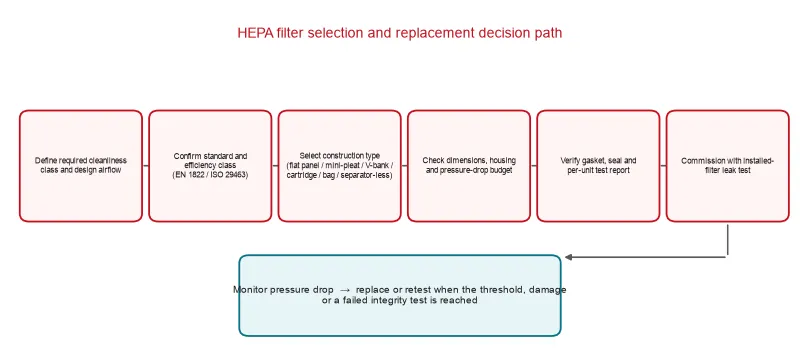
Figure 8: Decision flow chart for HEPA filter selection and replacement.
Match the Filter to the Cleanliness and Process Requirement
It is essential to identify the cleanliness target and level of risk associated with the process at first. After that, the standard and filtration efficiency class will be established together with the design team. Don't expect to know the class merely by looking at the room class title. The connection between the classification of rooms and the efficiency of the filters installed is a confused issue. According to the ISO 14644-1, it is necessary to classify cleanroom air cleanliness in connection with how many particles are present [1]. It is important to point out that there is no specified HEPA class for the filter. The ISO 14644-3 defines cleanroom test criteria [2]; however, there is no so-called universal filter replacement time defined.
Check Airflow, Dimensions, and Pressure-Drop Budget
It is necessary to have a clear understanding of the designed airflow and available space for installation. Make comparisons for the rated airflow and resistance under the same conditions and model. You will also need to consider terminal housing, the face velocity, and the full system pressure budget, including the prefilters and any gas-phase stages. There are also other issues, such as housing leakage and bypass, distribution of airflow, orientation of installation, easy access for testing and replacement, and whether it is necessary to have terminal or in-duct filtration.
Verify Operating Conditions, Seals, and Test Documentation
Always look for records regarding what the temperatures, humidity, materials, and gaskets are to be used. Impregnation catalog indicates that the maximum temperature and airflow in a unit without contamination should be no more than 70°C and 80% RH. Always confirm with the manufacturer.
A filter test before it gets into the installation site is not the same as a filter leak test. A factory test determines the level of efficiency for a filter before shipping. The installed leak test helps to confirm that the filter, housing interface, and seal do not have any leaks based on the actual installation. Use the term "DOP/PAO scan" only if it accurately describes what you are doing. A report should detail the filter ID, test criteria, acceptance criteria, results, date, and name of the tester, if possible.
Decide on Pre-Filtration and Maintenance
Evaluate particle loading upstream, the type of pre-filter to use as well as how accessible it will be for change-outs, monitoring of pressure drop, and when to retest in the cleanroom. The use of F7s in the example is because that is what was seen in the project, not because it is a universally applicable type. In fact, the appropriate pre-filter classification will depend on the ambient load conditions at the site and the anticipated maintenance schedule. A filter selection worksheet or specification checklist should provide the required filter class and type, air flow rate, dimensions, maximum allowable pressure drop, temperature and humidity, gasket material to use, testing and maintenance access requirements and instructions. A pressure drop or face velocity calculator should be utilized only if Deiiang will ensure the formulas used and all assumptions are accurate. Do not use a calculator to determine service life or energy savings unless it has been validated and its parameters have been set.
Frequently Asked Questions About HEPA Filters
What are the six types of HEPA filters?
Based on construction and design, the authors choose to classify HEPA filters as flat panel or box filters, minipleat filters, V-bank or high-capacity box filters, cylindrical or cartridge filters, bag or pocket filters and separator or separator-less framed filters. The categories may overlap in that one filter can carry more than one classification.
What is the difference between HEPA filter types and HEPA classes?
Types refer to construction and configuration. HEPA filter classes refer to performance results obtained when testing filters in accordance with a stated standard. Filters have a structural and performance classification. A class designation should not be used interchangeably between standards without proper verification of the applicable standard edition and test basis.
What is the difference between H13 and H14 HEPA filters?
H13 and H14 are differentiated high-efficiency classifications according to EN 1822, with the latter being required to have higher filtration efficiency. When choosing a filter, compare exact standard, test basis, and product test report. Make sure to check out Deiiang catalogue data reports H13 at 99.97-99.99% and H14 at 99.995-99.999% at 0.3 µm. Find the EN 1822 test report for the same unit.
What does "True HEPA" mean?
"True HEPA" is a marketing term and does not replace a stated class, standard, and test documentation. Check the specific product's captured performance and associated test reports.
Is ULPA the same as HEPA?
No. ULPA is a higher class in terms of efficiency according to EN 1822 class, which specifies units ULPA U15, U16, and U17.
Do bag filters count as HEPA filters?
Not necessarily. Bag or pocket filters are medium efficiency pre-filters. The mere fact of being bag constructed does not give HEPA qualification. It must be composed of demonstrated product class and test documentation. Deiiang states that its F5-F9 bag filters are pre-filters.
How often should a HEPA filter be replaced?
There is not one time frame applicable for all filters. Refer to the manufacturer's information along with the requirements set by each facility, such as pressure drop, loading, seal performance, integrity test results, and process specifics.
What information should I provide when requesting a HEPA filter quote?
Complete the necessary class and standard requirements, define filter and housing dimensions and airflow specifications, allowable pressure drop, temperature and humidity, variables involving gaskets and filter materials for both test and operational specifications while noting if terminal filtration configuration or duct filtration is indicated. Please also note if replacement access is verified as required.
Request a Filter Selection Review from Deiiang
If you are involved with cleanroom filtration, HVAC, or industrial filtration systems, you can ask Deiiang to examine the specific filter performance in relation to the project. You must send in the drawings, airflow specifications, dimensional considerations, allowable pressure drop, gasket specifics, and any documentation containing testing data requirements. The Deiiang engineering team will conduct a filter review based on the project constraints. No filter will be identified as providing a specific cleanliness answer without the product being reviewed based on the project specifications and applicable testing results.
Deiiang is a manufacturer of cleanrooms and air filter technology. Jason.peng is the product designer who has completed this review article. His relevant role, verified experience, as well as appropriate and recent review date must be identified along with this published article. All product information utilized to prepare this article is provided through Deiiang from their catalogues. Links to the product catalogues or interactive catalogue pages on the website must be provided.
Inquiry checklist:
Project unique type and cleanliness standard that has been established
Appropriate standard and specific class that is required
Design airflow specifications and dimensional requirements
Housing and plenum space that is available
Allowable pressure drop
Temperature and humidity levels
Any additional gaskets and material requirements
Required testing and applicable documentation
Any and all airflow regime specifications required by project and/or process mechanism in operation
References
- [1] iso 14644-1:2015 - Cleanrooms and associated controlled environments - Part 1: Classification of air cleanliness by particle concentration. iso.org/standard/53394.html It addresses classification by airborne particle concentration and does not assign an HEPA class to filter technology.
- [2] iso 14644-3:2019 - Cleanrooms and associated controlled environments - Part 3: Test methods. iso.org/standard/60598.html It covers test methods including installed filter leak testing according to the qualifying protocol set for the specific facility.
- [3] EN 1822-1:2019 - High efficiency air filters (EPA, HEPA and ULPA) - Part 1: Classification, performance testing, marking. webstore.ansi.org/standards/din/dinen18222019
- [4] EN 1822-4 and EN 1822-5 - Test methods for filter elements and filter media. webstore.ansi.org/standards/din/dinen18222019
- [5] ISO 29463-1:2024 - High efficiency filters and filter media for removing particles in air - Part 1: Classification, performance, testing and marking. iso.org/standard/84367.html
- [6] IEST-RP-CC001 - HEPA and ULPA Filters. Statements in a supplier report should be traceable to the applicable clause of the current edition. iest.org/Standards-RPs/Recommended-Practices/IEST-RP-CC001
- [7] EN 779:2012 - Particulate air filters for general ventilation - Determination of the filtration performance. shop.standards.ie/EN-779-2012 Legacy classification, superseded in many markets by ISO 16890.
- [8] Deiiang combined high efficiency filter data, and DOP integrated filter series, the novel super high efficiency baffle-free filter series, and F5-F9 pre-filter catalogues were used for this article, which were all provided through Deiiang.