+86 13638632902
 Jason@cleanroomequips.com


 MENU
MENU
hardwall clean rooms rely on engineered air filtration to control airborne particle concentration. The filtration system is not a single component but a chain that includes upstream filtration, terminal filters, fans or ffus, return-air paths, and controls. This article explains how these elements work together and how they are selected, installed, maintained, and verified.
What Makes Up a hardwall cleanroom Air Filtration System?
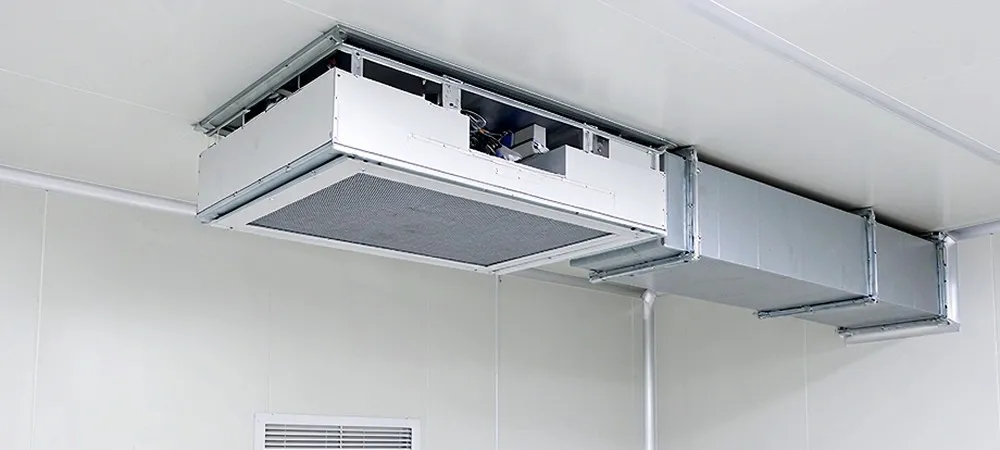
An air filtration system in a hardwall clean room typically includes several stages and components working together. Understanding the full chain helps avoid treating any single element as the whole system.
Terminal filtration vs upstream HVAC filtration
Terminal filtration is the final filtration stage before air enters the cleanroom, often a HEPA filter mounted in the ceiling or in a fan filter unit. Upstream filtration, which may include prefilters and intermediate filters, protects the terminal stage and is often part of the HVAC air-handling path.
Filtration removes particles. HVAC conditions the air for temperature and humidity and manages how air moves through the facility. These are related but distinct functions. Fans or FFUs move air through the filters, and return paths bring air back for recirculation or exhaust.
Why filter selection alone cannot define room performance
Filters capture particles, but the final cleanliness of a room depends on the complete engineered system. Airflow patterns, installation quality, pressure relationships, return-air design, and operating conditions all affect the result.
No single element determines the final cleanliness of the room. Catalogue filter data describes a component, not a completed facility.
Filter Types Used in hardwall clean rooms
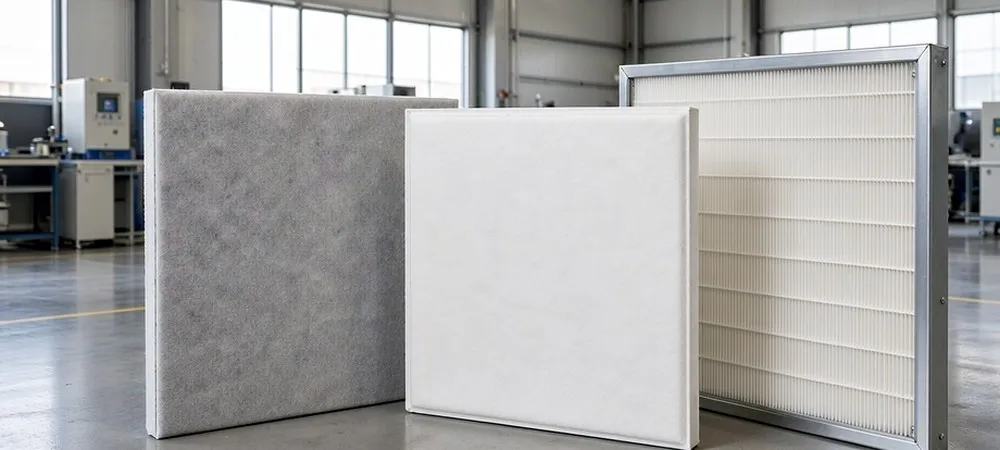
Cleanroom filtration often uses multiple stages. Each stage addresses different particle sizes and protects downstream filters. The specific combination depends on the application and design.
Prefilters
Prefilters capture larger particles and reduce loading on downstream filters. They are often located upstream in the air-handling path and may require more frequent attention.
Intermediate or secondary filters
Intermediate or secondary filters provide additional protection between prefilters and final filters. Their use depends on the system design and the contamination risks of the process.
HEPA filters
HEPA filters are widely used as terminal filters in cleanroom ceilings or FFUs. They capture fine airborne particles from the supply air before it enters the cleanroom.
ULPA filters
ULPA filters provide higher filtration efficiency for very fine airborne particles. They may be considered when project-specific particle-control requirements justify a higher-efficiency filtration stage.
Filter configuration should follow the application
The choice of filter types, quantities, and configurations follows the design requirements. Not every cleanroom uses the same filter stages or the same filter grades. Selection depends on the cleanliness target, process, and system design.
What Is the Role of HEPA Filtration?
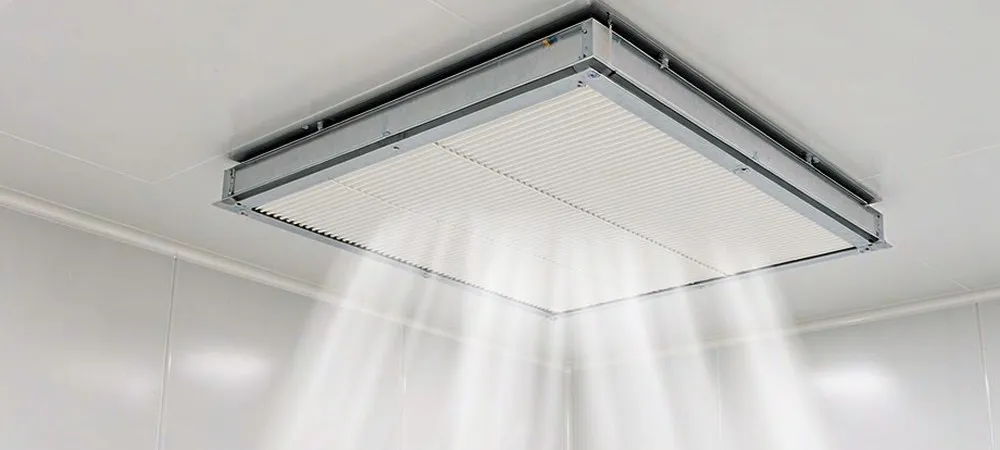
HEPA filtration is widely used in cleanrooms to capture airborne particles. It is often installed as the terminal filter, meaning the last filtration stage before air enters the cleanroom.
Removing airborne particles from supplied air
HEPA filters remove fine particles from the air stream passing through them. They are a primary means of controlling particle concentration in the supply air.
Terminal HEPA filtration
Terminal HEPA filters are typically located at or near the point where air enters the cleanroom. This placement is intended to reduce opportunity for unfiltered bypass before air reaches the space.
HEPA filtration does not establish ISO classification by itself
HEPA filtration alone does not determine the ISO class of a cleanroom. iso 14644-1:2015 classifies air cleanliness by airborne particle concentration. The classification depends on the complete system, operating conditions, and installed-room verification (iso 14644-1:2015).
Whole-room performance requires verification
Installed-room verification is necessary because filter performance, installation quality, airflow patterns, and room integrity all affect the result. A HEPA filter that performs well in a test rig does not guarantee the room will meet a given classification.
When Might ULPA Filtration Be Considered?
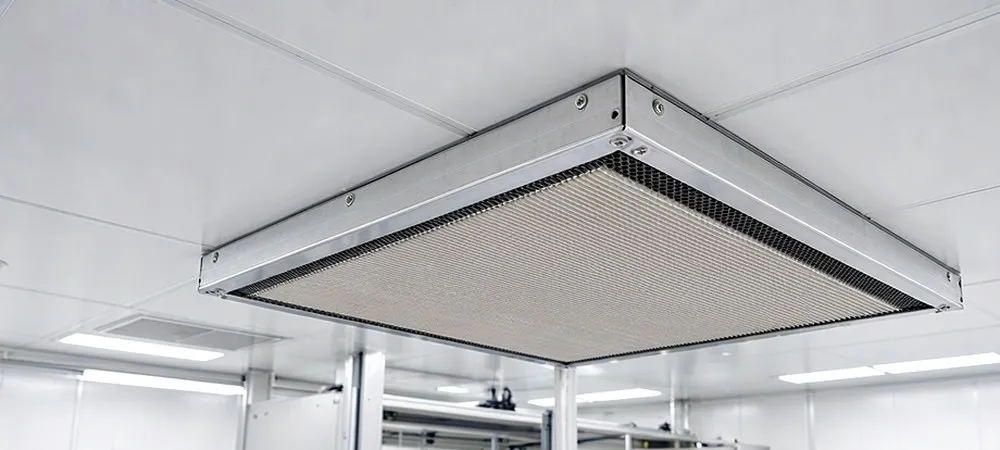
ULPA filtration may be considered when the application requires higher filtration efficiency for very fine airborne particles. The decision is application-driven rather than automatic.
Applications where ULPA may be considered
ULPA filtration may be evaluated for processes with stringent particle-control requirements. The specific need should be established from the project's contamination-control objectives rather than assumed from a general industry category.
Higher efficiency does not automatically mean a better system
Depending on filter construction, rated airflow, and system design, a selected ULPA solution may impose higher resistance than a HEPA alternative. That difference can affect fan selection, energy use, and maintenance requirements.
HEPA vs ULPA should be project-specific
The design team should evaluate whether the application justifies ULPA filtration and whether the supporting system can accommodate it. ULPA is not universally required. The choice depends on the process, contamination risks, and design requirements.
How Do Fan Filter Units Work in Hardwall Clean Rooms?
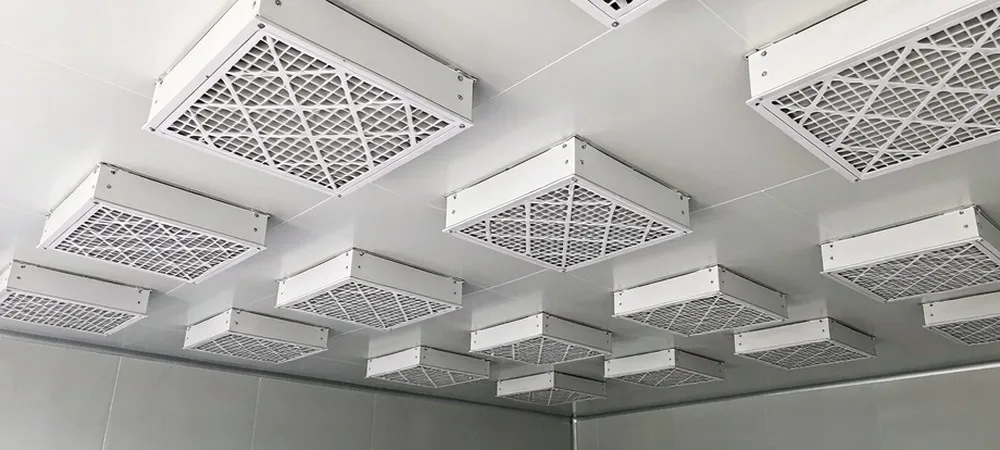
A fan filter unit, or FFU, combines a fan and a filter in a single modular unit. FFUs are often installed in cleanroom ceilings to supply filtered air directly into the room.
what is an ffu?
An FFU is a modular terminal unit containing both a fan and a filter. It is designed to draw air through the filter and discharge it into the cleanroom.
How an FFU moves and filters air
Air enters the FFU, passes through the filter, and is discharged into the cleanroom. The fan provides the pressure needed to move air through the filter and into the space.
How FFUs are arranged
In FFU-based systems, multiple units may be distributed across selected ceiling locations according to the airflow design. Other configurations, such as ducted terminal HEPA systems, may also be used.
Deiiang published FFU example
As a component example, the Deiiang company-published FFU brochure ("FFU样册E.txt", 4KB English brochure) describes a modular terminal fan/filter unit with HEPA filtration and a nominal outlet-face velocity of 0.45 m/s ±20%.
Do not derive room performance from one FFU specification
This is component outlet-face data. It is not whole-room velocity, ISO classification, airflow uniformity, or completed-room performance. Component specifications should not be treated as room acceptance criteria.
Airflow Concepts Used With Cleanroom Filtration
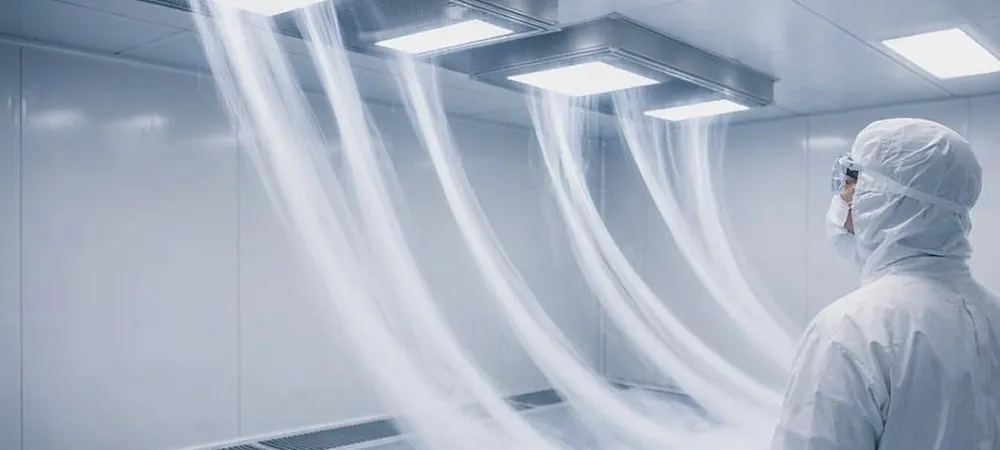
Filtration works together with an airflow concept. The airflow concept describes how supply air moves through the room and how contamination is removed.
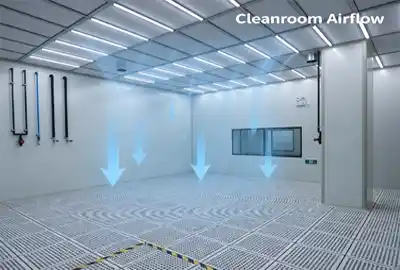
unidirectional airflow moves air in a consistent direction, often from ceiling to floor depending on the cleanroom configuration and the critical process location, to sweep particles away from critical areas. Non-unidirectional or mixed airflow uses a less uniform pattern and may be suitable for different applications.
Localized airflow may be used to protect a specific critical zone rather than the entire room. The appropriate concept depends on the process, cleanliness requirements, and contamination risks. No single airflow concept is universally correct.
How Filtration Integrates With HVAC
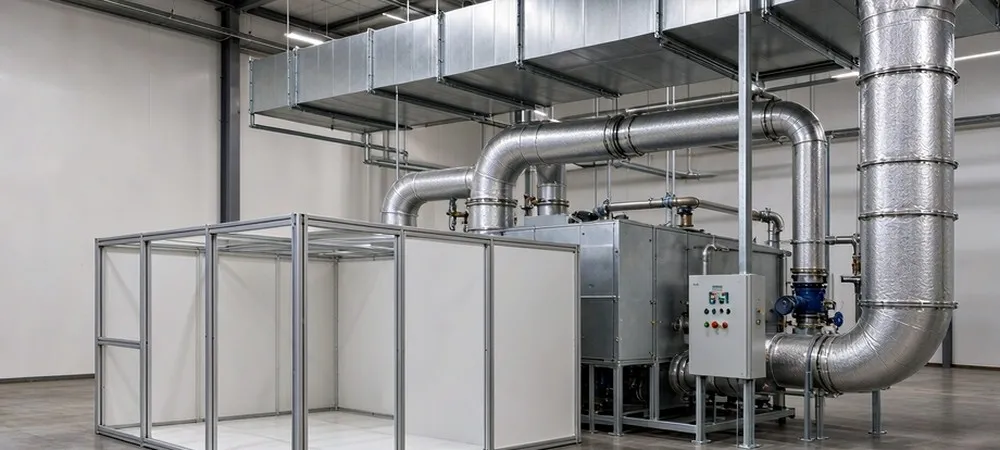
Filtration and HVAC are separate but connected functions. Filtration removes particles. HVAC conditions the air and manages how it moves through the facility.
HVAC systems manage temperature, humidity, recirculation, make-up air, and exhaust. Recirculation returns filtered air to the supply path. Make-up air replaces air lost through exhaust or leakage. Exhaust removes air from specific areas where contamination or heat must be managed.
These functions must be coordinated with filtration design. A filter system that performs well in isolation may not deliver the intended result if HVAC integration is incomplete.
Pressure Control and Return-Air Design
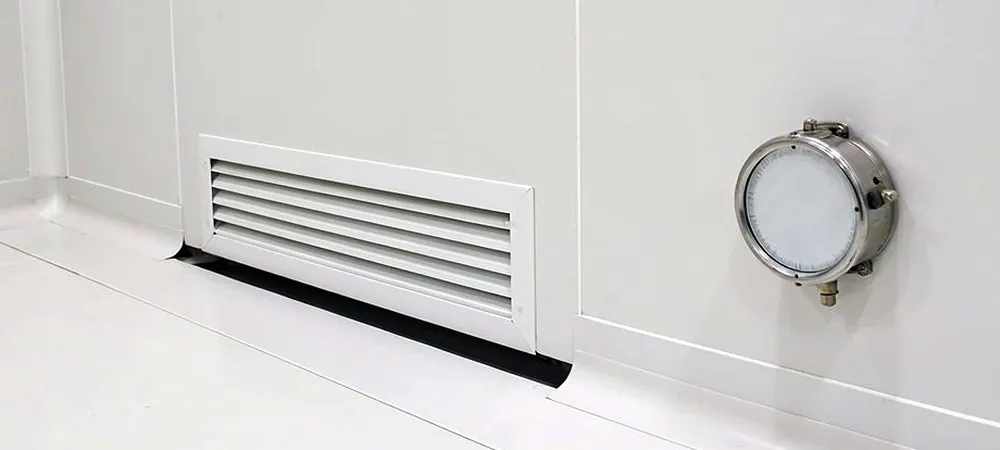
Pressure relationships help influence the direction of airflow between spaces. Return-air design determines how air leaves the cleanroom and returns to the system.
Why supply and return air must work together
Supply air alone does not establish a controlled airflow pattern. Return-air location and capacity influence how air moves through the room and how particles are carried away from critical areas.
Return-air location and configuration
Return-air paths vary by design. Grilles may be located at low level, at ceiling level, or in other positions depending on the airflow concept and contamination-control strategy.
Account for make-up air, exhaust, leakage and door opening
Make-up air, exhaust, leakage, and door openings all affect pressure relationships. These factors should be considered together rather than in isolation.
Pressure control does not replace filtration
Positive pressure may be used to help keep contamination out of a cleanroom. Negative pressure may be used to help contain contamination within a space. No universal pressure values apply. Pressure control is distinct from filtration, and a room can have good filtration and still have pressure problems if the system is not balanced.
Verify airflow relationships after installation
Airflow and pressure relationships should be verified after installation to confirm they match the design intent. This verification should follow the project acceptance criteria.
How Are Cleanroom Filters and FFUs Sized and Selected?
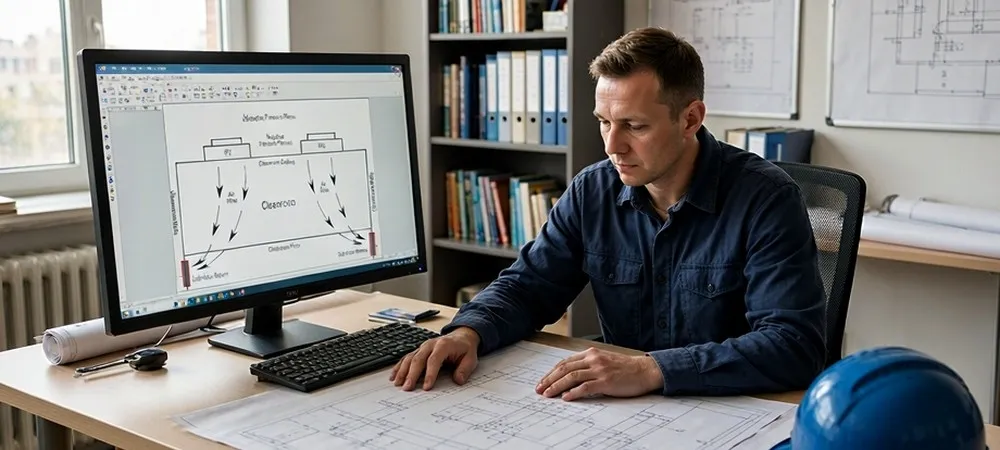
Filter and FFU selection depends on multiple project-specific factors. There is no universal FFU-per-area ratio that applies to every cleanroom.
Required cleanliness conditions
The required cleanliness class and the operating state in which it applies are primary selection inputs.
Room size and geometry
Room dimensions, ceiling area, and layout affect the available space for filters and the airflow strategy.
Process equipment and heat loads
Process heat and contamination sources influence how much air movement and cooling capacity the system requires.
Personnel and material activity
The number of people and the volume of material movement are contamination sources that the system must address.
Airflow concept
The choice between unidirectional, non-unidirectional, mixed, or localized airflow affects filter placement and quantity.
Return-air arrangement
Return-air location and capacity interact with supply-air design and influence how air moves through the space.
Exhaust and pressure requirements
Exhaust needs and pressure strategies affect the balance between supply and return air.
Filter resistance and fan capability
The fan must be compatible with filter resistance and total system pressure drop. This is a project-specific design consideration.
Ceiling coordination
Filters, lighting, sensors, and other ceiling services must be coordinated to avoid conflicts.
No universal FFU-per-area rule
There is no universal FFU density rule that applies across all cleanrooms. Selection depends on the factors above.
Deiiang catalogue velocity as component data
The Deiiang FFU brochure states a nominal outlet-face velocity of 0.45 m/s ±20%. This is component data, not a room-level acceptance criterion or a design rule for FFU density.
| Selection Factor | Design Question |
|---|---|
| Cleanliness target | What class and occupancy state apply? |
| Room dimensions | How much ceiling area is available? |
| Heat and process loads | How do process heat and contamination sources affect the required airflow and cooling strategy? |
| People and materials | What contamination sources exist? |
| Airflow concept | Unidirectional, mixed, or localized? |
| Return and pressure | How will air leave the room? |
| Filter resistance | Is the fan operating capability compatible with filter resistance and total system pressure drop? |
| Ceiling coordination | How do filters fit with lighting and services? |
Cleanliness target
What class and occupancy state apply?
Room dimensions
How much ceiling area is available?
Heat and process loads
How do process heat and contamination sources affect the required airflow and cooling strategy?
People and materials
What contamination sources exist?
Airflow concept
Unidirectional, mixed, or localized?
Return and pressure
How will air leave the room?
Filter resistance
Is the fan operating capability compatible with filter resistance and total system pressure drop?
Ceiling coordination
How do filters fit with lighting and services?
Filter Maintenance and Replacement
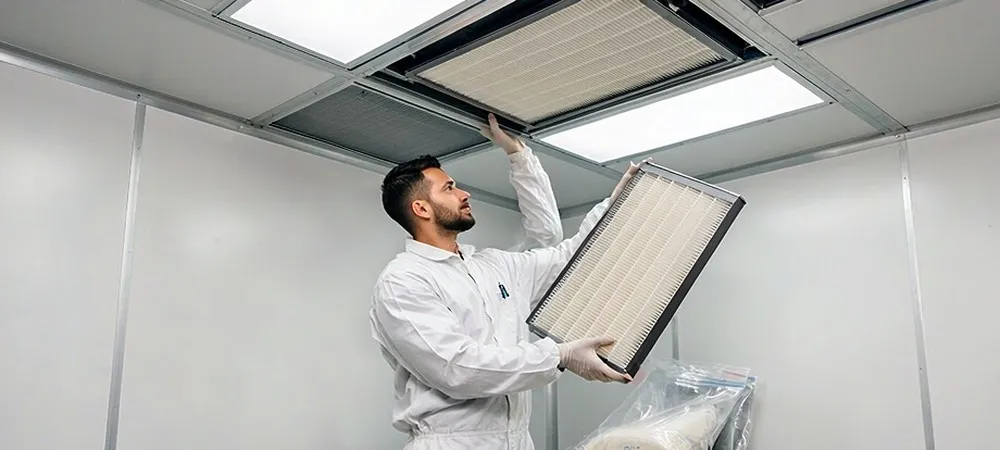
Filter maintenance should follow condition and design requirements rather than a fixed age. No universal replacement interval applies across all projects.
When should a final filter be replaced?
Replacement should be based on observed condition, pressure drop, integrity and test results, physical condition, facility-approved criteria, and manufacturer guidance rather than a fixed calendar interval.
Maintenance access should be considered during design
Safe access to filters and FFUs should be planned during design. Access provisions affect maintenance feasibility and contamination control.
Contamination control during filter replacement
Prefilters may require more frequent attention because they capture larger particles and protect downstream filters. HEPA and ULPA filters should be monitored for condition, pressure drop, damage, and integrity or test results, using facility-approved criteria.
Reverification after filter replacement
After filter replacement, reverification may be required depending on the change and applicable procedures. The scope of reverification should be determined from the impact of the change.
Filter Installation and System Integration
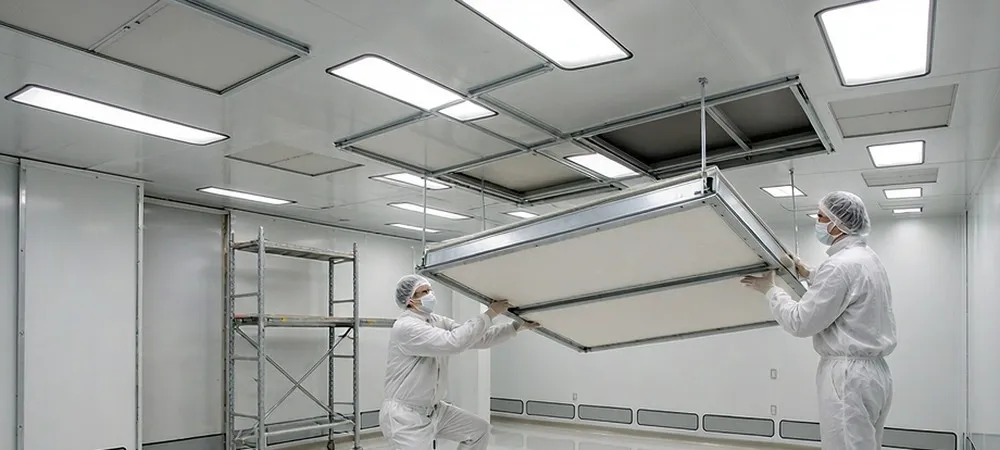
Installation quality affects filtration performance. Filters must be properly sealed in their housings and coordinated with ceiling services.
Correct filter and housing installation
Proper housing and seal integrity are necessary to minimize unintended bypass around the filter. Installation should follow manufacturer guidance and project requirements.
FFU installation
FFU installation should follow manufacturer guidance and project requirements, including electrical and control coordination.
Coordinate lighting and ceiling services
Ceiling services such as lighting, sensors, and sprinklers must be coordinated to avoid conflicts with filters and FFUs.
Coordinate with HVAC and return-air systems
Filter and FFU installation must be coordinated with HVAC and return-air systems to support the intended airflow design.
Protect filters during construction
Filters should be protected during installation to prevent damage. Construction activity can introduce particles that affect filter condition.
Pre-start inspection
A pre-start inspection helps confirm that filters, seals, and connections are correctly installed before the system is energized.
How Are Filtration Systems Tested and Verified?
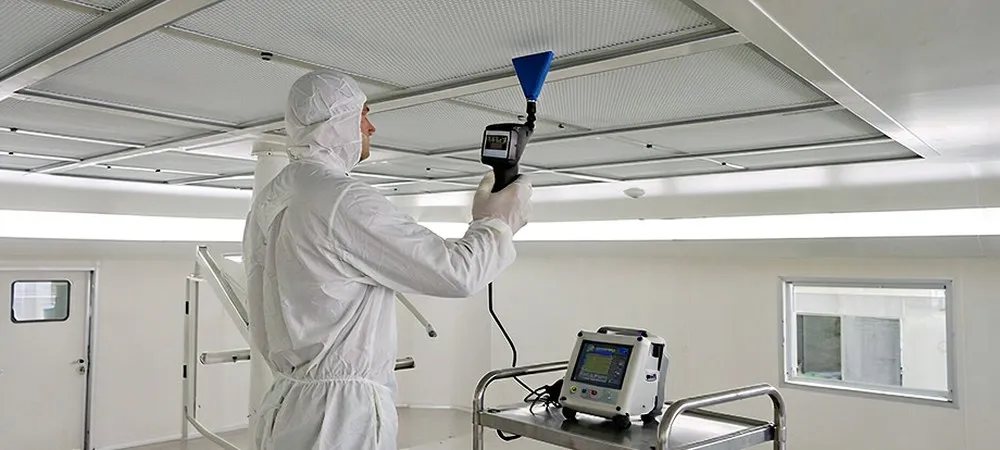
Testing and verification confirm that the installed system meets the agreed requirements. Component testing and room-level verification serve different purposes.
Component documentation vs installed-system verification
Component documentation describes a product. Installed-system verification determines whether the completed system meets the project requirements. These are separate evidence categories.
Visual installation inspection
Visual inspection confirms installation quality, including filter seating, seal condition, and housing integrity.
Installed filter leakage testing
Leakage testing may be required to check filter and housing integrity. It is not universally mandatory and depends on the project acceptance criteria.
Airflow velocity/volume testing
Airflow measurement may be specified to confirm supply air velocity or volume. The applicable method depends on the project requirements.
Airflow visualization
Airflow visualization may be used to observe air movement patterns and confirm the intended airflow concept.
Pressure-difference testing
Pressure-difference testing may be specified to confirm pressure relationships between spaces.
Airborne particle classification
ISO 14644-1:2015 addresses classification of air cleanliness by particle concentration. It does not establish chemical or microbiological/viable contamination classification (ISO 14644-1:2015).
Define occupancy/operating state
The operating state in which classification applies should be defined in the project requirements.
Set acceptance criteria before testing
Acceptance criteria should be documented before testing begins. iso 14644-3:2019 provides test methods (iso 14644-3:2019). iso 14644-4:2022 addresses design, construction, and start-up (ISO 14644-4:2022). Not every test is mandatory, and the applicable set depends on the project specification.
Correct and retest deviations
Deviations should be documented and resolved, with retesting where required by the project acceptance criteria.
Common Filtration Selection and Specification Mistakes

Several recurring mistakes can affect filtration system performance. Recognizing them helps avoid design and specification problems.
Assuming HEPA automatically establishes an ISO class
HEPA filtration does not by itself determine ISO classification. Classification depends on the complete system and installed-room verification.
Treating FFU outlet velocity as room velocity
Component outlet-face velocity is not the same as whole-room velocity or room performance.
Using generic FFU density rules
Generic FFU-per-area rules ignore project-specific factors such as heat load, process requirements, and airflow design.
Ignoring return-air design
Return-air design is sometimes overlooked even though it affects airflow patterns and contamination removal.
Selecting ULPA simply because it appears "better"
ULPA may not be required for every application. Higher filtration efficiency can affect system resistance and operating cost.
Ignoring filter pressure drop
Filter resistance affects fan selection and energy use. It should be considered during design.
Using fixed replacement intervals
There is no universal replacement interval. Replacement should be based on condition, performance, and manufacturer guidance.
Treating catalogue data as acceptance criteria
Catalogue specifications describe components. Room acceptance criteria should come from the project requirements.
Questions to Ask a Hardwall Cleanroom Filtration Supplier
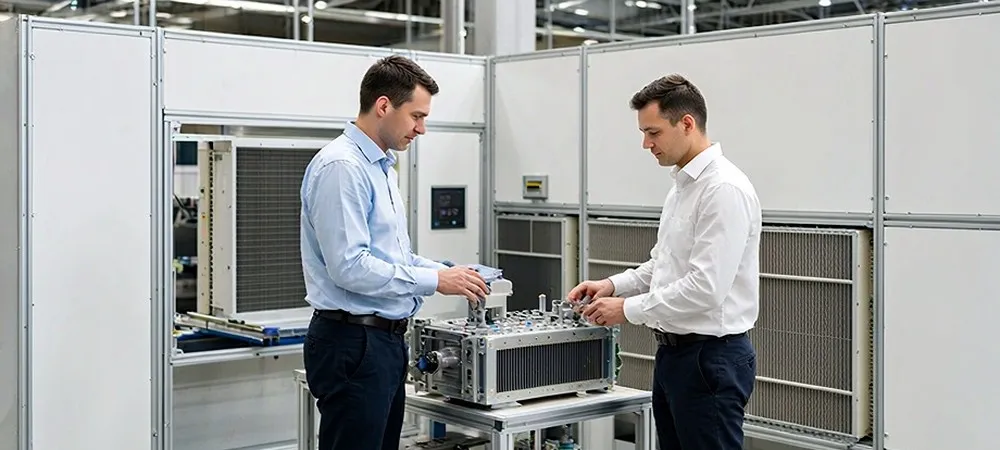
A structured set of questions helps evaluate whether a supplier can address the full filtration system, not just individual components.
What filtration stages are proposed?
Ask which filtration stages are proposed and why they were selected for the application.
Why was this filtration strategy selected?
Ask how the filtration strategy relates to the cleanliness target, process, and contamination risks.
What exact filter/FFU specifications apply?
Ask for the specifications of the proposed filters and FFUs, including model, filtration class, and airflow data.
Which values are catalogue values?
Ask which published values are component catalogue data and which are project-specific design commitments.
How was FFU quantity/location determined?
Ask how the proposed FFU quantity, location, and operating basis were determined from the room and airflow requirements.
How are supply and return coordinated?
Ask how supply and return air paths are designed to work together.
How does filtration integrate with HVAC?
Ask how filtration integrates with temperature, humidity, recirculation, make-up air, and exhaust.
How will filters be accessed/replaced?
Ask how filters and FFUs will be accessed for maintenance and replacement.
What controls/monitoring are included?
Ask what controls and monitoring are included in the scope.
What commissioning tests are included?
Ask what commissioning tests are included and how acceptance will be determined.
What documentation will be delivered?
Ask what documentation will be provided, including specifications, drawings, test protocols, and records.
What Should Be Included in a Filtration-System RFQ?

A complete RFQ helps suppliers respond accurately and reduces the risk of scope gaps.
Application and process information
Describe the process, products, equipment, and contamination risks.
Required cleanliness conditions
Specify the required cleanliness class and the occupancy state in which it applies.
Room dimensions and layout
Provide room dimensions, ceiling area, and layout information.
Heat loads and occupancy
Describe process heat loads, equipment loads, and expected occupancy.
HVAC, utilities and controls
Define HVAC requirements, utility interfaces, and control scope.
Filter and FFU schedule
Request a schedule that identifies filter type, location, FFU model where applicable, quantity, control and electrical requirements, and published catalogue parameters.
Maintenance requirements
Specify maintenance access requirements and replacement approach.
Commissioning/testing and acceptance criteria
Define commissioning responsibilities, test methods, and acceptance criteria.
Documentation and scope boundaries
Specify required documentation and clarify scope boundaries between parties.
Application and process description
Required cleanliness class and occupancy state
Room geometry and ceiling coordination
Heat, process and occupancy loads
Airflow concept and supply/return strategy
HVAC integration requirements
Pressure and exhaust requirements
Controls and monitoring scope
Filter and FFU schedule with published catalogue parameters
Maintenance access and replacement approach
Catalogue/component values clearly separated from contractual room-performance requirements
Acceptance criteria and required documentation
Frequently Asked Questions
These answers summarize key points about hardwall cleanroom filtration systems.
What type of air filters are commonly used in hardwall clean rooms?
Common configurations include prefilters or intermediate filters upstream and HEPA filters as terminal filters. The specific combination depends on the application and design requirements. Not every cleanroom uses the same filter stages.
Are ULPA filters always required in a hardwall clean room?
No. ULPA filters may be considered when higher filtration efficiency for very fine airborne particles is justified by the application. The decision depends on the process, contamination risks, and system design.
What does an FFU do in a hardwall clean room?
An FFU combines a fan and filter in a modular unit. It moves air through the filter and discharges filtered air into the cleanroom. In FFU-based designs, multiple units may be distributed according to the room airflow strategy.
Does FFU air velocity determine the cleanroom ISO classification?
No. Component outlet-face velocity is not a whole-room performance value. ISO 14644-1:2015 classifies air cleanliness by airborne particle concentration, and classification depends on the complete system and installed-room verification.
How are cleanroom filters tested and replaced?
Testing may include visual inspection, leakage testing where required, airflow measurement, and particle classification. Replacement should be based on condition, pressure drop, integrity results, physical condition, approved maintenance criteria, and manufacturer guidance rather than a fixed age. Reverification may be required after replacement.
Conclusion
Hardwall cleanroom air filtration is a system, not a single component. Upstream filters, terminal HEPA filters, fans or FFUs, return paths, and controls work together with HVAC to control airborne particles and condition the air.
HEPA filtration is widely used, but it does not by itself determine ISO classification. Filter and FFU selection depends on project-specific factors. There is no universal FFU density rule, no fixed replacement interval that applies across all projects, and no single airflow concept that fits every room.
Component data, such as a published outlet-face velocity, is not a room acceptance criterion. Final performance should be verified through an agreed testing and acceptance process using applicable standards and project requirements.
References
ISO 14644-1:2015, Cleanrooms and associated controlled environments — Part 1: Classification of air cleanliness by particle concentration. https://www.iso.org/standard/53394.html
ISO 14644-3:2019, Cleanrooms and associated controlled environments — Part 3: Test methods. https://www.iso.org/standard/60598.html
iso 14644-4:2022, Cleanrooms and associated controlled environments — Part 4: Design, construction and start-up. https://www.iso.org/standard/72379.html
Deiiang company-published English FFU brochure, local source filename "FFU样册E.txt" (4KB): modular terminal fan/filter unit with HEPA filtration and nominal outlet-face velocity 0.45 m/s ±20%. This is company-published component data and does not establish whole-room velocity, ISO classification, uniformity, or completed-room performance. No public URL was supplied for this document.